PALMOILMAGAZINE, JAKARTA – Bumitama Agri Ltd (Bumitama) is intensifying efforts to trace the origins of palm oil fresh fruit bunches (FFB) down to individual smallholder farm plots, marking a concrete step in the company’s commitment to greater supply chain transparency and sustainability.
In the palm oil industry, the biggest challenge is often not what is produced, but where it comes from. As global markets increasingly demand full traceability—extending to the boundaries of farmers’ land plots—supply chains that once operated with limited visibility are now under growing pressure to become fully transparent.
Bumitama has chosen to move beyond conventional sourcing practices by tracing FFB origins to the last identifiable farm plot, a technical effort that reflects a broader transformation in palm oil governance and sustainability standards..
Also Read: Indonesia Sets June CPO Reference Price at USD 1,029.51/MT Amid Softer Global Demand
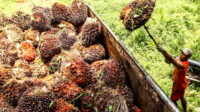
Palm oil remains one of the world’s most strategic commodities, yet its origins frequently disappear within long and layered distribution networks. Harvested fruit moves from farmers to local collectors, then to larger aggregators, before eventually reaching palm oil mills (PKS). Along this chain, source identification often becomes increasingly blurred.
That opacity, however, is becoming increasingly unacceptable in global trade.
Although Bumitama does not export its products directly, regulations such as the European Union Deforestation Regulation (EUDR) are reshaping industry expectations. Markets now require more than village names or GPS coordinates. They demand clearly defined land plot boundaries that show precisely where fruit is grown, whether the land is legally established, and whether it is free from deforestation risks.
Also Read: Agriculture Ministry Presses 139 Palm Oil Mills to Reverse FFB Price Cuts
Traceability Mapping Reaches Nearly Entire Supply Chain
According to Agam Fatchurrochman, Deputy Head of Sustainability & Certification at Bumitama, the company had mapped traceability across nearly its entire supply chain by December 2025.
The achievement is significant given the scale of Bumitama’s domestic operations, which recorded Rp19.95 trillion in sales and supply chain tracking extending to supplier land plots linked directly through FFB purchase agreements (SPK).
Bumitama manages approximately 184,000 hectares of plantations, consisting of 66% nucleus estates and 34% plasma plantations.
In 2025, the company produced 1.25 million tons of crude palm oil (CPO) from processing 3.65 million tons of FFB. Of this volume, 39% originated from nucleus estates, 21% from plasma plantations, and another 39% from independent growers and surrounding external suppliers—a supplier segment regarded as the most challenging to map accurately.
Historically, many companies relied only on supplier coordinates or village-level information, offering a rough picture that no longer satisfies evolving sustainability requirements.
Since late 2024, however, Bumitama has adopted a fundamentally different approach by working directly with suppliers to map farm polygons.
Also Read: One-Gate Export System and a New House Called Danantara
The result is a shift in how supply chains are understood—not merely as commercial routes, but as verifiable geographic landscapes.
More Accurate Monitoring of Deforestation Risks
The implications of polygon mapping are substantial.
Instead of relying on the traditional 50–70 kilometer mill-radius approach, which often covers broad areas with limited precision, monitoring now focuses on the actual shape and location of supplier land.
“Monitoring is now conducted with greater precision based on the actual form of supplier land. Quarterly assessments have become sharper, risk points can be identified faster, potential violations mitigated more effectively, and clear and clean FFB sources mapped with greater confidence,” Agam told InfoSAWIT.
Also Read: KPBN CPO Bids Surge 7.7% Despite Withdrawn Tenders, Malaysia Futures End Mixed
The company combines GPS surveys, satellite imagery, GIS analysis, and field verification to validate land data.
Validation also involves geotagged photographs and anomaly detection, allowing the company to identify duplicate coordinates, locations outside designated villages, or spatial inconsistencies.
“Even the most sophisticated systems still require something classic—field verification and quality control,” Agam explained.
Also Read: Indonesia Calms Palm Oil Market Concerns as Government Protects Farmers and Export Industry
Technology Alone Is Not Enough
Despite technological progress, Agam acknowledged that the more difficult challenge lies in human engagement.
On the ground, data collection encounters complex social realities—including cultural diversity, varying education levels, and concerns about data transparency.
Some collectors fear losing their intermediary roles if companies transact directly with farmers. Meanwhile, certain farmers remain concerned about land data security and whether disclosure could eventually lead to large-scale land acquisition.
Such skepticism, he noted, reflects long-standing imbalances between corporations and local communities.
For that reason, the company views trust-building as equally important as mapping itself.
Through intensive outreach, transparent communication, and participatory engagement, Bumitama aims to ensure stakeholders see themselves as part of the system rather than merely subjects of it.
Also Read: Government Sees Smallholder Replanting as Key to Boost Palm Oil Productivity
Toward Nearly 100% Traceable Supply Chains by 2027
Bumitama is also preparing online self-assessment tools that will allow suppliers to independently evaluate their sustainability performance, review achievement scores, and jointly design improvement plans with the company.
The initiative represents a shift away from compliance audits alone toward a more collaborative coaching approach.
The target is clear: approaching 100% traceability by 2027.
Ultimately, Bumitama says the effort is about more than building a tracking system.
It reflects an emerging understanding that sustainability is no longer merely about downstream certification or market access, but about upstream responsibility—knowing the farmers, understanding the land, mapping its boundaries, and ensuring every bunch of palm fruit entering the supply chain carries a verifiable and accountable origin.
In today’s global marketplace, it is no longer only palm oil quality that is under scrutiny—but also the integrity of its traceable journey. (T2)
(P2)