PALMOILMAGAZINE, BANDUNG – The launch of the B50 biodiesel program by President Prabowo on Thursday, July 9, 2026, marks a new chapter in Indonesia’s energy transition. The move from B40 to B50 demonstrates the government’s political resolve and continued commitment to achieving energy independence. Yet behind the optimism lies an important question: Who stands to benefit the most from this policy?
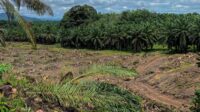
The answer goes beyond simply reducing diesel imports or increasing domestic palm oil consumption. B50 carries far more complex economic implications because it is built on one fundamental reality: Indonesia’s capacity to produce palm oil has not improved significantly. Plantation productivity remains at only about 30% of its actual potential.
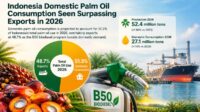
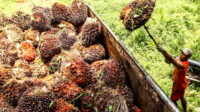
A simple calculation illustrates the challenge. Every 10-percentage-point increase in the biodiesel blending mandate requires an additional 4 million metric tons of palm oil per year. This means that implementing B50 would require approximately 19–20 million metric tons of palm oil annually. Meanwhile, Indonesia’s total palm oil production remains around 50–51 million metric tons. After meeting domestic demand for food and industrial uses—estimated at around 10 million metric tons—only 20–21 million metric tons remain available for export.
Also Read: Indonesia’s KPBN CPO Price Rises to IDR15,700/kg as Malaysian Palm Oil Futures Extend Losses
In theory, Indonesia has the capacity to move toward B90. However, the consequence would be clear: there would be virtually no palm oil left for export. At that point, competing producer countries could seize the market opportunities left by Indonesia.
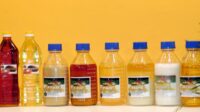
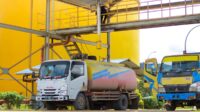
From an energy perspective, the benefits are evident. By implementing B50, Indonesia could eliminate imports of approximately 19 million metric tons of diesel fuel, generating estimated savings of IDR157 trillion. On the other hand, the country could forgo around IDR397 trillion in foreign exchange earnings due to reduced palm oil exports.
For some observers, those figures may be the primary consideration. However, when the issue concerns energy sovereignty and national interests, economic calculations alone are not always the deciding factor. Achieving self-reliance comes at a cost, and from this perspective, such sacrifices are viewed as a strategic investment in the nation’s future.
Also Read: Sudaryono: B50 Reflects President Prabowo’s Fast-Track Energy Vision
Recent years have demonstrated how palm oil has evolved from being merely an agricultural commodity into an instrument of economic diplomacy. In 2022, when approximately 20% of Indonesia’s palm oil market share in Western Europe was affected by the European Union Deforestation Regulation (EUDR) over concerns about deforestation and environmental degradation, the domestic market became a crucial buffer.
Indonesia’s biodiesel program successfully absorbed surplus palm oil that could no longer be exported, helping stabilize domestic palm oil prices. Now that European countries are once again seeking Indonesian palm oil supplies, Indonesia’s bargaining position is considered much stronger. In this context, biodiesel is not merely an energy policy but also a tool of economic diplomacy.
Indonesia has also become the first country in the world to implement B50 based on palm oil and a pioneer in developing palm-based gasoline (Bensa). While Brazil has long utilized sugarcane-based bioethanol, Indonesia is leading the way in palm oil-based biodiesel.
Also Read: SNV Impact Forum 2026 Calls for Stronger Partnerships to Scale Regenerative Agriculture
Looking ahead, the opportunities remain significant. If the palm oil sector receives subsidized fertilizer support, enabling national production to increase to around 70 million metric tons annually, the additional 20 million metric tons could potentially be used for gasoline blending. Under such a scenario, Indonesia would not only eliminate diesel imports but could also reduce its dependence on imported gasoline.
Another issue highlighted by the author is the disparity in palm oil prices. As of July 2026, palm oil sold domestically through KPBN was priced at around IDR16,036 per kilogram, compared with approximately IDR16,011/kg in Kuala Lumpur and IDR23,346/kg in Rotterdam. Converted into fresh fruit bunch (FFB) prices, these values equate to roughly IDR3,980/kg, IDR3,975/kg, and IDR5,662/kg, respectively. Meanwhile, Indonesian smallholders receive only around IDR3,800/kg for their FFB.
This price gap indicates that there remains considerable room to improve Indonesia’s palm oil marketing system. The expectation is that PT Danantara Sumberdaya Indonesia, which has been mandated as the country’s sole palm oil export operator, will establish a governance framework that delivers greater benefits to both smallholders and industry players.
Also Read: DPR Praises Removal of Illegal Oil Palm in Aceh Protected Forest
It is also worth noting that Indonesia’s exports are no longer dominated by crude palm oil (CPO) but increasingly consist of higher-value downstream products. Consequently, the potential loss of foreign exchange from reduced exports could be significantly greater than estimates based solely on CPO exports.
From the government’s revenue perspective, differences in fiscal treatment also deserve attention. Palm oil sold domestically is subject only to 11% value-added tax (VAT), while exports are subject to Export Duty (BK) and Export Levy (PE). Based on reference prices in Kuala Lumpur and Rotterdam, these fiscal charges amount to approximately 23.48% and 17.39%, respectively. Government revenue from the palm oil sector could therefore increase if national productivity were significantly improved.
For that reason, boosting productivity remains the key priority. Providing subsidized fertilizers across the plantation sector could accelerate production growth. The author also argues that applying the Production Force Management agronomic engineering approach has the potential to increase plantation productivity by 30% to 80%.
Also Read: 93 Aceh Singkil Smallholders Complete BPDP Oil Palm Training
From an energy cost perspective, the price difference between fossil diesel and biodiesel is considered relatively modest. Assuming global crude oil prices remain around US$70 per barrel, fossil diesel—after accounting for transportation, refining, and distribution costs—is estimated to cost approximately IDR12,000–13,000 per liter. By comparison, biodiesel is currently priced between IDR14,015 and IDR14,562 per liter.
In the author’s view, regional trade dynamics also deserve close attention. Malaysia, which produces around 20 million metric tons of palm oil annually, still imports approximately 1.5 million metric tons from Indonesia. With domestic consumption estimated at around 3 million metric tons, Malaysia is able to export roughly 18.5 million metric tons of palm oil each year—only slightly below Indonesia’s exports of around 21 million metric tons.
According to the author, these figures indicate that Malaysia continues to benefit significantly from Indonesia’s palm oil industry. The author further argues that Malaysian-owned palm oil plantations operating in Indonesia may effectively serve as part of Malaysia’s production chain, meaning that Indonesia’s economic gains are not yet fully optimized beyond revenues generated through Export Duties (BK) and Export Levies (PE).
Also Read: GAPKI: Indonesia’s Palm Oil Output Slips in May 2026, but CPO Stocks Rise to 3.04 Million Tons
Based on this view, the author proposes that all foreign-owned palm oil plantations operating in Indonesia should be required to pay what he considers a fair royalty to the Indonesian government. Such a policy, for example under a 50:50 revenue-sharing scheme, would create a more balanced distribution of economic benefits. According to the author’s calculations, implementing this policy could generate an additional IDR450 trillion in Non-Tax State Revenue (PNBP).
Ultimately, the debate surrounding B50 extends far beyond the biodiesel blending ratio itself. According to the author, it has evolved into a broader discussion about Indonesia’s economic development strategy, natural resource governance, and the extent to which the country’s vast palm oil wealth truly delivers the greatest possible benefits to its people and the nation. (*)
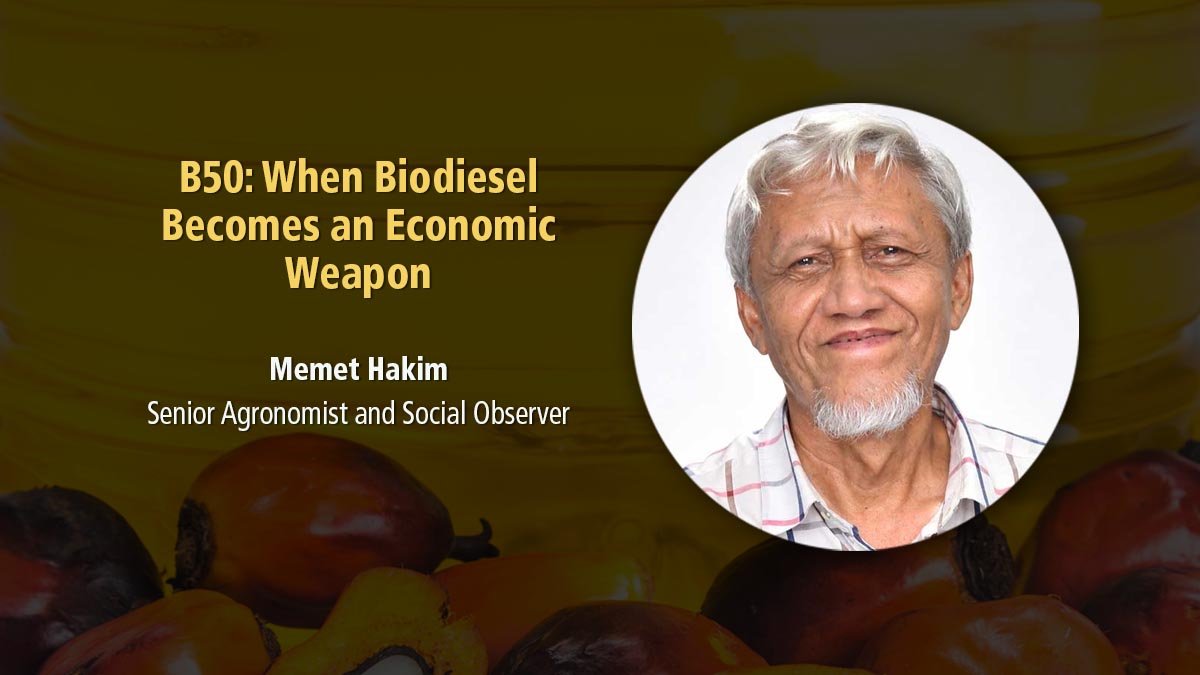
Author: Memet Hakim, Senior Agronomist and Social Observer.
Disclaimer: This article reflects the personal opinions of the author. All views, analyses, and conclusions expressed are solely the responsibility of the author.