Hotspots are reappearing across the country before the dry season has even peaked, reigniting an old debate: Who should be held accountable?
PALMOILMAGAZINE, JAKARTA – Satellite data as of this month shows just how serious the threat is. More than 2,900 hotspots were detected in Sumatra and Kalimantan. The former recorded over 1,000 hotspots spread across various provinces. In Kalimantan, the number is even higher, dotting nearly all regions.
The haze always follows the same path, a blip on a satellite monitor turns into a column of smoke, soon swelling into a crisis far larger than the fire itself. Every severe dry spell plunges Sumatra and Kalimantan back into familiar dread. Yet the moment flames spread, public discourse rushes to assign blame, bringing genuine solutions to an immediate standstill.
Also Read: Industry and Public Accountability in Efforts to Mitigate Forest and Land Fires
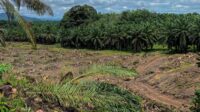
Whenever the haze descends, palm oil plantations become the default target. They are the easiest suspects to name, often well before any formal investigation gets underway.
This does not mean the plantation industry should be placed outside the law. On the contrary, companies proven to have intentionally used fire to clear land or neglected their prevention obligations must indeed face strict legal consequences. Nonetheless, law enforcement also loses its meaning when the problem is oversimplified.
We must distinguish between those who set the fires, those who were negligent in preventing them, and those who were actually victims of the fire’s spread. A company whose land has burned is not necessarily the one that started the fire.
Also Read: Fair and Proportional Law Enforcement Is Essential in Tackling Forest and Land Fires
Conversely, a fire originating outside the concession area does not automatically absolve the company of responsibility if it is proven that its prevention systems were inadequate. Lumping all three into a single category simply because the fire was found within the concession boundaries is potentially leading to injustice.
When a forest fire happens, the question that should be asked is not merely: Where was the fire detected? The more relevant questions are: Where did the fire come from? Who has control over that area? What actions were taken before the fire started, when it broke out, and after it was brought under control? These three questions may seem simple, but the answers determine the course of justice and compliance assessments. Without this process, forest fire management can easily devolve into policy based on assumptions.
Debates over forest fires also frequently get bogged down in how data is interpreted. Hotspots detected by satellite monitoring are a crucial tool for early warning. However, a hotspot does not identify the perpetrator. Nor is it sole evidence that a fire was caused by a specific activity. Every heat signal requires verification.
Also Read: GAPKI and PWI Strengthen Media Partnership to Support Indonesia’s Palm Oil Industry
Ideally, the response to forest fires should treat hotspots or fire locations as the starting point for investigation, rather than immediately condemning the land rights holders as those responsible for the fires. It is problematic when satellite technology is treated as a judge to determine who started the fire and how it spread without field verification and spatial analysis of fire-spread patterns. Jumping to conclusions too quickly can actually be misleading.
Indonesia actually has no shortage of regulations. Various provisions have been put in place to address burning bans, prevention obligations, permit holders’ responsibilities, and even criminal penalties and administrative sanctions. What still needs improvement is how we understand the reality on the ground and assess compliance with these regulations.
Many hotspots flare up in areas lacking the surveillance typical of large concessions—such as community land, open-access territory, or traditional slash-and-burn farming plots. Despite a nationwide ban, traditional burning persists in several regions, where local authorities often hesitate to intervene lacking viable alternatives and fear of social friction.
Also Read: Indonesia’s Palm Oil Exports Jump 64% in June 2026 to US$3.92 Billion
Breaking this vicious cycle requires indiscriminate enforcement of zero-burning laws paired with sustained, practical mitigation. The government must partner with NGOs and the private sector to help smallholders transition to mechanized clearing, a costly, massive effort but an unavoidable one.
Simultaneously, concession holders must face rigorous audits of their fire preparedness. Compliance should be measured by dedicated firefighting units, retention ponds, equipment readiness, early-warning setups, and peatland water-table management.
Ending this crisis requires precise, fact-based enforcement coupled with systemic prevention. As long as the focus remains on tallying burned acreage and hunting for convenient scapegoats rather than addressing root causes, every dry season will tell the same story, leaving us beneath crimson skies, wondering why the haze always returns. (*)
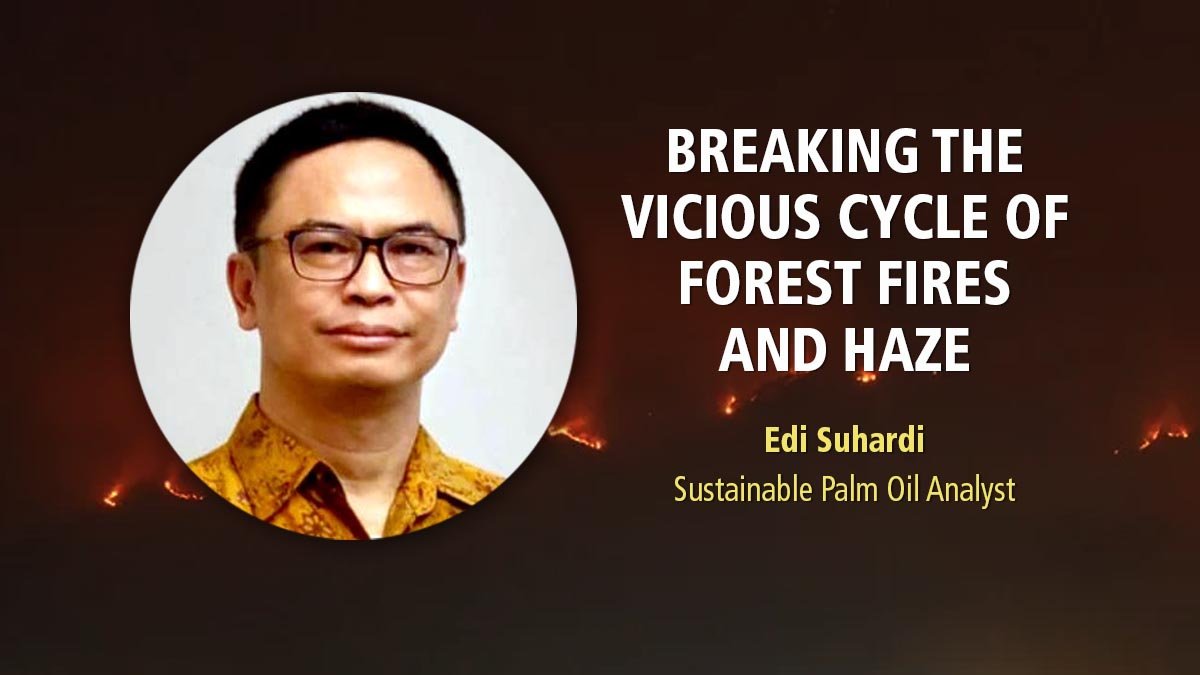
By: Edi Suhardi / Sustainability Analyst