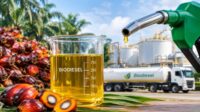


Indonesia’s expanding biodiesel program is strengthening domestic palm oil demand, but GAPKI says policymakers must balance energy security with export competitiveness, productivity and access to global markets.
PALMOILMAGAZINE, JAKARTA — Indonesia’s mandatory biodiesel program, global economic uncertainty and growing sustainability requirements are emerging as key challenges for the country’s palm oil industry, with policy decisions increasingly carrying implications for global vegetable oil supplies, prices and trade flows.
As the world’s largest palm oil producer and exporter, Indonesia plays a pivotal role in global markets. Chairman of the Indonesian Palm Oil Association (GAPKI), Eddy Martono, said the government needs to maintain a careful balance between growing domestic demand and the industry’s export interests.
Also Read: IPOC 2026 to Strengthen Indonesia’s Palm Oil Strategy for Food, Energy and Economic Resilience
He acknowledged the important economic contribution of the biodiesel program, particularly its role in strengthening domestic absorption of palm oil at a time when global markets remain uncertain.
However, rising domestic consumption is also drawing increasing attention from international buyers. During visits to several countries, including India, Eddy said Indonesia’s biodiesel mandate had become one of the issues frequently raised by trading partners.
For major palm oil-consuming countries that rely on Indonesian supplies, changes in Indonesia’s domestic biodiesel policy can have direct implications for global availability. As a result, the direction of the country’s biodiesel program remains closely watched by international markets.
This makes it important for the government to assess the broader impact of domestic policies on export competitiveness and international trade relations. While the biodiesel program needs to proceed in line with government commitments, maintaining access to overseas markets will also be critical to ensuring Indonesian palm oil remains competitive against other vegetable oils.
Productivity Remains a Key Challenge
Beyond supply considerations, sustainability and plantation productivity remain major challenges for the Indonesian palm oil industry.
Eddy said greater attention should be given to improving yields and productivity through targeted programs involving companies, smallholders and other stakeholders across the plantation sector.
Also Read: Indonesia Palm Oil and Derivatives Support 6.72% Export Growth in August 2026
“Improving productivity is important to ensure the palm oil industry can continue meeting domestic demand while maintaining its role in export markets,” he said at a GAPKI press conference attended by PalmOilMagazine in Jakarta on Friday (Oct. 9, 2026).
Looking ahead, policy certainty will be increasingly important as companies formulate business and investment strategies. Industry players must also prepare for evolving international trade barriers, including non-tariff measures and sustainability requirements that could affect access to key export markets.
For Indonesia’s palm oil industry, the challenge is no longer simply maintaining its position as the world’s largest producer. It is also about ensuring that downstream development and biodiesel expansion move in parallel with productivity gains, sustainability improvements and export competitiveness.
Also Read: Indonesia Biodiesel Consumption Jumps 13.59%, Driving July Palm Oil Demand
The ability to balance national energy objectives with the requirements of global markets will be a critical factor shaping Indonesia’s palm oil industry as competition and policy dynamics in the global vegetable oil market continue to evolve. (P2)