PALMOILMAGAZINE, JAKARTA, AGRICOM – Indonesia’s crude palm oil (CPO) reference price set by PT Kharisma Pemasaran Bersama Nusantara (KPBN) moved higher on Wednesday (June 10, 2026), supported by firmer palm oil futures in Malaysia and improving sentiment across the global vegetable oils market.
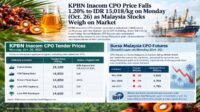
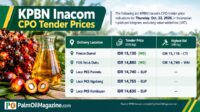
According to data obtained by Agricom.id, KPBN set the CPO price at IDR 15,225 per kilogram, up IDR 70 per kilogram or approximately 0.46% from IDR 15,155 per kilogram recorded on Tuesday.
For the day’s transactions, Franco Dumai CPO was priced at IDR 15,225 per kilogram, while Franco Teluk Bayur stood at IDR 15,095 per kilogram. Meanwhile, FOB Talang Duku CPO was set at IDR 15,025 per kilogram.
Also Read: Indonesia Customs Ready to Enforce New Export Controls for Palm Oil, Coal, and Ferroalloys
At Parindu, CPO was offered at IDR 14,805 per kilogram. However, the tender was withdrawn (WD), with the highest bid reaching only IDR 8,000 per kilogram.
In related products, Palm Kernel Oil (CPKO) Franco Dumai was traded at IDR 25,573 per kilogram through the IBP mechanism. Palm Kernel (PK) Franco Belawan was priced at IDR 12,475 per kilogram under the MM mechanism.
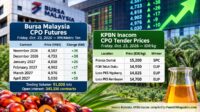
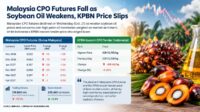
The rise in domestic prices coincided with stronger performance in the Malaysian palm oil market. On Wednesday, crude palm oil futures on the Bursa Malaysia Derivatives Exchange closed higher after recovering from losses in the previous trading session.
Also Read: SPKS Aceh Backs Police Crackdown on Palm Oil Mills Buying FFB Below Official Prices
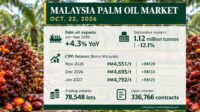
According to Reuters, the benchmark August 2026 palm oil futures contract gained RM11 per tonne, or 0.24%, to settle at RM4,539 per tonne.
The market was supported by expectations of improving export demand and tighter supply conditions. Data released by the Malaysian Palm Oil Board (MPOB) showed that Malaysia’s palm oil production declined in May 2026 compared with the previous month, helping to underpin prices.
Despite the drop in output, MPOB reported that palm oil inventories increased for a second consecutive month. The stock build occurred because exports fell at a faster pace than production during the same period.
Market sentiment also received support from stronger export estimates. Cargo surveyors projected that Malaysian palm oil product exports during June 1–10 rose between 3.5% and 4.9% compared with the corresponding period of the previous month.
The export growth is seen as an early sign of recovering demand from international buyers, potentially easing concerns over rising inventories in the months ahead.
Meanwhile, competing vegetable oils posted weaker performances. The most active soybean oil contract on China’s Dalian Commodity Exchange slipped 0.05%, while Dalian palm oil futures declined 0.13%.
Also Read: Minister Amran Pushes for Higher Palm Oil FFB Prices, Vows Direct Oversight of Industry Compliance
In the United States, soybean oil futures on the Chicago Board of Trade (CBOT) edged down by 0.01%. The relative weakness in rival vegetable oils improved palm oil’s competitiveness in the global edible oils market.
With export prospects improving and supply tightening due to lower production, traders are expected to closely monitor upcoming inventory and export data for further signals on the direction of CPO prices in the near term. (P3)