

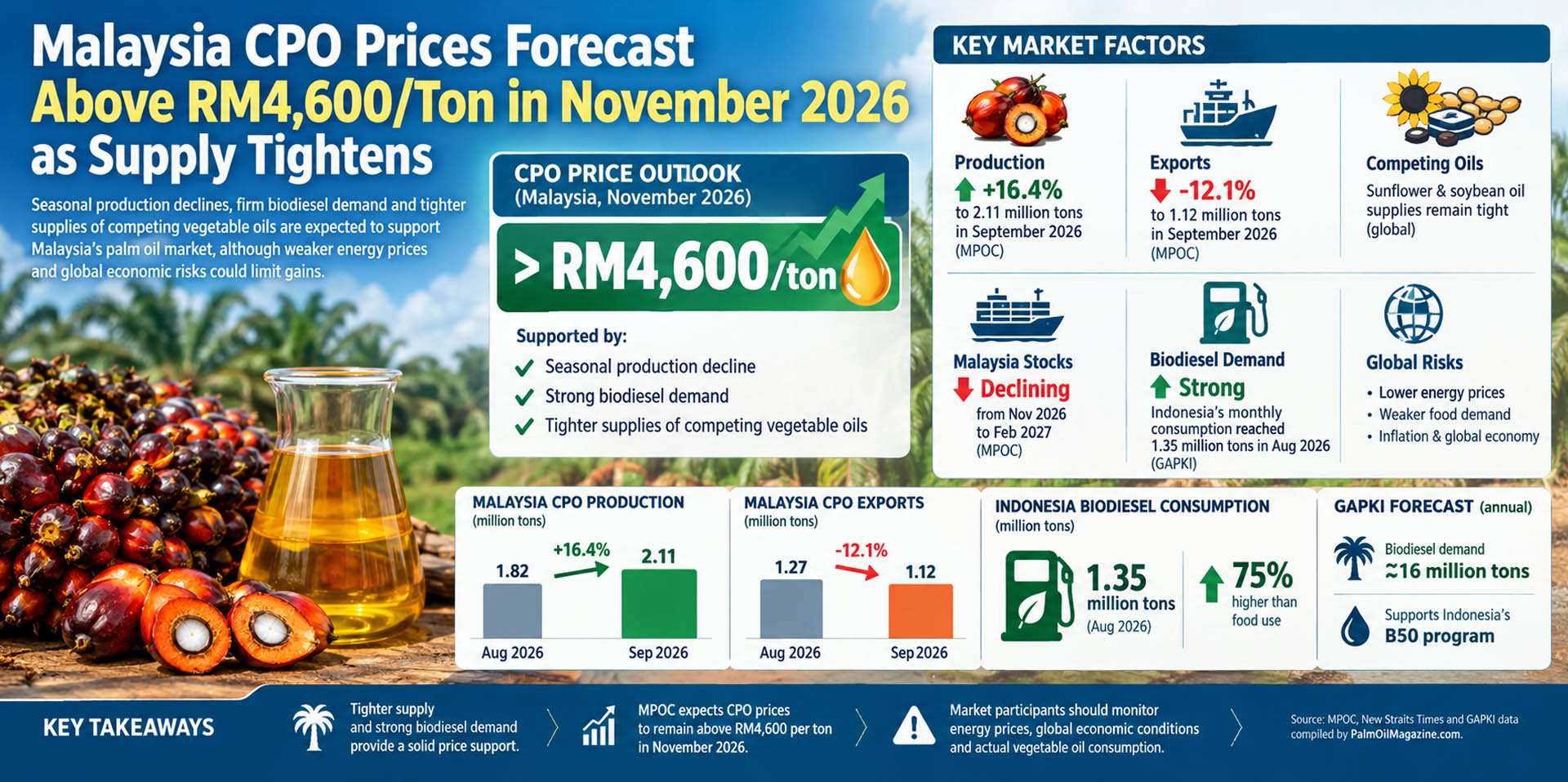
Seasonal production declines, resilient biodiesel demand and tighter supplies of competing vegetable oils are expected to support Malaysia’s palm oil market, although weaker energy prices and global economic risks could limit gains.
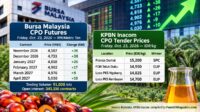
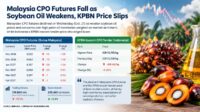
PALMOILMAGAZINE, KUALA LUMPUR — Malaysia’s crude palm oil (CPO) prices are expected to remain above RM4,600 per ton in November 2026, supported by seasonal production declines, firm biodiesel demand and tightening supplies of competing vegetable oils in the global market.
The Malaysian Palm Oil Council (MPOC) said India’s reduction in import duties on vegetable oils could help revive palm oil demand in the coming months. At the same time, tighter supplies of sunflower and soybean oils are expected to strengthen palm oil’s competitiveness in international markets.
Also Read: Malaysia CPO Futures Rise as Palm Oil Exports Gain 4.3% in First Nine Months of 2026
However, MPOC cautioned that the price outlook remains exposed to downside risks. Weaker energy prices and softer-than-expected food use of vegetable oils, amid persistent inflationary pressures and an uncertain global economic environment, could limit further gains.
In its latest report, MPOC said Malaysia’s palm oil production rose 16.4% to 2.11 million tons in September 2026, driven by higher fresh fruit bunch (FFB) production and an improvement in the oil extraction rate (OER).
Production, however, is believed to have peaked in September. Malaysia’s output is expected to enter a seasonal decline over the following five months, potentially tightening supplies and providing additional support to CPO prices.
Also Read: Malaysia CPO Futures Rise as Palm Oil Exports Gain 4.3% in First Nine Months of 2026
Malaysia’s Palm Oil Exports Seen Recovering
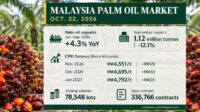
According to New Straits Times, as reported on Friday (Oct. 23, 2026), Malaysia’s cumulative palm oil exports during the first nine months of 2026 were still 4.3% higher than in the same period a year earlier. September shipments, however, fell 12.1% to 1.12 million tons.
MPOC attributed the September decline partly to limited vessel availability in the Malacca Strait and stronger competition from Indonesia. Indonesian exporters accelerated shipments ahead of new export regulations announced in June 2026 and a scheduled increase in export duties in October following higher reference prices.
Also Read: Malaysia Palm Oil Exports Seen Stable at 16 Million Tons in 2027, MPOC Says
The decline in Malaysian exports is expected to be temporary. MPOC forecasts a significant recovery in shipments from October through December 2026 as vessel availability improves and supplies of competing vegetable oils become tighter.
Lower CPO prices from their September peak could also encourage global buyers to secure forward supplies at more attractive prices, potentially supporting export demand toward the end of the year.
Supplies of Competing Vegetable Oils Tighten
In the global vegetable oil market, continuing logistical disruptions in the Black Sea region are limiting sunflower seed processing activity. As a result, sunflower oil supplies are expected to remain constrained in the coming months unless safer shipping routes become available.
The tightening supply outlook comes despite global sunflower seed production being forecast to reach a record 65.3 million tons in 2027, with much of the expected production growth coming from the Black Sea region.
Also Read: Malaysia CPO Futures Rise to RM4,700 as Early-October Exports Jump Up to 37.73%
Meanwhile, soybean oil supplies from South America are expected to tighten as the region enters its soybean planting season from October through December.
The combination of tighter sunflower and soybean oil supplies could improve palm oil’s competitiveness. India is expected to increase its reliance on palm oil imports to meet vegetable oil demand and replenish inventories following the Diwali festival in November.
A similar trend could emerge in China. Reduced soybean supplies from Brazil could encourage greater palm oil consumption to meet domestic demand.
Also Read: Rising Biodiesel Demand Could Push CPO Prices Higher in 2027, GAPKI Says
Lower Stocks and Biodiesel Demand Provide Support
On the supply side, seasonal production declines are expected to begin drawing down Malaysia’s palm oil inventories. MPOC projects Malaysian stocks to decline from November 2026 through February 2027.
The expected inventory drawdown could provide a supportive factor for prices, particularly during the final quarter of 2026 as the market faces the prospect of tighter supplies.
Beyond production and inventories, biodiesel demand remains one of the key pillars supporting the palm oil market. Relatively firm energy prices continue to provide an incentive for biodiesel blending in several major markets.
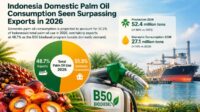
Data from the Indonesian Palm Oil Association (GAPKI) showed that Indonesia’s monthly palm oil consumption for biodiesel reached a record 1.35 million tons in August 2026, 75% higher than palm oil consumption for food purposes.
On an annualized basis, palm oil demand for biodiesel is estimated at around 16 million tons. The scale of consumption suggests Indonesia is moving increasingly close to full implementation of its B50 mandatory biodiesel program.
With biodiesel demand remaining strong, Malaysian production entering a seasonal downturn and competing vegetable oil supplies tightening, MPOC expects CPO prices to have a solid foundation to remain above RM4,600 per ton in November 2026.
Nevertheless, market participants will continue to monitor energy prices, global economic conditions and actual vegetable oil consumption, all of which could determine the direction of palm oil prices in the final months of 2026. (P2)