PALMOILMAGAZINE, JAKARTA — As heavy rains have yet to fully subside, public discourse is once again dominated by images of flash floods and landslides. West Sumatra, North Sumatra, and Aceh have become the latest stages for successive hydrometeorological disasters. Amid the chorus of blame—deforestation, mining, palm oil—Prof. Dr. Chairil Anwar Siregar invites the public to look elsewhere: to the skies.
Speaking calmly, almost philosophically, from his office in the Gunung Batu area of Bogor on Friday morning, the Research Professor and Principal Investigator at BRIN’s Center for Ecology Research described recent disasters as stark lessons in an increasingly extreme climate.
“Imagine intense, heavy rainfall pouring down day after day without pause. Eventually, the soil layers dissolve. Who could possibly hold that back?” Chairil said, as quoted by Palmoilmagazine.com from greenindonesia.co on Tuesday (December 16, 2025).
Also Read:
For him, what has unfolded across Sumatra is hardly surprising. It is part of a broader natural process moving in a single direction: the escalation of destructive energy. Nature, Chairil noted, even without human interference, has its own cycles of collapse.
“Dinosaurs went extinct without any human involvement,” he said, reminding listeners that from a cosmic—religious—perspective, nothing is truly permanent. “Nature itself is heading toward destruction. There is nothing completely sustainable in this world.”
When the Soil Dissolves
To explain landslides, Chairil turned to a simple analogy. The topsoil layer—the solum—is like a slice of white bread: fragile, porous, and highly absorbent. Beneath it lies softer rock, and below that, hard rock that forms the foundation.
“Under normal rainfall, the soil can still hold. But under continuous heavy rain, the pores become saturated. Like bread soaked in water, it simply dissolves,” he explained.
In the sloping terrain of the Bukit Barisan range, the situation becomes even more complex. Waterlogged soil sits atop softer rock layers, burdened by vegetation with enormous mass. Once equilibrium is disturbed, the ground gives way.
Also Read: Palm Oil Amid Black Campaigns and Misguided Policies
“Planted forests can weigh up to 100 tons per hectare. Natural forests can reach 300 to 400 tons. That’s stored potential energy. Even without rain, it already poses a risk,” Chairil said.
As soil, timber, and other materials rush downslope, rivers and basins become clogged. At a critical point, these natural dams collapse. Flash floods and landslides then strike simultaneously, sweeping through villages and towns with devastating force.
Like an Explosion
Chairil’s views often run counter to prevailing narratives. He does not deny the roles of deforestation, mining, or oil palm plantations. Yet, in his assessment, these are secondary contributors. The primary driver is extreme rainfall linked to climate change.
“So why all the noise and finger-pointing?” he asked bluntly.
He then drew a striking analogy: a nuclear bomb. Using a simple physics-based approach, Chairil estimated the kinetic energy of extreme rainfall. Raindrops measuring two millimeters in diameter, falling at nine meters per second for 12 hours, can generate up to 50 million kilojoules of energy over 1,000 hectares.
“If it continues nonstop for 24 hours, the force can exceed that of an atomic bomb,” he said. “Just imagine the impact.”
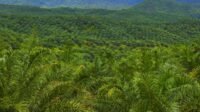
With daily rainfall reaching 400 millimeters, Chairil stressed that even the best-managed forests would struggle to withstand such conditions. In several cases, he added, oil palm plantations actually remained intact and even served as temporary shelters for residents.
“Don’t be too quick to blame palm oil,” he cautioned.
An Unavoidable Choice
If extreme climate events are becoming the new normal, Chairil foresees shorter intervals between disasters. Given the soil characteristics and topography of Aceh, North Sumatra, and West Sumatra, similar risks will continue to loom.
As a result, he put forward a solution that may sound harsh, but realistic: relocation.
“Find safe locations. Build new settlements. Move communities,” he said firmly. The government, he added, must also take disaster-risk mapping seriously and implement it in practice—not merely treat it as a bureaucratic document.
Rehabilitation and reforestation remain important, but they must be guided by careful strategy. Not all land is suitable for heavy forest cover. Choosing the right plant species and matching them to land capability is critical.
“Nature has its own laws,” Chairil concluded. “Our task is not to fight them, but to understand their limits.” (P2)