PALMOILMAGAZINE, DUBAI – Palm oil storage and transfer operations depend heavily on thermal conditions to keep oil pumpable for circulation, transfer, and processing activities. Unlike many petroleum products, palm oil and related edible oils are highly temperature sensitive, where even moderate temperature reduction can significantly increase viscosity and affect flow behaviour inside storage systems.
Across many storage terminals, tank farms, refineries, and bulk liquid handling facilities, conventional heating systems such as steam coils, diesel boilers, electrical heaters, and thermal oil systems continue to be widely used to support storage operations. While these systems are operationally established, many facilities still experience recurring challenges associated with reheating dependency, unstable thermal conditions, localized overheating, transfer delays, and excessive energy consumption.
Also Read: Indonesia’s Palm Oil Stocks Edge Lower as Biodiesel Consumption Accelerates
One of the commonly overlooked operational realities in large storage tanks is that acceptable temperature readings from localized sensors do not necessarily represent actual overall tank conditions. In large-volume tanks, different thermal zones can exist simultaneously within the same tank due to stratification, wall cooling, roof losses, dead zones, and circulation limitations. As a result, oil near the heating source may experience repeated exposure to elevated temperatures while other areas of the tank may remain comparatively cooler and more viscous.
This creates an operational condition where tank temperature readings may appear acceptable while hidden high-viscosity zones still exist inside the tank. Such conditions can affect transfer readiness, circulation stability, pumping consistency, and overall operational reliability. In some facilities, repeated reheating practices become part of normal operations to recover pumpability conditions before transfer activities.
Localized overheating near heating surfaces also presents another operational concern. In conventional bottom-coil heating arrangements, oil directly surrounding the heating area may continuously experience higher thermal exposure compared to the rest of the storage volume. Over extended operation periods, repeated thermal stress near localized heating regions may contribute to undesirable product conditions and inefficient thermal behaviour across the tank.
Also Read: GAPKI: Existing Export Controls Are Sufficient, Focus Should Be on Enforcement
Operationally, the issue is not only about achieving a target temperature but about supporting stable and consistent thermal conditions across the entire storage operation. Large storage infrastructure requires thermal behaviour that supports circulation continuity, predictable viscosity conditions, transfer readiness, and reduced dependency on repeated recovery heating cycles.
Another major challenge is energy dependency. Continuous boiler operation and electrical reheating across large storage facilities can result in significant fuel and power consumption, particularly in operations requiring 24-hour pumpability support. Rising fuel costs, increasing energy demand, and decarbonization pressures are driving many operators to review how thermal systems are managed within edible oil storage infrastructure.
As storage capacities increase, conventional reheating-focused approaches may become increasingly inefficient due to large thermal mass behaviour and uneven heat distribution characteristics inside tanks. In many cases, facilities continue operating reactively by reheating oil after viscosity conditions deteriorate instead of supporting more stable thermal conditions continuously.
This has created growing operational interest in approaches focused on thermal stability and continuous pumpability support within storage operations.
One such approach is Terminal Flow Assurance (TFA), an industrial thermal management framework intended to support stable thermal behaviour and pumpability across palm oil storage and transfer infrastructure. The approach focuses on supporting more controlled thermal circulation conditions inside storage systems while reducing dependency on repeated reheating practices.
The operational objective of TFA is not simply heating oil to elevated temperatures, but supporting storage conditions where oil remains continuously transferable and operationally stable for circulation and pumping activities. The approach also considers retrofit feasibility within existing storage infrastructure without requiring complete replacement of tank systems.
Also Read: Indonesia Cuts July 2026 CPO Reference Price to USD 1,000.90 per Ton Amid Weak Global Demand
In addition, integration of solar thermal support within storage heating infrastructure is increasingly being evaluated as part of broader energy optimization strategies. Industrial solar thermal integration may support reduced boiler operating dependency and lower electrical heating demand while contributing toward lower operational fuel consumption and reduced emissions across thermal operations.
As industrial facilities continue facing pressure to improve operational efficiency, reduce energy dependency, and support more stable storage conditions, thermal management within edible oil infrastructure is becoming increasingly important beyond conventional reheating practices alone.
Future storage operations may increasingly move toward thermal stability-focused approaches where continuous pumpability, controlled circulation behaviour, operational readiness, and energy optimization become central priorities within large-scale palm oil storage infrastructure. (*)
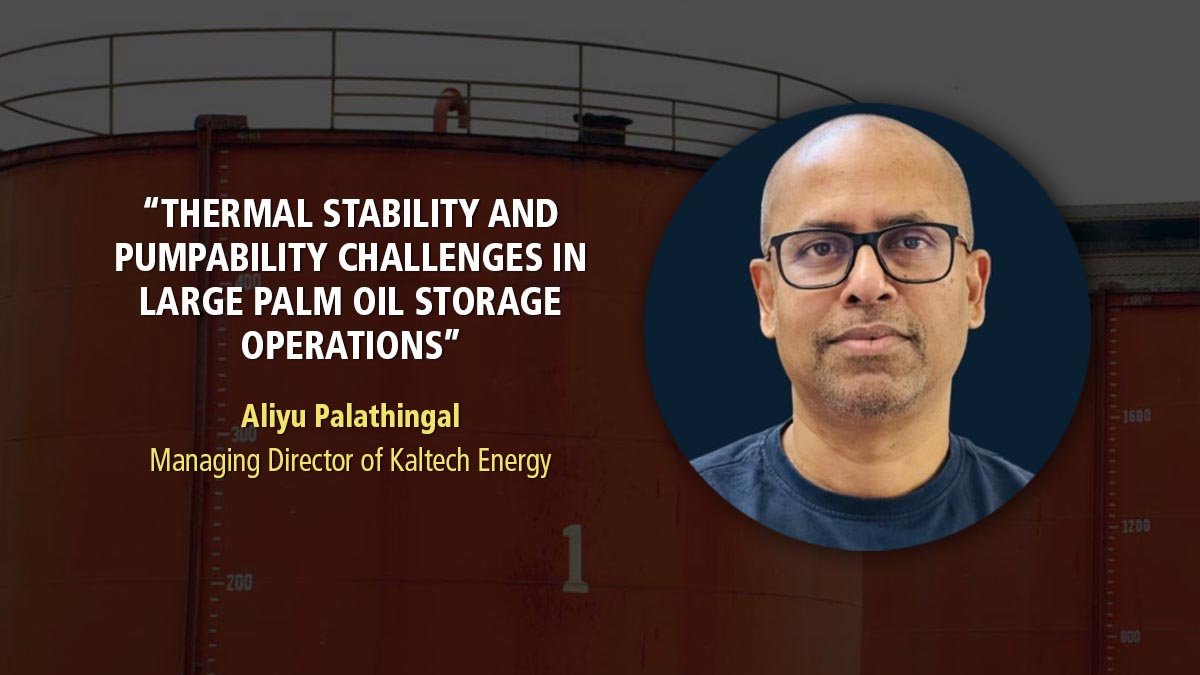
By Aliyu Palathingal
Managing Director of Kaltech Energy