
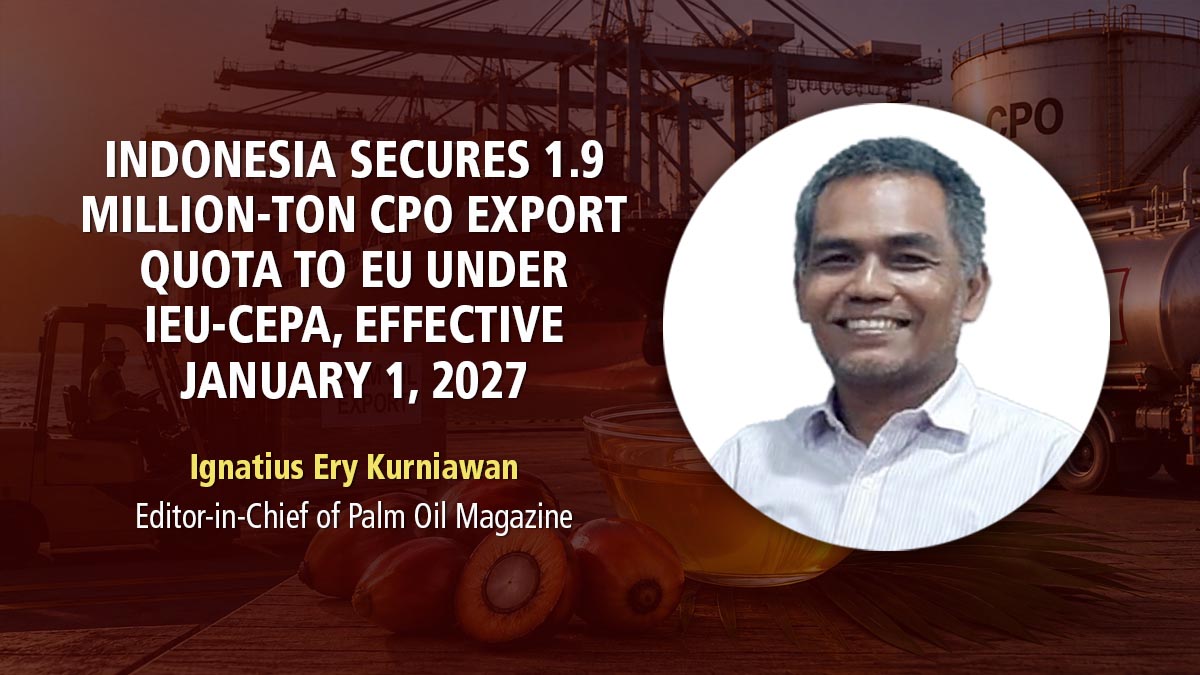
Signed after a decade of negotiations, the Indonesia–European Union trade agreement opens the door to zero-tariff access for Indonesian palm oil, although exporters must meet stringent regulatory, traceability and sustainability requirements.
PALMOILMAGAZINE, JAKARTA — Indonesia’s palm oil industry is set to gain improved access to the European Union market following the signing of the Indonesia–European Union Comprehensive Economic Partnership Agreement (IEU-CEPA), which provides an initial duty-free export quota of 1.9 million tons for crude palm oil (CPO).
After nearly a decade of negotiations that began in July 2016, Indonesia and the European Union officially signed the landmark agreement in Brussels, Belgium, on November 21, 2026.
Also Read: When Smallholders Support Global Palm Oil Markets, It Is Time to Rethink Farm Scale
The agreement was signed by Indonesian Trade Minister Budi Santoso and European Commissioner Maroš Šefčovič. At the same ceremony, Coordinating Minister for Economic Affairs Airlangga Hartarto signed the Investment Protection Agreement (IPA), witnessed by European Commission President Ursula von der Leyen.
For Indonesia’s palm oil industry, including CPO and its downstream products, the agreement represents a significant opportunity to strengthen its presence across the European Union’s 27 member states.
Also Read: B50 Biodiesel Mandate Requires a Cautious Approach
Zero Tariffs and a 1.9 Million-Ton Export Quota
Under the IEU-CEPA, approximately 90.4% of Indonesian tariff lines will receive immediate duty-free treatment, or zero import tariffs, from the first day of implementation. Palm oil and its derivatives, including palm kernel oil (PKO), oleochemicals and other downstream products, are among the commodities covered by the preferential trade arrangements.
According to details released by the Indonesian government following the signing ceremony in Brussels, Indonesia will receive the following initial duty-free export allocations:
- 1.9 Million Tons of CPO: Indonesian crude palm oil will receive a duty-free quota of 1.9 million tons for exports to the European Union market.
- 140,000 Tons of Other Processed Palm Oil Products: Additional duty-free quota allocation of 140,000 tons will cover processed palm oil and other derivative products.
- Progressive Increases Through Year Nine: The initial allocations are not fixed. The duty-free quotas for both categories will gradually increase each year, reaching their maximum levels in the ninth year of the agreement.
The arrangement is expected to benefit not only exports of crude palm oil but also Indonesia’s value-added downstream palm oil industry. It creates greater opportunities for Indonesian derivatives to enter European supply chains serving the food, cosmetics and chemical industries.
The agreement is targeted to take full effect on January 1, 2027, following the completion of ratification processes by the European Parliament and Indonesia. Its implementation is expected to coincide with the expiration of the European Union’s Generalised Scheme of Preferences (GSP) facility on December 31, 2026.
Also Read: Palm Oil as a Renewable Natural Resource
Zero Tariffs Do Not Mean Zero Requirements
Despite the opening of zero-tariff access, the 1.9 million-ton quota will not automatically be available to all exporters. Preferential tariffs under the IEU-CEPA do not exempt Indonesian palm oil producers and exporters from the European Union’s stringent market standards and non-tariff measures.
Indonesian businesses must meet four major groups of requirements to benefit from the agreement.
Also Read: Riau Independent Smallholder FFB Prices Fall IDR 117 to IDR 3,602/kg for November 18–24
- Compliance with the EU Deforestation Regulation (EUDR)
The European Union is scheduled to begin implementing the EU Deforestation Regulation (EUDR) on December 30, 2026, for large and medium-sized companies.
CPO and its derivatives must be demonstrated to be deforestation-free, meaning they cannot originate from land subject to deforestation or forest degradation after December 31, 2020.
Exporters must also provide geolocation traceability data, including precise coordinates or plot polygons for plantations exceeding four hectares. In addition, they must obtain a Due Diligence Statement (DDS) reference number through the EU information system.
Also Read: Universitas Pamulang Researchers Examine Strategies to Retain Oil Palm Plantation Employees
- Rules of Origin Requirements
To establish that palm oil products genuinely originate from Indonesia and have been legally produced or processed domestically, rather than merely transiting through Indonesia from third countries, exporters must provide recognized Proof of Origin documentation under the IEU-CEPA.
Exporters must also ensure that Harmonized System (HS) tariff classifications are accurate and correspond to the preferential tariff schedules agreed under the trade deal.
- Sustainability, Legality and Technical Quality Standards
The IEU-CEPA includes a dedicated protocol on sustainable palm oil, emphasizing environmental protection, climate change mitigation and labor standards.
Plantations and palm oil mills must comply with applicable Indonesian laws concerning land legality and community rights, while also meeting European technical quality and safety requirements.
These include food safety standards and limits on contaminants in processed palm oil products, such as 3-MCPD and glycidyl esters.
- Compliance with Indonesia’s Domestic Export Regulations
At the domestic level, exporters must continue to comply with Indonesia’s existing trade regulations.
These include obtaining Export Approval (Persetujuan Ekspor or PE) from the Ministry of Trade, meeting Domestic Market Obligation (DMO) requirements whenever applicable to the relevant tariff lines, and fulfilling Export Duty (Bea Keluar or BK) and Export Levy (Pungutan Ekspor or PE) obligations in accordance with prevailing Ministry of Finance regulations.
Also Read: Indonesia Targets Smallholder Palm Oil Productivity Gains Through GAP and Land Legalization
An Opportunity to Move Indonesia’s Palm Oil Industry Up the Value Chain
The full implementation of the IEU-CEPA over the next five years is projected to increase Indonesia’s exports to the European Union by nearly 58%, generate an additional US$2.8 billion in economic benefits and deliver positive employment impacts for approximately five million Indonesian workers.
For Indonesia’s palm oil industry, the initial duty-free quotas of 1.9 million tons for CPO and 140,000 tons for processed palm oil products represent a major opportunity to strengthen its competitiveness in the global premium market.
However, capitalizing on these benefits will depend heavily on the industry’s readiness to meet the agreement’s requirements.
From large plantation companies to independent smallholders, stakeholders will need to accelerate plantation geolocation mapping, strengthen supply chain traceability and improve compliance with sustainability standards.
Ensuring that these requirements are met will be essential for Indonesia to maximize the benefits of zero-tariff access once the agreement officially enters into force. (*)
By Ignatius Ery Kurniawan, Editor-in-Chief of Palm Oil Magazine