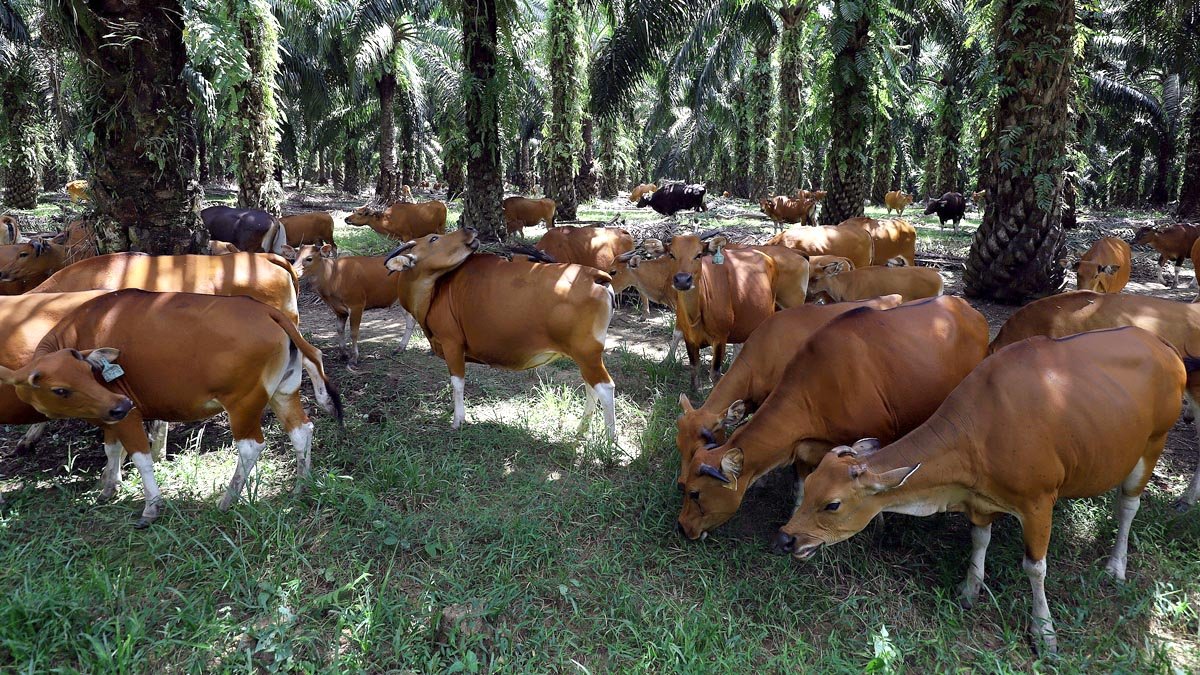
PALMOILMAGAZINE, JAKARTA – The development of Indonesia’s oil palm-cattle integration system (SISKA) continues to face a major challenge: ensuring the availability of high-quality and nutritious feed for productive livestock.
Forage growing beneath oil palm plantations is often unable to fully meet the nutritional requirements of cattle, particularly during critical phases such as pregnancy, lactation, and calf growth, when animals require higher levels of protein and energy.
Chairman of CENTRAS at IPB University, Prof. Nahrowi, stated that nutritional adequacy remains one of the most important factors in increasing cattle populations within integrated oil palm ecosystems.
Also Read: CPOPC Strengthens Smallholder Skills Through Practical GAP Training Programs
“The biggest challenge in expanding cattle populations under the palm oil integration system is ensuring sufficient nutrition, especially for productive cattle that require high protein and energy intake during reproductive and growth phases,” Nahrowi said in an official statement from GAPENSISKA received by InfoSAWIT on Saturday (9/5/2026).
According to him, one strategic raw material with strong potential as a sustainable livestock feed source is Palm Kernel Meal (PKM), also known in Indonesia as Bungkil Inti Sawit (BIS). Its availability is considered stable, abundant, and sustainable due to continuous activity in the palm oil processing industry.
However, raw PKM still has nutritional limitations. Its high content of Non-Starch Polysaccharides (NSP), particularly β-mannan compounds, makes the material difficult for animals to digest efficiently, especially for monogastric livestock and less effective even for ruminants.
Also Read: National Defense Council Stresses Palm Oil Productivity as Key to B50 Success
Research data show that mannan levels in PKM range between 350–380 grams/kg, significantly higher than soybean meal (SBM), which contains only around 20–40 grams/kg. This high mannan content has long limited the use of PKM as a premium livestock feed ingredient.
To address the issue, CENTRAS IPB developed a valorization technology through fractionation and enzymatic hydrolysis using mannanase enzymes, resulting in a new feed product called Palmofeed.
Research findings showed that Palmofeed offers better nutritional quality compared to raw PKM. Palmofeed contains 17.48 percent crude protein, higher than raw PKM, which typically ranges between 14–16 percent. Meanwhile, crude fiber levels declined to 12.28 percent from around 16 percent in untreated PKM.
Also Read: BPDP Targets Industry-Ready Research Through 2026 Grant Program
Shell contamination levels also dropped significantly to 7.63 percent, compared to approximately 15 percent in conventional PKM.
“Palmofeed is capable of improving in vitro digestibility values by up to 33 percent, significantly higher than raw PKM, which only reaches around 24 percent. This creates major opportunities for a more efficient and higher-value palm-based feed industry,” Nahrowi explained.
The effectiveness of Palmofeed was also demonstrated in a 35-day broiler chicken trial. Feed formulations containing up to 12.5 percent Palmofeed combined with mannanase enzymes achieved a Feed Conversion Ratio (FCR) of 1.95, outperforming standard basal feed formulations, which recorded an FCR of 2.08.
Also Read: KPBN CPO Prices Climb to IDR 15,325/kg, Malaysian Palm Oil Market Rebounds
From an economic standpoint, palm-based feed formulations were also considered more cost-efficient. Feed protein costs from palm-based formulations were estimated at around IDR 218.75 per percentage point of crude protein, substantially lower than corn at IDR 675.44 and rice bran at approximately IDR 333.67.
Given this potential, Nahrowi stressed that establishing integrated feed mill industries within oil palm plantation areas has become increasingly urgent to strengthen Indonesia’s SISKA ecosystem.
“The transition from raw material feeding toward precision feed systems must be accelerated. Without integrated local feed industries, maintaining consistent nutritional quality and stable feed supplies will remain a major obstacle for palm oil-cattle integration development,” he concluded.
Also Read: PTPN IV PalmCo and ITS Launch Five-Year Partnership to Develop Palm-Based Green Fuel
With innovations such as Palmofeed, Indonesia’s palm oil industry is seen as having potential beyond vegetable oil production, positioning itself as a key pillar in sustainable livestock feed development capable of supporting national food security through stronger integration between plantations, feed industries, and livestock farming. (P2)