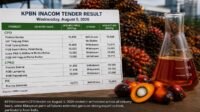
PALMOILMAGAZINE, JAKARTA – Indonesia’s crude palm oil (CPO) price, as set by PT Kharisma Pemasaran Bersama Nusantara (KPBN), edged lower in Wednesday’s trading (May 6, 2026), reflecting softer global market conditions. The Franco Dumai price was recorded at IDR 15,575 per kilogram, down IDR 50 per kilogram from Tuesday’s level of IDR 15,625 per kilogram.
Prices across other delivery points showed mixed movements. CPO Loco Parindu opened at IDR 15,222 per kilogram but was withdrawn (WD), with the highest bid reaching IDR 15,062 per kilogram. Meanwhile, CPO Loco Kembayan was set at IDR 15,125 per kilogram, and Loco Ngabang stood at IDR 15,225 per kilogram.
For downstream products, crude palm kernel oil (CPKO) Franco Belawan was listed at IDR 33,329 per kilogram but was also withdrawn, with the highest offer at IDR 32,825 per kilogram. Similarly, CPKO Loco Sei Mangkei was recorded at IDR 33,227 per kilogram, with a highest bid of IDR 32,545 per kilogram before being withdrawn.
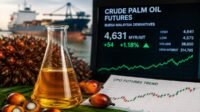
In the global market, palm oil prices faced stronger downward pressure. Trading on the Bursa Malaysia Derivatives Exchange closed sharply lower on the same day, with prices dropping nearly 3%. The benchmark July 2026 contract fell by RM133 per ton, or 2.82%, to settle at RM4,577 per metric ton.
The decline was largely driven by weaker crude oil prices, which fell to their lowest level in two weeks. Market sentiment was influenced by geopolitical developments, particularly expectations of a potential agreement between the United States and Iran that could increase global oil supply.
Lower crude oil prices directly reduce the attractiveness of palm oil as a biodiesel feedstock—one of the key pillars supporting global CPO demand—thereby exerting downward pressure on prices.
Also Read: BPDP Expands 2026 Research Grants Beyond Palm Oil, Opens Funding for Coconut and Cocoa
Additional pressure came from a 2.39% drop in soyoil prices on the Chicago Board of Trade (CBOT). In the global vegetable oil market, palm oil often moves in tandem with competing oils such as soybean oil, as they vie for the same market share.
However, market movements in Asia showed a more mixed trend. On the Dalian Commodity Exchange, the most active soybean oil contract rose 0.78%, while palm oil futures gained 0.37%.
This divergence highlights the influence of regional factors amid prevailing global pressures. Looking ahead, market participants are expected to closely monitor energy prices, competing vegetable oil trends, and currency movements as key indicators shaping the direction of CPO prices. (P3)