PALMOILMAGAZINE, JAKARTA – The mud floods that swallowed homes across Sumatra arrived with a familiar accusation: palm oil is once again blamed as the culprit. Amid grief and loss, a commodity that has existed for more than a century finds itself back in the dock.
But is palm oil always the single defendant whenever nature turns hostile? Or are we overlooking the quiet transformation being undertaken by thousands of smallholders on the ground?
For over a century, oil palm has grown into one of Indonesia’s most vital economic commodities. Since its commercial introduction in 1911, palm oil has become the livelihood backbone of millions of households, particularly in Sumatra and Kalimantan. Yet in recent years, the industry’s image has often been cast in a darker light—frequently portrayed as the primary driver of environmental degradation and a recurring suspect in ecological disasters.
Also Read: Indonesia Sets February 2026 Biodiesel Price at IDR 13,856/Liter
The devastating mud and flash floods that hit parts of Sumatra at the end of 2025 revived that narrative. Thousands of homes were submerged, economic activities halted, and lives were lost. The tragedy demands empathy, solidarity, and unconditional assistance. Behind the statistics and images of destruction are families who have lost everything.
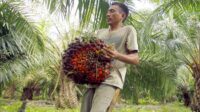
Among them are oil palm farmers.
Many smallholder plantations were inundated, harvest access routes cut off, and fresh fruit bunch (FFB) prices declined. Small farmers—often positioned at the margins of policy debates—bear the brunt of both natural disasters and market volatility. The irony arises when their suffering is met with renewed blame, as if the complexity of environmental disasters could be reduced to a single crop.
The reality is far more nuanced.
Also Read: North Sumatra FFB Price Inches Up to IDR 3,565.77/kg for February 18–24 Period
A Sector Undergoing Transformation
Over the past two decades, the palm oil sector has undergone significant transformation toward more sustainable practices. Internationally recognized sustainability standards have become central references. Schemes such as the Roundtable on Sustainable Palm Oil (RSPO), a market-driven initiative, and the Indonesian Sustainable Palm Oil (ISPO), Indonesia’s national regulatory framework, have reshaped how plantations are managed—from land clearing practices to the protection of high conservation value areas.
According to RSPO data, as of 2024 more than 500,000 smallholders worldwide have been certified or are in the process of achieving sustainable certification, with Indonesia contributing the largest share. Meanwhile, the Kementerian Pertanian Republik Indonesia records that approximately 42% of Indonesia’s total oil palm plantation area is managed by smallholders.
This means that when palm oil is accused of causing environmental harm, it is not only large corporations that are cornered, but also hundreds of thousands of farmers striving to adapt and improve.
The Cost of Change—and the Risk of Simplification
Transitioning to sustainable palm oil is not easy for smallholders. Certification fees, technical assistance requirements, improved agronomic practices, and administrative compliance all demand time, resources, and commitment. Yet many continue to move forward—replanting on existing land, preserving river buffer zones, limiting new land clearing, and gradually embracing sustainability as a long-term necessity rather than a marketing slogan.
If these efforts are ignored in public discourse—if palm oil continues to be framed solely as a driver of destruction—what future does sustainable palm oil have?
Also Read: East Kutai Positions Palm Oil as Cornerstone of Food Security and Energy Transition
Oversimplified narratives risk undermining genuine progress. Instead of reinforcing good practices, prolonged stigma could push farmers back toward cheaper, faster, but ecologically fragile methods. Recognition, therefore, is not about offering empty praise, but about acknowledging that change is underway and deserves structural support.
Sustainability cannot stand on its own. The government plays a pivotal role: ensuring consistent spatial planning, enforcing environmental regulations, and providing financing access and technical assistance to smallholders. Without these pillars, sustainable palm oil risks remaining a policy slogan rather than a systemic transformation.
At a Crossroads
The disaster in Sumatra should be a moment of collective reflection—not mutual accusation. Environmental degradation is rarely the product of a single cause; it is the accumulation of policies, practices, and choices over time.
Palm oil, with all its controversies, now stands at a crossroads. Will it remain trapped by stigma, or will it be given the space to demonstrate that sustainability is not merely a promise—but a pathway that is already being built and must be pursued together? (*)
Author: Editor-in-Chief of InfoSAWIT, Ignatius Ery Kurniawan
Source: InfoSAWIT Magazine, December 2025 edition