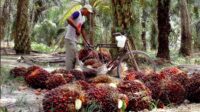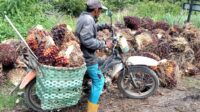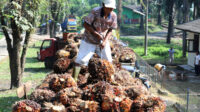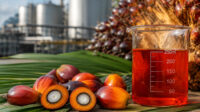
PALMOILMAGAZINE, BOGOR – Minister of Agriculture Andi Amran Sulaiman has reaffirmed the government’s commitment to protecting Indonesia’s palm oil smallholders, stressing that authorities will not remain passive when market practices threaten farmers’ livelihoods.
Speaking during the Ministerial and Top Executive Lecture Series, held as part of the 25th anniversary celebrations of the Faculty of Economics and Management at IPB University, Amran addressed concerns over the decline in Fresh Fruit Bunch (FFB) prices that affected palm oil growers in several regions earlier this year.
The issue was raised by Abdul Aziz, Chairman of the university’s Student Executive Board (BEM), who praised the government’s progress in accelerating Indonesia’s food self-sufficiency agenda amid global food security challenges and geopolitical uncertainty.
Also Read: KPBN CPO Tender Ends in Withdrawal as Highest Bid Rises to IDR 15,150/kg
Aziz also questioned how the government plans to sustain the country’s rice surplus while addressing complaints from palm oil farmers over lower FFB prices.
Responding to the question, Amran highlighted the strong performance of Indonesia’s agricultural sector. He noted that national rice production has reached approximately 34.6 million tons, while rice reserves stand at around 5.3 million tons—the highest level recorded since Indonesia’s independence.
“We initially promised food self-sufficiency within four years, and thankfully we achieved it much sooner. This success belongs to everyone—farmers, academics, local governments, and all Indonesians who contributed to the effort,” Amran said.
Also Read: West Kalimantan FFB Prices Climb Above IDR 3,400/kg in Late June 2026
He added that Indonesia’s agricultural sector recently recorded its highest Gross Domestic Product (GDP) growth in 25 years, further strengthening the country’s position as a global reference point in food security.
Palm Oil Price Decline Viewed as Market Anomaly
While celebrating progress in food production, Amran emphasized that the government is equally focused on protecting palm oil farmers.
According to the minister, reports of falling FFB prices prompted immediate attention from the government because the decline did not reflect prevailing global market conditions.
Also Read: Agrinas Palma Nusantara Explores Green Energy Development Partnership with Korean Consortium
Amran recalled receiving numerous complaints from palm oil farmers while performing the Hajj pilgrimage in Saudi Arabia. Several growers expressed concerns over the sharp drop in FFB prices despite favorable international market trends.
“I was in the Holy Land when reports came in about falling FFB prices. After completing my religious duties, I received a call from the President, who instructed that the issue be addressed immediately because it affects the livelihoods of millions of Indonesian palm oil farmers,” he said.
The minister argued that the market situation at the time was inconsistent with global fundamentals.
Also Read: Jambi FFB Prices Extend Gains, Reaching IDR 3,706.67/kg for Prime-Age Palms
“International palm oil prices were rising and the U.S. dollar was strengthening against the rupiah, yet FFB prices received by farmers were declining. That was an anomaly. Market principles apply everywhere, but they were not reflected in the prices farmers received. That is why I ordered an immediate investigation,” Amran explained.
Government Tightens Oversight
Upon returning to Indonesia, Amran said he initiated cross-sector coordination to address the issue. The government also engaged law enforcement authorities to ensure there were no irregularities within the palm oil supply chain that could disadvantage farmers.
“As soon as I returned, I sent a formal request to the National Police Chief. Anyone manipulating the system should be dealt with firmly. I do not want farmers to suffer losses. Around 17 million Indonesians depend on this sector for their livelihoods,” he said.
Also Read: Final Call: Registration for Indonesia’s 2026 Palm Oil Scholarship Closes on June 20
According to Amran, those interventions have begun to produce results. FFB prices, which had been under pressure, have gradually recovered in recent months.
“Thankfully, palm oil prices have started to rebound. They have increased by around 80 to 90 percent compared with the period when we first addressed the issue,” he noted.
The minister stressed that the state has a responsibility to safeguard farmers whenever market distortions threaten their welfare. As a result, oversight of Indonesia’s palm oil trade and pricing mechanisms will continue to be strengthened to ensure greater transparency and fairness.
Also Read: UNJA Secures BPDP Scholarship Program Again, Offers 30 Palm Oil Human Capital Scholarships for 2026
Call for Youth Participation
During the event, Amran also encouraged university students to contribute to the future of Indonesian agriculture through innovation, research, and entrepreneurship.
He urged young people to remain resilient in the face of setbacks and to actively seek solutions to challenges facing rural communities and the agricultural sector.
“Never stop trying. If you fail, try again. Then try again. This nation needs young people who are willing to fight, innovate, and solve real problems faced by society,” he said.
The minister concluded that strengthening both food security and farmer welfare will remain central pillars of Indonesia’s agricultural development strategy in the years ahead. (P2)