PALMOILMAGAZINE, JAKARTA – The Indonesian government has outlined an ambitious roadmap for the national palm oil industry in 2026, placing greater plantation productivity, downstream industrial development, and stronger governance at the core of its policy agenda.
Acting Director General of Plantations at the Ministry of Agriculture, Ali Jamil, said the palm oil industry will remain one of Indonesia’s key economic pillars, supporting economic growth, employment, food security, and energy resilience. The government is therefore introducing a range of policies aimed at improving the industry’s competitiveness while strengthening the role of smallholder farmers.
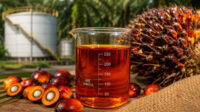
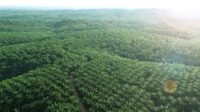
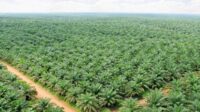
According to Ministry of Agriculture data, Indonesia currently has approximately 16.83 million hectares of oil palm plantations, producing around 45.4 million tonnes of crude palm oil (CPO), maintaining its position as the world’s largest palm oil producer. Ali Jamil presented the figures during the Ngobrol Sawit 2026 webinar held in Jakarta.
Also Read: Prabowo Launches B50 Biodiesel, Declares Indonesia First Nation to Mandate 50% Palm-Based Fuel Blend
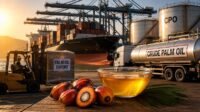
Palm oil also continues to be one of Indonesia’s leading export commodities, generating approximately US$22.85 billion in export earnings from 32.34 million tonnes of shipments. The industry directly employs around 4.2 million workers and supports another 12 million indirect jobs, while contributing roughly 3.5% to the country’s Gross Domestic Product (GDP).
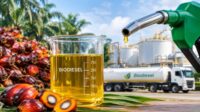
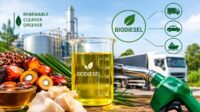
Domestically, about 10.29 million tonnes of palm oil are used annually for cooking oil and other food products. Meanwhile, Indonesia’s biodiesel program is driving rising demand for feedstock. The B40 mandate is expected to require around 15.6 million kilolitres of biodiesel, equivalent to 14.5 million tonnes of CPO, while the future B50 program could increase demand to 20.1 million kilolitres, or approximately 18.7 million tonnes of CPO.
Also Read: Bahlil: B50 Biodiesel Will Drive Palm Oil Demand and Bolster Energy Independence
Smallholder Productivity Remains a Major Challenge
Despite managing around 6.9 million hectares, representing 41% of Indonesia’s total oil palm plantation area, smallholder plantations continue to record relatively low productivity.
Current yields average only 2–3 tonnes of CPO per hectare annually, although productivity could potentially reach 4–6 tonnes per hectare through the adoption of certified planting materials and better agricultural practices.
Ali Jamil identified several structural constraints limiting productivity, including aging and unproductive trees, widespread use of uncertified seedlings, unresolved land legality issues, weak farmer institutions, fluctuating fresh fruit bunch (FFB) prices that slow the implementation of the Smallholder Replanting Program (PSR), and incomplete mapping of farmers’ plantation areas.
Also Read: Indonesia’s KPBN Tender: CPO Price Rises to IDR15,600/kg as Trading Activity Recovers
Government Prioritizes Replanting and Better Governance
To address these challenges, the government is preparing a comprehensive package of measures focused on strengthening the smallholder sector.
Priority programs include accelerating the Smallholder Replanting Program (PSR), expanding access to agricultural infrastructure and production facilities, improving plantation governance through Plantation Cultivation Registration Certificates (STDB) and certification, enhancing farmer capacity through training and technical assistance, widening access to financing via the People’s Business Credit (KUR) scheme, and encouraging business diversification by integrating oil palm with food crops, livestock, and biomass utilization.
For large-scale plantations, policy priorities include improving regulatory certainty, ensuring companies fulfill the mandatory 20% community plantation development obligation, gradually resolving plantations located within forest areas, supporting the transition toward B50 biodiesel, accelerating downstream industrial investment, and expanding the utilization of palm biomass and processing by-products into higher-value products.
Also Read: Agrinas Palma Nusantara Reports Strong 2025 Performance with IDR2.86 Trillion Operating Surplus
Downstream Development and Partnerships Drive Future Growth
The government views downstream development as a key strategy to increase the value added of Indonesia’s palm oil industry.
Policy initiatives include improving palm oil mill efficiency, separating food-grade and non-food-grade CPO production, promoting Good Agricultural Practices (GAP), encouraging collective management of smallholder plantations, and accelerating replanting activities.
Equally important is strengthening partnerships among farmers, plantation companies, cooperatives, financial institutions, and government agencies. Such collaboration is expected to improve productivity, enhance sustainability, and ensure that the benefits of industry growth are shared more broadly.
By combining higher plantation productivity, stronger farmer capacity, accelerated downstream industrialization, and improved governance, the government expects Indonesia’s palm oil sector to become increasingly competitive while enhancing farmer welfare and reinforcing its contribution to national economic growth, food security, and energy security. (P2)