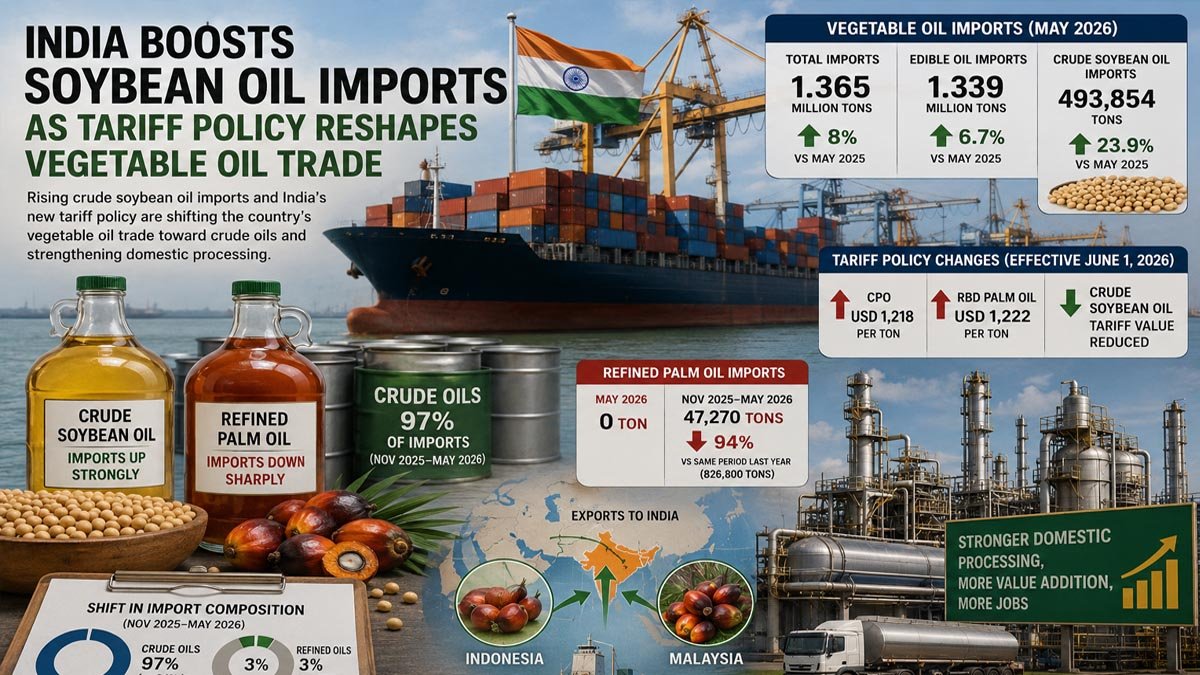
PALMOILMAGAZINE, NEW DELHI – India’s vegetable oil imports continued to rise in May 2026, supported by a sharp increase in crude soybean oil purchases as the commodity became increasingly competitive against palm oil.
According to the latest data from the Solvent Extractors’ Association of India (SEA), the country imported 1.365 million tons of vegetable oils in May, an increase of 8% compared with 1.267 million tons recorded in the same month last year.
The growth was largely driven by higher edible oil imports. SEA reported that India’s edible oil imports reached 1.339 million tons in May 2026, up 6.7% from 1.255 million tons in May 2025.
The most significant increase came from crude soybean oil imports, which climbed to 493,854 tons from 398,585 tons a year earlier.
Also Read: KPBN CPO Prices Drop Below IDR 15,000/kg as Global Market Sentiment Weakens
SEA attributed the surge to the narrowing price premium between soybean oil and palm oil, making soybean oil more attractive to Indian buyers.
“Edible oil imports increased in May primarily due to higher crude soybean oil imports as the price premium of soybean oil over palm oil narrowed,” SEA said in its report, as quoted by Palmoilmagazine.com from Indian media.
Meanwhile, imports of non-edible oils also posted strong growth, more than doubling to 26,202 tons compared with 12,040 tons in May 2025.
Also Read: Malaysian CPO Futures Steady at RM4,475 as Global Markets Remain Under Pressure
Vegetable Oil Imports Reach 9.37 Million Tons
On a cumulative basis, India imported 9.365 million tons of vegetable oils during the first seven months of the 2025/2026 marketing year (November 2025–May 2026), representing a 12% increase from 8.339 million tons during the same period a year earlier.
Edible oil imports accounted for 9.217 million tons, up 13% from 8.131 million tons recorded between November 2024 and May 2025.
In contrast, non-edible oil imports declined to 147,710 tons from 207,505 tons in the corresponding period of the previous marketing year.
Also Read: RSPO Strengthens Smallholder Support with IDR416 Billion Amid Stricter Global Sustainability Rules
Tariff Changes Encourage Crude Palm Oil Imports
SEA also highlighted India’s revised tariff values, which took effect on June 1, 2026. Under the new policy, the tariff value for crude palm oil (CPO) was increased to USD 1,218 per ton, while refined, bleached and deodorized (RBD) palm oil was set at USD 1,222 per ton. At the same time, the government slightly reduced the tariff value applied to crude soybean oil.
According to SEA, the policy maintains a higher import duty differential between crude and refined palm oil, encouraging imports of raw materials for processing within India rather than imports of refined products.
“No imports of RBD Palmolein were recorded during May 2026. Cumulative imports of RBD Palmolein between November 2025 and May 2026 dropped sharply to 47,270 tons from 826,800 tons in the same period last year,” SEA reported.
Also Read: Jambi FFB Prices Extend Gains, Reaching IDR 3,706.67/kg for Prime-Age Palms
The association believes the decline in refined palm oil imports reflects the success of government measures aimed at strengthening domestic refining capacity, increasing value addition, and generating employment opportunities.
The shift is also evident in the composition of vegetable oil imports. During the first seven months of the current marketing year, refined oils accounted for only 3% of total imports, down from 16% a year earlier. Conversely, crude oils represented 97% of imports, up from 84% during the same period last year.
SEA further noted continued imports of refined oils from Nepal, which benefits from zero-duty access to the Indian market under the South Asian Free Trade Area (SAFTA) agreement.
Also Read: Final Call: Registration for Indonesia’s 2026 Palm Oil Scholarship Closes on June 20
India’s rising soybean oil imports and evolving tariff framework are expected to continue influencing global vegetable oil trade flows. The developments could have important implications for palm oil exporters, particularly major producing countries such as Indonesia and Malaysia, as competition intensifies in one of the world’s largest vegetable oil markets. (P2)