PALMOILMAGAZINE, JAKARTA – President Prabowo Subianto appears to be doing more than simply streamlining the export trade system. Through the “single window” policy for natural resource commodities, the state is taking a more far-reaching step: assuming control over foreign exchange flows, trade, and Indonesia’s bargaining position in the global market. The problem is that history has shown that such centralization ambitions often result in market distortions and crises of confidence.
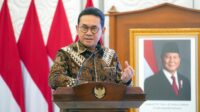
There are moments when a policy sounds administrative on the surface, but in reality harbors far greater political-economic implications beneath it. President Prabowo Subianto’s speech at the DPR RI Building in Senayan, Jakarta, on Wednesday (May 20), felt like it fell into that category.
Through the latest Government Regulation on the Management of Natural Resource Commodity Exports, the government is not merely introducing new rules. The state is shifting its perspective on strategic commodities: from mere revenue sources to instruments of national economic control.
Also Read: Palm Oil as a Self-Sufficiency Model and Engine of Economic Growth
The regulations are strict and strike directly at the heart of the old trade system. Major commodities such as crude palm oil (CPO), coal, and ferrous alloys can no longer be exported directly by businesses. All export flows are required to pass through a single gateway via a state-owned enterprise designated by the government.
The president referred to this mechanism as a “marketing facility”—a national marketing platform that would aggregate commodities, sell them to global markets, and then return the proceeds to exporters. On paper, the concept seems simple. It even sounds rational. The state is stepping in to streamline a system that has long been riddled with inefficiencies.
But the market never interprets policy solely through its official language. Industry players understand that this seemingly administrative term actually harbors significant changes; the state aims to penetrate deeper into a space previously controlled by market mechanisms. And when the state begins speaking of a “single window,” Indonesia’s economic history automatically brings old archives to mind.
The government does have an argument that is difficult to fully refute. The practice of under-invoicing exports has long been a chronic problem. Export prices are reported lower than their actual value; foreign exchange evaporates out of the domestic system; taxes and royalties are lost; while the state receives only a fraction of the actual trade value.
In that context, the state feels the need to take control. Export channels are narrowed, oversight is centralized, and the flow of export foreign exchange is locked in to ensure it circulates within the country. The logic is simple: if goods exit through a single gateway, the state will find it easier to monitor the money coming in.
However, the market sees this as more than just an effort at regulation. Behind the narrative of oversight lies a far greater ambition: to establish full control over Export Proceeds (DHE), strengthen Indonesia’s bargaining position in the global commodities market, and simultaneously create a centralized national commodities trading platform.
This idea immediately evoked an old echo once familiar to this nation: the state commodity trading house. A model in which the state is not merely a regulator, but also a major player in trade. There is a hint of an old dream of an Indonesian version of a semi-“OPEC-style” cartel—an ambition to no longer merely follow global market prices, but to help determine the direction of those prices itself.
The next question then turned to who would be in charge of this institution. Speculation spread rapidly. Some predicted it would fall under a conventional state-owned enterprise consortium. Others saw a more aggressive possibility: that the agency would be under Danantara.
If the second scenario is chosen, Danantara’s role will change drastically. It will no longer be merely a sovereign investment institution but also a national strategic commodities trading hub—controlling recurring revenue streams based on export margins. A new economic superstructure that combines investment, trade, and foreign exchange control functions.
Also Read: POPSI Criticizes Government’s Single-Gate Palm Oil Export Plan
Fiscally, the idea is indeed tempting. The government could gain stronger foreign exchange control, more transparent trade data, and opportunities to optimize state revenue. Foreign exchange locked within the country is expected to strengthen the rupiah and help support the current account deficit.
The problem is, economic theory often sounds much neater than it plays out in practice. And that is precisely where market anxiety begins to find its justification.
For the business community, full centralization carries significant risks. The margins of exporting companies—particularly in the coal and CPO sectors—are at risk of being eroded. Flexibility in international trade could vanish. Companies lose pricing power. And above all, excessive bureaucracy always casts a shadow of inefficiency and poor governance.
Also Read: Sawit Watch Raises Alarm Over Indonesia’s Single-Gate CPO Export Proposal
Indonesia has, in fact, followed a similar path before. During the New Order era, particularly in the 1990s, CPO exports were forced to pass through a single channel via PT Prima Comexindo, owned by businessman Hashim. That experiment did not end well. Market distortions emerged, inequality widened, and the industry’s competitiveness actually weakened in the long run.
Therefore, the question arising today feels both relevant and unsettling: are we repeating the bitter romance of the past in a more modern guise?
The global trade landscape of the 21st century is moving toward free trade and fair trade. The state remains present to oversee, but does not occupy the entire market space. In the modern economic landscape, a nation’s strength is no longer measured solely by the extent of its control, but by its ability to create a system trusted by business actors.
Also Read: KPBN CPO Prices Plunge Again to IDR 12,285/kg, Bursa Malaysia Remains Weak Due to Sluggish Exports
The government certainly has understandable intentions. For years, capital flight, manipulation of export prices, and weak compliance with foreign exchange regulations have been unresolved challenges. The state feels the need to act more forcefully.
Theoretically, this strategy is indeed promising. If SOEs can become the sole point of negotiation, Indonesia has the potential to increase its bargaining power in the global commodities market. As a major global producer of palm oil and coal, it is not impossible for Indonesia to shift from being a price taker to a price maker.
However, Indonesia’s economic history has repeatedly shown a consistent pattern: well-intentioned regulations often collapse when faced with execution capacity.
Also Read: Malaysian CPO Market Under Pressure as Export Demand Slows
Ultimately, the modern economy always relies on one intangible yet all-determining asset: trust. Amid global uncertainty, Indonesia’s reputation must be safeguarded through a balance between policy credibility, market confidence, and execution competence. These three elements are inseparable.
Policies drafted hastily and too one-sidedly will only be interpreted by the market as a danger signal. The consequences could be more costly than the short-term benefits sought: capital flight, a decline in investor confidence, and the fragility of domestic economic resilience.
A country is certainly entitled to have grand ambitions. But history teaches us that trying to control the market too tightly can sometimes cause a country to lose what is most important: the trust of those who have been sustaining the market itself. (*)
By: Edi Suhardi, Sustainability Analyst