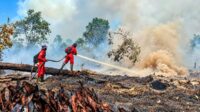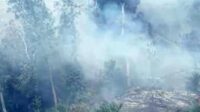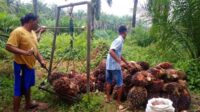


PALMOILMAGAZINE, JAKARTA – Forest and land fires (Karhutla) in Indonesia (Sumatra and Kalimantan) have led to a severe transboundary haze crisis across the ASEAN region, most notably Indonesia, Singapore, and Malaysia. The consequences are evident: worsening air pollution, respiratory health issues, school closures, flight cancellations, disruptions to tourism, and a range of other socio-economic impacts across these three nations.
It is just reasonable for people to ask who is responsible and what are the causes. However, it is not reasonable if the answer is locked to a single culprit: the palm oil industry. Such accusatory answer is frequently circulated across social media.
While many may readily accept such answer, others remain skeptical and consider alternative possibilities—seeking answers grounded in facts derived from field research.
Also Read: GAPKI Strengthens Forest and Land Fire Prevention, Expands Monitoring Around Palm Oil Concessions
It is undeniable that numerous industries are involved in forest clearing and management in Indonesia. Beyond the palm oil sector, this includes the forestry industry, various other types of plantations, agriculture, mining, and other economic activities.
Although satellite data may show numerous hotspots and burned areas within oil palm plantations, it is crucial to remember that correlation does not imply causation. The presence of fires within an oil palm plantation does not necessarily mean that the palm company is the party responsible for starting them.
Various factors could be at play. Fires might spread from outside a plantation concession, or they could originate from enclaves within a concession that remain under the control of local communities. In such scenarios, the palm oil companies themselves often end up as victims of the fires.
Fires can also result from human activities outside of plantations, with flames or embers carried by the wind into plantation areas—areas already highly susceptible to fire due to extreme drought, which has been further exacerbated this year by the super El Niño event. Other factors include technical limitations (such as sensor resolution) and intentional burning in the vicinity of plantations. Under Indonesian law, local communities are permitted to clear up to two hectares of land using fire—a practice rooted in “local wisdom” intended to support small-scale agriculture, as stipulated in Article 69 of Law No. 39/2009.
It has been suggested that this legal provision might be exploited by certain companies—both within and outside the palm oil sector. However, given the regulations enforced nationally by the Indonesian government, combined with the demands of a global market increasingly focused on sustainability principles—most notably the deforestation-free requirements under the EUDR (European Union Deforestation-free Regulation)—it is highly unlikely that palm oil companies would deliberately and openly clear new land by burning forests or vegetation.
At the national level, the Indonesian government has implemented a range of regulations that effectively prevent palm oil companies from clearing new land, whether through burning or other methods. These include a moratorium on new palm oil plantation permits, as well as regulations that prohibit companies from clearing forests via burning or causing environmental pollution. Furthermore, companies are mandated to implement fire prevention measures both within and outside their concession areas and to assist in firefighting efforts in the vicinity of their plantations.
BACA JUGA: Indonesian Smallholders Step Up Fire Patrols as Land Fires Spread
There are three laws that can be used to impose very severe sanctions on palm oil companies if they commit violations—such as clearing land by burning, causing environmental pollution, or operating a plantation without the required permits. These three laws are: Law No. 32/2009 on environmental pollution and degradation (specifically Article 88 regarding “strict liability”); Law No. 39/2014, which addresses violations in plantation operations, including the burning of forest and land areas; and Law No. 41/1999, which covers violations related to the utilization and management of forest areas. Fines imposed on companies found to be in violation of these laws can reach hundreds of billions of rupiah—an amount that could potentially exceed the total market value of the companies’ own assets.
Furthermore, Law No. 39/2014 on Plantations and Government Regulation (PP) No. 4/2001 on the control of environmental pollution require all palm oil companies operating in Indonesia to prevent Karhutla both within and outside their concessions.
According to data from Statistics Indonesia (BPS), there are 2,286 palm oil companies operating in Indonesia. These companies are affiliated with various industry organizations, including the Indonesian Palm Oil Association (IPOA – GAPKI).
Also Read: 84% of Indonesia’s September Fire Hotspots Found in Open-Access Areas, Expert Says
GAPKI itself, which has 751 member companies, issued “Guidelines for the Prevention and Control of karhutla in oil palm plantations” on April 30, 2020. Through these guidelines, GAPKI has urged its members to strengthen their capacity for preventing the karhutla. This capacity includes preparing logistics and firefighting teams; setting up facilities and infrastructure to support prevention efforts; activating the Karhutla Task Force; training personnel; coordinating with all stakeholders; assisting with firefighting efforts outside of plantation concession areas; and providing aid to communities affected by fires.
These guidelines assist GAPKI members in complying with government-enacted regulations and direct them toward meeting the sustainability principles increasingly demanded in the global market.
To gain access to global markets—particularly in Europe—palm oil companies are required to obtain sustainability certifications, such as ISPO or RSPO. Such certification can only be secured if companies comply with government regulations and implement agricultural best practices aligned with sustainability principles—specifically regarding traceability and deforestation-free production, as mandated by the European Union Deforestation-free Regulation (EUDR) for entry into the European market. The Indonesian government has required all palm oil companies to get the ISPO certification in stages in order to ensure access to the global market that is increasingly conscious of sustainability principles.
Also Read: RSPO Calls for Coordinated Response to Indonesia Fires to Protect Communities and Wildlife
The EU will begin enforcing the EUDR on December 30, 2026, for large and medium-sized enterprises, and on June 30, 2027, for smallholders.
Oil palm growers have increasingly recognized that the implementation of the EUDR signals an intensification of green challenges they face—a reality they have been aware of for decades, not just in recent years.
Since the 1990s, when palm oil commanded approximately 40 percent of the global market share, the industry has contended with both tariff and non-tariff barriers, particularly in European markets. The non-tariff barriers include policies that discriminate against palm oil. In the global market, palm oil’s primary competitors include soybean, rapeseed, and sunflower oils, among other vegetable oils.
Palm oil outperforms its competitors due to its superior efficiency, productivity, and versatility. From the same land area, oil palm can yield nearly eight times more oil than its competitors. Its high versatility makes it an essential ingredient in a vast array of consumer goods used daily. Having such unbeatable properties, palm oil outcompetes other vegetable oils in the global market. Attempting to surpass palm oil in the global market is akin to trying to defeat Lionel Messi on a soccer pitch—it is impossible to win unless one resorts to foul play.
This explains why the palm oil industry has become a target for negative campaigns from all sides. Any opportunity that can be exploited as a trigger is seized upon to launch negative campaigns against the industry—ranging from health, environmental, and socio-economic concerns—such as issues regarding gender and child labor—to various other topics. Decades ago, these negative campaigns were dominated by health-related claims. However, as these lacked scientific substantiation, the focus shifted to environmental issues. Many environmental allegations have also been proven scientifically unfounded. Perhaps this is why the scope of these negative campaigns has expanded to include social issues, such as gender and child labor.
As growers, we do not object to being accused of wrongdoing, provided that such accusations are based on facts and realities derived from rigorous field investigations. We therefore urge all parties to uphold the principles of honesty, fairness, and truth—grounded in the actual facts on the ground—while adhering to the principles of sustainability and science-based practices.
Also Read: IPOC 2026 to Strengthen Indonesia’s Palm Oil Strategy for Food, Energy and Economic Resilience
We recognize that many nations rely on palm oil to meet their vegetable oil needs, while other vegetable oils are also trying to access their markets. They depend on Indonesia, the world’s largest producer and exporter of palm oil. Within Indonesia itself, the palm oil industry plays a pivotal role in the national economy, contributing approximately US$20 billion annually and providing employment—directly and indirectly—to around 16 million people.
Taking all the aforementioned factors into account, we, as oil palm growers, support all efforts to conduct field research into the causes of the transboundary haze crisis that could be the basis for resolving the environmental problem for good, as well as all initiatives aimed at addressing the impacts resulting from this crisis. We stand ready to provide such support within the framework of national efforts led by the Indonesian government, as well as within a regional framework based on the ASEAN Agreement on Transboundary Haze Pollution, which was signed by the 11 ASEAN member states in 2002. (*)
By Eddy Martono, Chairman of IPOA (The Indonesian Palm Oil Association)