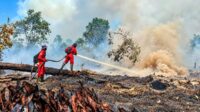
Indonesia recorded 28,692 hotspots in September 2026, with a forestry expert saying most were detected outside formally managed oil palm plantation areas, highlighting the need for stronger land governance and fire prevention.
PALMOILMAGAZINE, JAKARTA — Indonesia needs to shift its approach to forest and land fires from a predominantly enforcement-driven response toward stronger prevention and better land governance, experts said, arguing that unresolved social and economic conditions at the local level continue to fuel recurring fires.
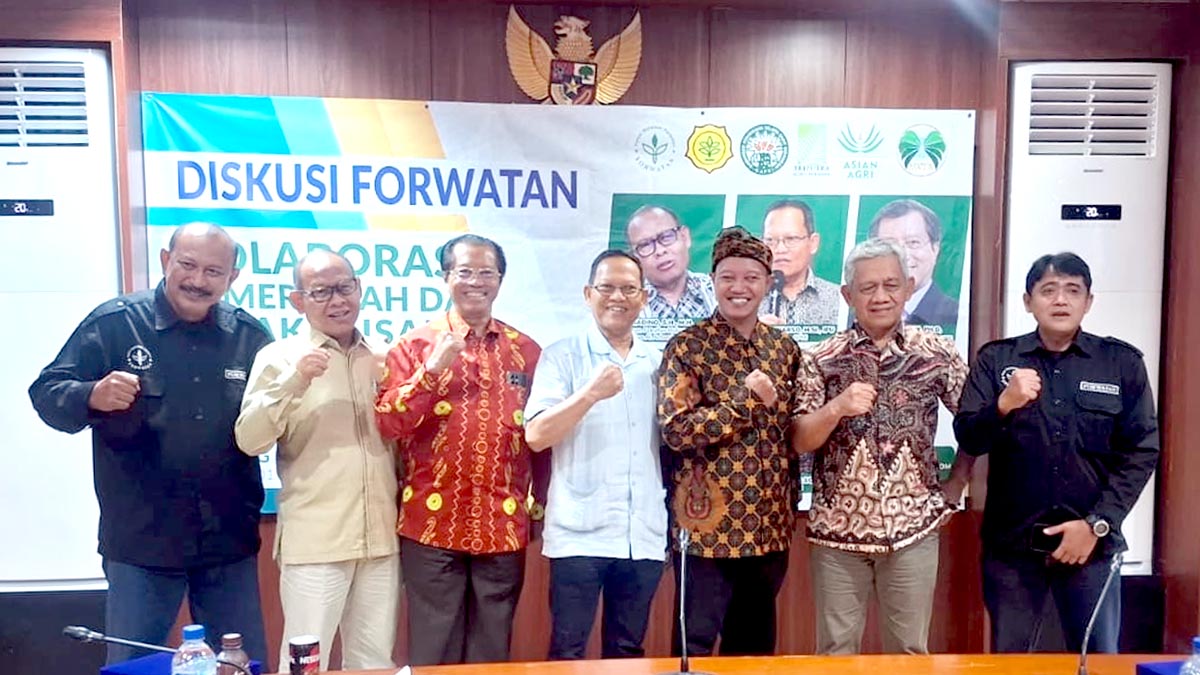
The issue was raised during a discussion organized by the Agricultural Journalists Forum (Forwatan) titled “Government and Business Collaboration in Tackling Forest and Land Fires” at the Ministry of Agriculture’s C Building in South Jakarta on Thursday (Oct. 1).
Also Read: APHI-GAPKI Urge Joint Protocol to Speed Up Forest and Land Fire Response
The discussion brought together five speakers: Soewarso, chairman of the Association of Indonesian Forest Concessionaires (APHI); forestry expert Dr. Petrus Gunarso; Hendratmojo Bagus Hudoro, director of Plantation Protection at the Ministry of Agriculture; Mukti Sardjono, executive director of the Indonesian Palm Oil Association (GAPKI); and Dr. Sadino, a legal expert from Al Azhar University Indonesia.
Hotspots Rise as Government Steps Up Response
Data from Sipongi, the Ministry of Forestry’s forest and land fire information system, recorded 28,692 hotspots between Sept. 1 and Sept. 30, 2026.
The five provinces with the highest number of detected hotspots were Central Kalimantan with 10,896, West Kalimantan with 3,969, South Sumatra with 3,506, South Papua with 1,396, and South Kalimantan with 1,073, according to Bagus.
Also Read: Desacralizing Local Wisdom to Mitigate Forest and Land Fires
He stressed that hotspots are indicators of elevated temperatures and must be verified on the ground before being classified as actual fires.
“Hotspots are indicators of high temperatures that require factual verification in the field through ground checks. They do not necessarily represent fire incidents. However, full vigilance remains necessary because plantation commodities are agronomically located on dry land and face higher risks as they enter the dry-season adaptation phase,” Bagus said at the event attended by PalmOilMagazine on Thursday.
Indonesia’s current forest and land fire response framework refers to Law No. 39/2014, Presidential Instruction No. 3/2020 and Agriculture Ministry Regulation No. 6/2025. Violations can carry criminal penalties of up to 10 years in prison and fines of up to IDR 10 billion.
Also Read: Indonesian Smallholders Step Up Fire Patrols as Land Fires Spread
The Ministry of Agriculture has also pursued preventive measures, including establishing 251 hectares of demonstration plots for land clearing without burning, forming Fire-Aware Farmer Groups in six high-risk provinces and requiring more than 2,000 plantation business permit holders to meet fire-prevention and response infrastructure standards.
Fires Linked to Land-Level Social and Economic Problems
Soewarso said forest and land fires should be viewed as an outcome of deeper problems at the local level rather than simply as isolated fire incidents.
“Forest and land fires are a consequence, not the main cause. The underlying problems are social and economic, including the use of fire for land clearing because it is considered the cheapest and fastest method, as well as traditional practices for pest control. In addition, many areas are open-access land or are occupied without clear spatial planning, making fire triggers difficult to control,” Soewarso said.
Also Read: RSPO Calls for Coordinated Response to Indonesia Fires to Protect Communities and Wildlife
To increase awareness of fire risks in areas managed by its members, APHI has issued a circular to its members and invited fire experts to conduct awareness programs and discussions on prevention and response measures.
84% of Hotspots in Non-Managed Areas
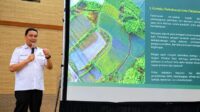
Forestry expert Petrus Gunarso presented a spatial analysis using Sipongi hotspot data alongside palm oil land-cover information and forest-area maps.
According to Petrus, the analysis showed that 84% of detected hotspots were located outside formally managed oil palm plantation areas, including areas classified as non-managed or open-access land.
His presentation indicated that the hotspots included areas categorized as conversion forests, accounting for 15%, protected forests at 10%, and other open areas. The remaining 16% of hotspots were detected within formally managed plantation areas.
Petrus contrasted the situation with Sarawak, Malaysia, where large-scale forest and land fires have been less prevalent, attributing the difference in part to clearer land ownership and more definitive spatial planning arrangements.
Legal Certainty and Industry Commitment
Legal expert Sadino said enforcement can become uneven when the principle of strict liability is applied without adequately accounting for geographical conditions or fires caused by outside parties.
He also raised concerns over civil lawsuits involving environmental damages worth trillions of rupiah, arguing that damage calculations do not always sufficiently distinguish between natural forests, industrial plantation forests and areas designated as Other Land Use Areas (Areal Penggunaan Lain, or APL).
Also Read: Riau Independent Smallholder FFB Prices Fall to IDR 3,866.97/kg for Sept. 30-Oct. 6
“Under criminal law, the maximum fine is IDR 10 billion and the maximum prison sentence is 10 years. But many civil lawsuits seek compensation worth trillions of rupiah, using mathematical calculations that treat APL plantation areas and virgin forests in the same way,” Sadino said.
“As a result, court decisions may sometimes be difficult to enforce or could push companies into bankruptcy when their assets are far below the value of the claims,” he added.
GAPKI Tightens Prevention Around Concessions
From the industry side, GAPKI Executive Director Mukti Sardjono said all 751 GAPKI member companies have met requirements for fire-prevention and disaster-response infrastructure and are taking steps to anticipate potential fire triggers in and around their operating areas.
GAPKI and its members are also working with the Ministry of Forestry, the Ministry of Environment, APHI and local government authorities on forest and land fire prevention and response, Mukti said.
Also Read: GAPKI Backs Inpres 11/2026, Calls for Stronger Collaboration to Prevent Forest and Land Fires
“So far, there have been no reports of fires entering and burning concession areas belonging to GAPKI members. We have tightened internal monitoring through regular written advisories and operational cooperation with the Ministry of Forestry and APHI in the field,” Mukti said.
“Fire does not recognize administrative boundaries, so prevention based on villages surrounding concession areas is our main focus,” he added. (P3)