

PT Danantara Sumberdaya Indonesia (DSI) is preparing to implement its export governance platform for palm oil and derivative products from January 1, 2027. The company expects its service fee to remain in the single-digit US dollar range, with the official tariff scheduled for announcement in December 2026.
PALMOILMAGAZINE, NUSA DUA – Indonesia’s new export governance framework for strategic commodities is entering its final preparation phase, with PT Danantara Sumberdaya Indonesia (DSI) confirming that export services for palm oil and its derivative products will begin operating through its platform on January 1, 2027, in accordance with government regulations.
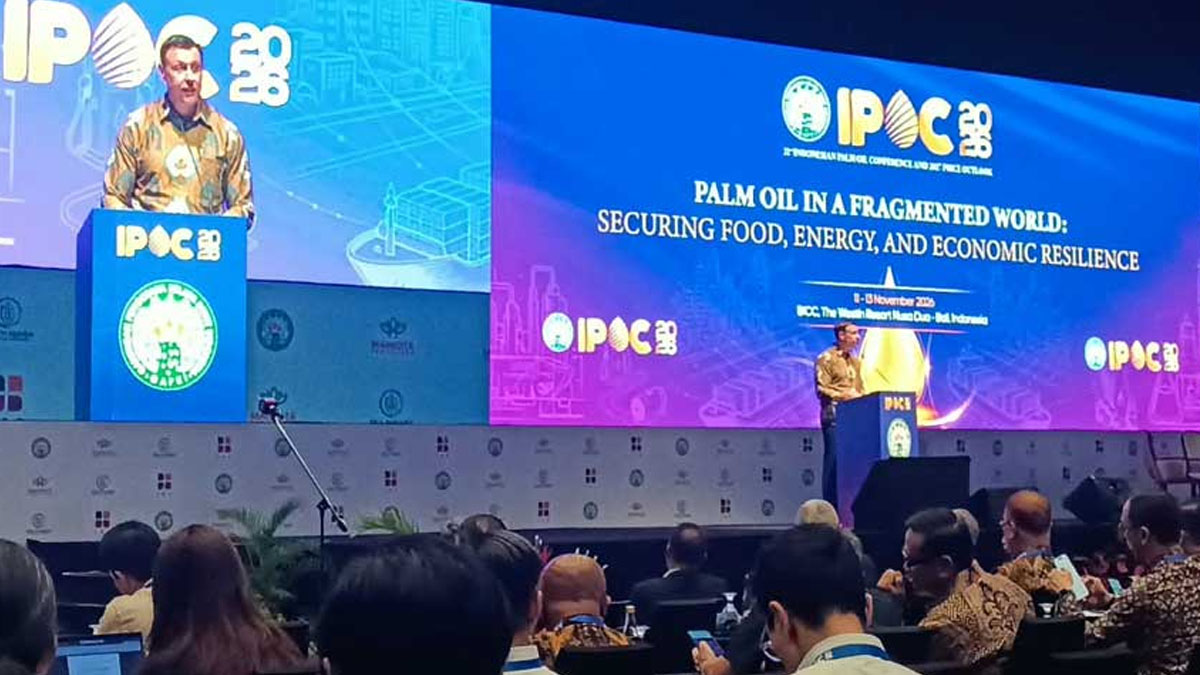
Luke Thomas Mahony, President Director of PT Danantara Sumberdaya Indonesia, outlined the implementation preparations during the 22nd Indonesian Palm Oil Conference and 2027 Price Outlook (IPOC 2026) in Nusa Dua, Bali.
Also Read: Indonesia’s DSI Says Single Export Gateway Will Strengthen Palm Oil Trade Ahead of 2027 Launch
He said that since the government policy was announced by President Prabowo Subianto in June 2026, DSI has been working with exporters to prepare the system, verify documentation, and conduct implementation trials.
According to Luke, industry stakeholders have raised several key concerns regarding the new framework, particularly service fees, processing speed, and the protection of companies’ commercially sensitive information.
Addressing the issue of costs, Luke said DSI would officially announce its service tariff in December 2026. However, he provided an initial indication that the fee is expected to remain in the single-digit US dollar range.
Also Read: DSI Strengthens Indonesia’s Strategic Commodity Export Ecosystem Through Pilot Platform
“We will announce the service fee in December. However, based on our current calculations, it will be in the single-digit US dollar range,” Luke said, as quoted by PalmOilMagazine from InfoSAWIT on Saturday (November 14, 2026).
He emphasized that providing clarity on service fees is essential to enable exporters to prepare their operations without facing additional uncertainty when the platform becomes operational.
Beyond costs, the protection of commercial information is another priority for DSI. Luke assured industry participants that company data submitted during the export verification process would be used strictly for verification purposes and treated confidentially.
Also Read: Oil World: Global Palm Oil Exports to Fall by Up to 3.5 Million Tons in 2027 as Prices Rise
“We respect data confidentiality and recognize the importance of individual transactions. Commercial information submitted to us will be used for export verification purposes and protected accordingly,” he said.
DSI Platform Will Not Change Exporter-Buyer Trade Relationships
Luke explained that DSI’s platform is not intended to replace existing trading arrangements between exporters and international buyers. Business relationships, physical product flows, and financing arrangements will continue under established trade practices.
Likewise, negotiations over prices, volumes, and product specifications will remain the responsibility of sellers and buyers. Indonesia’s Domestic Market Obligation (DMO) will also continue to follow existing government regulations.
Accordingly, DSI positions itself as an additional layer of governance and oversight rather than a replacement for existing market mechanisms.
Luke outlined three primary functions of the platform.
First, DSI will serve as a data integrator, connecting reporting and information systems across various government institutions to improve data visibility and traceability.
Second, it will act as a market enabler, facilitating coordination among the government, exporters, financial institutions, industry associations, including the Indonesian Palm Oil Association (GAPKI), and international buyers. This role is intended to help maintain trade continuity during the transition to the new system.
Third, DSI will function as a governance platform, developing systems and standards to support the long-term operation of oversight infrastructure for strategic commodity trading.
Luke said DSI had listened to feedback from GAPKI and its members, particularly regarding service costs, processing efficiency, and the protection of business information.
He added that dialogue with industry stakeholders would continue throughout the implementation process and after the system becomes operational.
DSI hopes the new framework will provide greater certainty for exporters while strengthening Indonesia’s position as a reliable supplier of palm oil in international markets.
“Our commitment is to make Indonesia’s palm oil trade more visible, more traceable, and more accountable. We want to build this system together with all industry stakeholders,” Luke concluded. (P2)