

Industry leaders call for stronger land governance, fire prevention, smallholder financing and investment strategies that translate sustainability commitments into measurable financial and commercial value.
PALMOILMAGAZINE, JAKARTA — Building a sustainable palm oil industry requires more than certification. Stronger land governance, integrated data systems, legal certainty and accessible financing are essential to expanding sustainable practices while reducing the risks of forest and land fires.
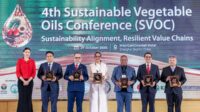
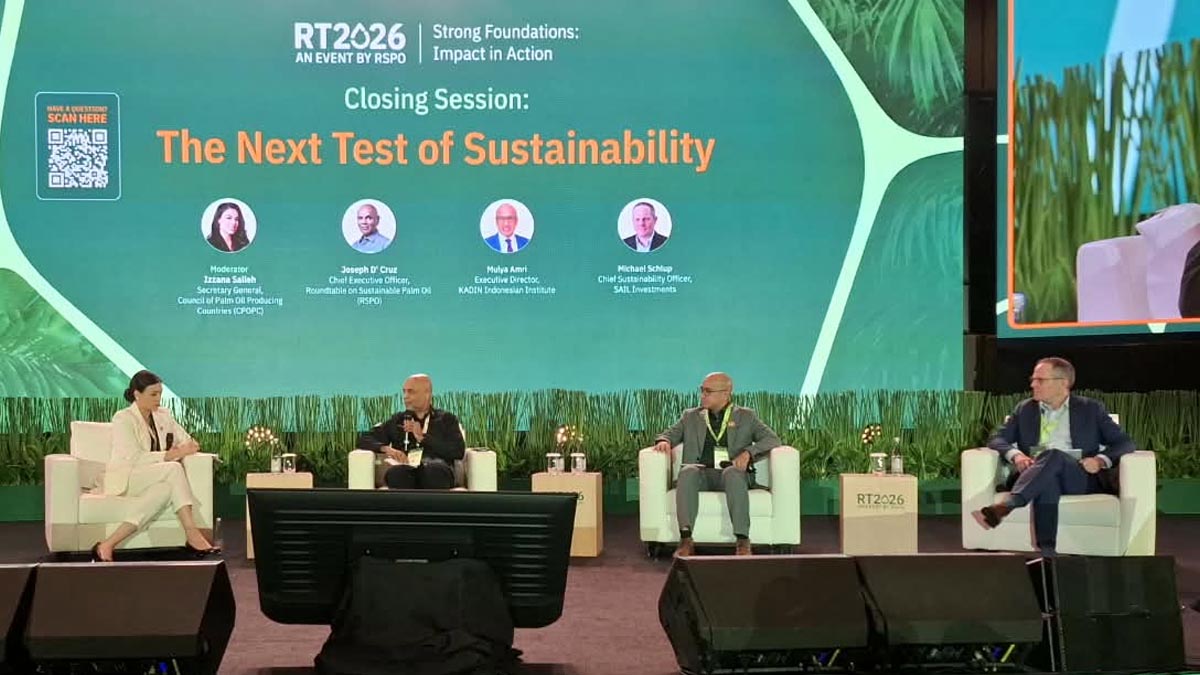
These priorities emerged during a session titled The Next Test of Sustainability at the Roundtable on Sustainable Palm Oil (RSPO) Conference 2026, held in Jakarta on Nov. 3–4, 2026. Representatives from the Council of Palm Oil Producing Countries (CPOPC), RSPO and the Indonesian Chamber of Commerce and Industry (Kadin Indonesia) emphasized the importance of collaboration among governments, businesses, financial institutions and communities in addressing the industry’s sustainability challenges.
Also Read: Zero Tolerance For Fires: RSPO Reinforces Strict Zero-Burning Standards
CPOPC Secretary-General Izzana Salleh stressed that sustainability must remain a central priority in developing the palm oil industry. Expanding sustainable practices, she said, requires the involvement of all stakeholders, including governments and financial institutions.
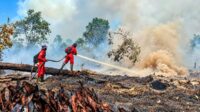
A similar position was expressed by RSPO CEO Joseph D’Cruz, who argued that forest and land fire management must rely more heavily on data and evidence. This would allow prevention measures and regulatory enforcement to focus on areas and issues that genuinely require attention.
D’Cruz said certified plantations operating in accordance with sustainability standards should not automatically be regarded as the source of fire-related problems. Instead, fire management efforts must be based on accurate identification of the underlying causes rather than narratives that encourage mutual blame.
Also Read: RSPO Strengthens Fire Monitoring in Indonesia with Satellite Data and Independent Audits
He also warned that the scale, severity and frequency of fire incidents could increase in the coming years.
“That is why RSPO is beginning to assess how our standards and requirements can adapt to address these risks,” he said during the session attended by PalmOilMagazine in Jakarta.
D’Cruz called for proven fire prevention practices to be expanded across entire landscapes. He said effective systems for reducing fire risks could be developed and implemented on a wider scale through cooperation among different stakeholders.
Also Read: Belayan Sejahtera Cooperative Mobilises Independent Smallholders to Prevent and Fight Forest Fires
He added that sustainability should not be viewed merely as a response to demands from buyers or external parties. Companies and communities have a direct interest in establishing protection systems that safeguard plantations, local communities, landscapes and the country from fire threats.
Land Governance and Financing Remain Key Challenges
Meanwhile, Mulya Amri, Executive Director of the Kadin Indonesia Institute, said strengthening sustainability requires complementary approaches from both the government and private sector.
He identified two approaches that must work together: a top-down approach through regulation and governance, and a bottom-up approach through incentives and disincentives.
Also Read: Indonesia Cuts November 2026 CPO Reference Price 6.07% to US$978.90/MT, Sets Export Duty at US$124
According to Mulya, several requirements under regulations such as the European Union Deforestation Regulation (EUDR) concern responsibilities that should primarily be addressed at the national level. These include land parcel mapping, clarity over land rights and the harmonization of spatial maps.
Indonesia still faces considerable challenges in integrating the various maps maintained by government ministries and agencies. The issue also involves aligning land ownership and tenure status across areas controlled by the state, individuals and customary communities.
When land data and legal certainty remain fragmented, the burden of meeting compliance requirements can shift to private-sector stakeholders, ranging from smallholders and plantation companies to commodity traders.
Also Read: Jambi FFB Prices Reach IDR 3,717.77/kg for 10–20-Year-Old Palms
Mulya therefore stressed that the government needs to strengthen land governance and legal certainty to ensure that certification and land legality verification processes can be implemented more fairly.
The private sector, meanwhile, can contribute by providing incentives and improving access to financing. One important example is financial support for oil palm replanting programmes.
According to Mulya, replanting is an effective way to reduce pressure to open new plantation areas. However, the process requires financial support because smallholders must manage a transition period during which newly planted oil palms have not yet begun producing fresh fruit bunches (FFB).
Beyond replanting finance, private-sector support could also be directed towards carbon trading mechanisms and peatland management initiatives.
Sustainability Needs to Become a Business Opportunity
From an investment perspective, Michael Schlup, Chief Sustainability Officer at SAIL Investments, said sustainability agendas need to be more closely connected to companies’ commercial interests.
Environmental and social risks, he argued, should be translated into measurable financial risks that corporate management teams and finance directors can understand and incorporate into business decisions.
Also Read: Ateng Sutisna Urges Transparency in Palm Oil Funds and Stronger Environmental Enforcement
Schlup emphasized the importance of communication between sustainability teams, chief financial officers (CFOs) and commercial departments. This approach would allow investments in sustainability transitions to be assessed based on their ability to reduce potential losses and generate economic value.
He explained that companies need to demonstrate how investments in sustainability systems can lower their exposure to risk. When the financial benefits can be quantified, sustainability initiatives become easier to recognize as part of corporate business strategies while also improving opportunities to secure financing.
Schlup also highlighted the importance of reliable data and transparency in supporting investment decisions, particularly those involving forest protection and fire risk management.
Also Read: TEI 2026 Opens Global Markets for Indonesian Palm Oil as BPDP Strengthens Downstreaming
Meanwhile, D’Cruz reminded participants that forest and land fires are not issues that can be addressed by a single country or business group alone. Fire risks can shift from one region to another, making collective awareness and long-term strategies essential.
He said public frustration over recurring fire incidents should be translated into deeper analysis of the underlying causes and practical solutions. Approaches based solely on assigning blame, he added, would not resolve the problem.
Collaboration among governments, companies, smallholders, financial institutions and communities will therefore be essential to expanding sustainable palm oil practices.
With stronger governance, economic incentives and data-driven decision-making, the palm oil industry is expected to be better positioned to address environmental challenges while responding to changing global market demands. (P2)