PALMOILMAGAZINE, JAKARTA – PTPN Group has reaffirmed its commitment to strengthening the palm oil industry as part of efforts to realize Indonesia’s Golden Vision 2045. The industry plays a strategic role in the national economy, significantly contributing to Gross Domestic Product (GDP), job creation, and exports to global markets.
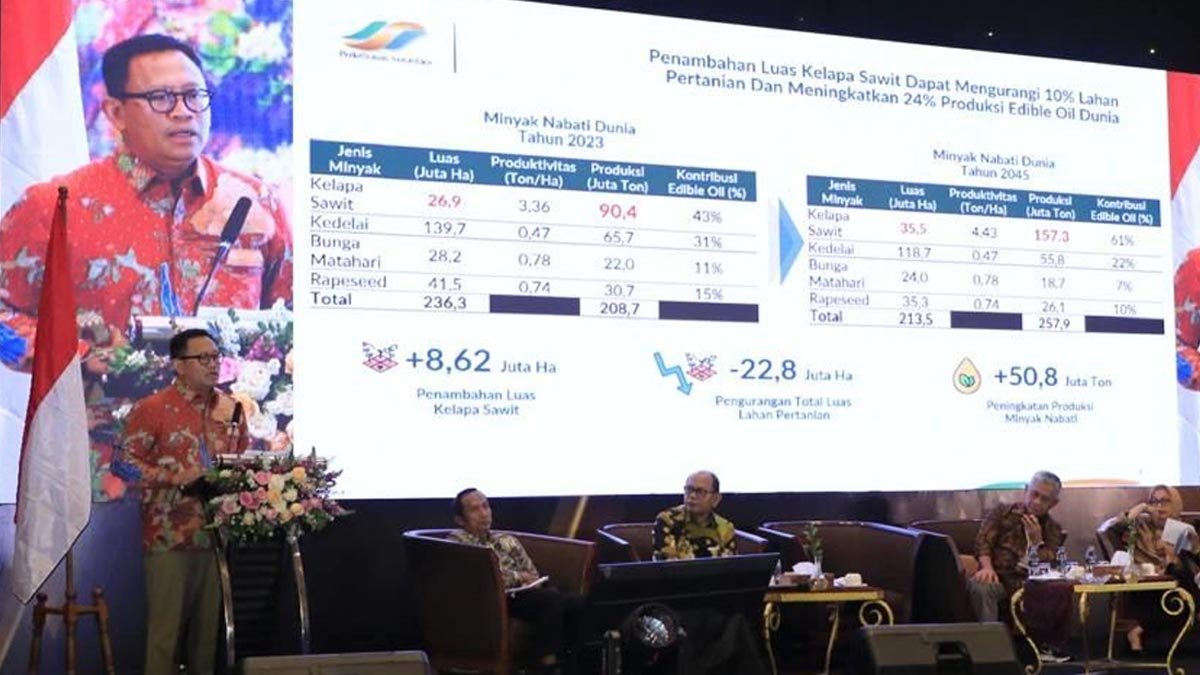
This commitment was highlighted in the National Seminar titled “The Strategic Role of Palm Oil Towards Indonesia’s Golden Vision 2045” held at The Sultan Hotel & Residence, Jakarta, on Monday (24/02/2025). The event was organized by Holding Perkebunan Nusantara PTPN III (Persero), PT Riset Perkebunan Nusantara (PT RPN), and the Palm Oil Agribusiness Strategic Policy Institute (PASPI).
Dwi Sutoro, Marketing Director of Holding Perkebunan Nusantara PTPN III (Persero), emphasized the vast potential of the palm oil sector in driving national economic growth. However, he also pointed out challenges such as environmental sustainability and industry governance efficiency.
Also Read:
“PTPN continues to strengthen the national palm oil industry by optimizing productivity, expanding downstream processing, and enhancing global market competitiveness. These efforts must be carried out with environmental and social considerations,” Dwi stated to Palmoilmagazine.com.
In line with Coordinating Ministerial Regulation No. 21 of 2022 and Presidential Regulation No. 40 of 2023, PTPN has been undergoing a transformation across various business lines. A key strategic move includes accelerating downstream food processing, targeting an increase in cooking oil production from 0.3 million tons to 1.1 million tons annually.
Additionally, the Smallholder Palm Oil Rejuvenation Program (PSR) has successfully rejuvenated 78,000 hectares of palm plantations. PTPN is also actively developing renewable energy through the utilization of biogas, Bio-CNG, biodiesel, and bioethanol as part of its sustainability initiatives.
Palm Oil as the World’s Leading Vegetable Oil
Dwi underscored that palm oil remains the world’s leading vegetable oil and must continue to be developed. He called on all stakeholders to establish a national palm oil management roadmap to enhance its global contribution.
PASPI Advisory Board Member, Prof. Bungaran Saragih, added that the government has set a national economic growth target of 8%. He believes that downstream processing in the palm oil industry is a key strategy to achieve this target.
“With agricultural downstream processing led by the palm oil industry, an 8% economic growth target is not just a dream. Palm oil must spearhead downstream development in the agricultural sector,” Bungaran stated.
Future Challenges and Strategies
Iman Yani Harahap, Director of PT Riset Perkebunan Nusantara (RPN), highlighted a major challenge ahead—how Indonesia can meet domestic demand while maintaining foreign exchange earnings from exports.
“We must strike a balance. Therefore, increasing palm oil productivity is the key,” Iman said.
Also Read: PTPN Holding Backs President Prabowo’s Food Self-Sufficiency with Upland Rice Initiatives
Echoing this, Puspita Suryaningtyas, a representative from the Food and Agriculture Directorate at the Ministry of National Development Planning (Bappenas), outlined that the palm oil industry will be driven through four key aspects in the 2025-2045 National Long-Term Development Plan (RPJPN).
These aspects include strengthening industrialization ecosystems to enhance palm oil sector efficiency, increasing production capacity to meet domestic needs, improving industry competitiveness to expand in global markets, and boosting export targets to maintain Indonesia’s position as a dominant player in the global palm oil industry.
With these strategies, the palm oil industry is expected to further contribute to national economic growth while solidifying its position in global markets through more sustainable and innovative approaches. (P3)