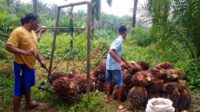
PALMOILMAGAZINE, JAKARTA – The implementation of traceability in Indonesia’s palm oil industry is becoming increasingly urgent amid rising global market demands, particularly from the European Union. However, significant challenges remain, especially at the smallholder level, which accounts for around 42 percent of the country’s total oil palm plantation area.
According to Windrawan Inantha, a researcher at the Strategic Advisor Center for Entrepreneurship, Change, and Third Sector (CECT) Sustainability at Universitas Trisakti, the weakest link in the palm oil supply chain lies with independent smallholders.
“In the context of traceability, smallholders represent the most vulnerable point in the supply chain,” he said, As quoted by Palmoilmagazine.com from Antara, Thursday, April 23, 2026.
Also Read: Smallholder Group Builds Service Center to Strengthen Palm Oil Farmers in Riau
Windrawan noted that traceability requirements have intensified following the enforcement of the EU Deforestation Regulation (EUDR), which mandates that palm oil products must be traceable down to their plantation origin and verified as deforestation-free.
He highlighted that the European Union’s evolving role—from merely a buyer to a key driver of global industry standards—requires Indonesia to adapt quickly. However, domestic market pressure remains relatively weak.
“Today, palm oil traceability is driven more by global market access requirements than by domestic consumer demand,” he explained.
In this context, the Badan Pengelola Dana Perkebunan (BPDP) is seen as not yet fully optimized in supporting traceability implementation, particularly at the farmer level.
Windrawan emphasized the need for policy adjustments to ensure BPDP programs better align with traceability readiness. He suggested that farmers who already possess legal documentation, such as the e-STDB (Cultivation Registration Certificate), should be prioritized for support.
“Policy incentives must be tangible at the farmer level, especially for those who already hold e-STDB or are in the process of obtaining legal status,” he stressed.
Also Read: GAPKI and the Government Strengthen National Preparedness to Mitigate Forest Fire Risks
Incentives and Infrastructure as Critical Enablers
A major barrier, he pointed out, is the lack of economic incentives for farmers who have begun adopting traceability standards. Without price differentiation or direct benefits, adoption is likely to remain slow.
“As long as traceable and non-traceable fresh fruit bunches are priced the same, change will be sluggish,” he said.
Beyond incentives, BPDP is also encouraged to strengthen data infrastructure at the smallholder level. This includes plantation mapping, training in geolocation technology, and the digitalization of farmer group administration.
Also Read: Indonesia’s Palm Oil Exports Hit US$3.69 Billion in February 2026, Up 28.88% YoY
Windrawan further underscored that land legality remains a key bottleneck in traceability implementation. Without clear land status, traceability systems cannot function effectively.
“As long as land legality remains unresolved, traceability data will lack integrity,” he noted.
He urged BPDP to intensify collaboration with relevant stakeholders, including the Ministry of Agrarian Affairs and Spatial Planning/National Land Agency (ATR/BPN), the Ministry of Forestry, local governments, and farmer organizations, to accelerate land legalization processes.
Also Read: Indonesia Moves Closer to B50 Rollout as Multi-Sector Trials Confirm Readiness
Additionally, BPDP is encouraged to facilitate incentive schemes such as purchase contracts or premium pricing for fresh fruit bunches sourced from traceable plantations. This, he argued, is essential to drive broader behavioral change among farmers.
While acknowledging BPDP’s initial steps in developing a WebGIS-based ISPO information system and mobile applications, Windrawan stressed that these efforts must be complemented by stronger policy backing and on-the-ground support.
“Without clear alignment toward smallholders—particularly through incentives and sustained assistance—the transformation toward full traceability will be difficult to achieve,” he concluded. (P2)