

PALMOILMAGAZINE, BOGOR — Astra Agro is calling for more region-specific research and stronger collaboration to tackle persistent threats from Ganoderma infections and rhinoceros beetle attacks, particularly in newly replanted oil palm plantations.
Pest and disease management remains a significant challenge for Indonesia’s palm oil industry, particularly in newly replanted areas where young oil palm trees are more vulnerable to biological threats. As the industry seeks to improve plantation productivity, strengthening crop protection research is becoming increasingly important to address evolving pest and disease pressures in the field.
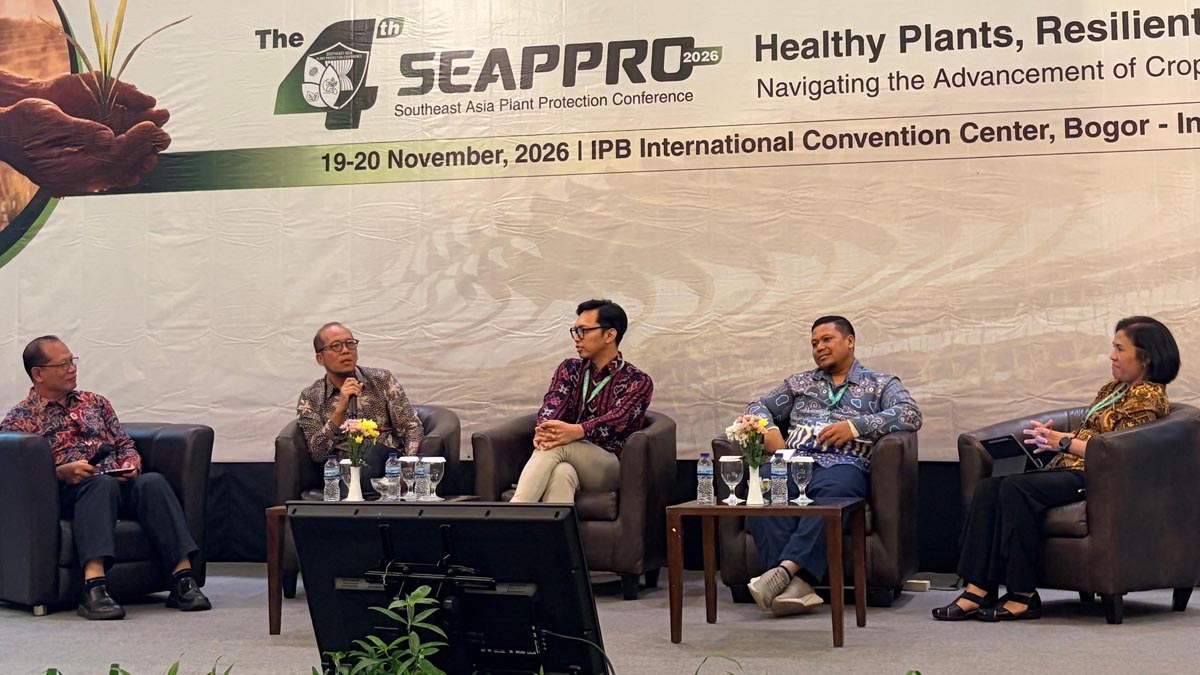
The issue was highlighted by Dr. Bandung Sahari, Director of PT Astra Agro Lestari Tbk, during a panel discussion at the Southeast Asia Plant Protection Conference (SEAPPRO) 2026, held at the IPB International Convention Centre in Bogor on Friday (Nov. 20).
Also Read: Astra Agro Lestari Granted RSPO Membership After Two-Year RSPO Assessment
Under the theme Trends in Oil Palm Pest and Disease Research, the discussion examined emerging threats to oil palm plantations and the role of research in maintaining crop health and supporting long-term productivity.
Bandung identified Ganoderma sp., the pathogen responsible for basal stem rot, as one of the industry’s major disease challenges. Meanwhile, Oryctes rhinoceros, commonly known as the rhinoceros beetle, continues to threaten young oil palm trees, particularly in replanting areas.
The risks are especially significant during the early stages of plantation development, when young palms remain vulnerable to pest attacks. Rhinoceros beetle infestations can damage the growing point, disrupting plant development and potentially causing tree mortality. Affected planting positions may subsequently require replacement planting, adding to plantation establishment costs.
Bandung said research into oil palm pests and diseases needs to become more targeted, taking into account regional characteristics and producing practical solutions that can be implemented at plantation level.
Geographical conditions, environmental factors and the types of plant pests and diseases vary across production areas, making a uniform management approach less effective.
“The palm oil industry can no longer be viewed simply on the scale of one or two hectares. It requires a landscape-based approach. Each region has its own characteristics and challenges, so pest and disease management must be adapted to the conditions of each area,” Bandung said in an official statement received by PalmOilMagazine on Friday (Nov. 20).
For Astra Agro, crop protection is a strategic priority as the company targets annual replanting of approximately 8,000 hectares. Protecting young palms from the early stages of growth is essential to ensure that replanting investments deliver optimal results and support plantation productivity over the long term.
The economic implications of pest attacks on young palms can also be substantial. A simulation of replacement planting requirements illustrates the potential financial burden associated with rhinoceros beetle infestations.
With an average planting density of approximately 140 palms per hectare, a 5% mortality rate would require around seven replacement palms per hectare. Assuming replacement costs of approximately IDR 75,000 per palm, covering seedlings, planting-hole preparation, labor and seedling transportation to plantation blocks, the additional expenditure across a replanting area of more than 8,000 hectares could reach billions of rupiah.
These estimates do not include potential losses resulting from delayed harvesting as replacement palms take time to establish and develop.
Meanwhile, basal stem rot caused by Ganoderma sp. continues to threaten fresh fruit bunch (FFB) production in oil palm-growing regions across Indonesia. The pathogen spreads through spores and hyphae, enabling infection to move between palms through root systems.
Despite decades of research, the industry has yet to develop a single technology or comprehensive approach capable of fully addressing Ganoderma infections. One of the strategies currently being pursued is the development of oil palm planting materials with improved resistance to the disease.
Also Read: Indonesia Targets Smallholder Palm Oil Productivity Gains Through GAP and Land Legalization
Although developing new varieties requires considerable time and research investment, Astra Agro has released three medium-resistant Ganoderma (MRG) varieties. The varieties are expected to provide better protection against the disease and help strengthen plantation resilience in the future.
Through its participation in SEAPPRO 2026, Astra Agro is also seeking to encourage knowledge exchange and closer collaboration among industry players, academics and research institutions.
Such cooperation is expected to accelerate the development of crop protection research that responds more directly to plantation-level challenges, strengthening the Indonesian palm oil industry’s ability to manage pest and disease risks while safeguarding long-term productivity. (P3)