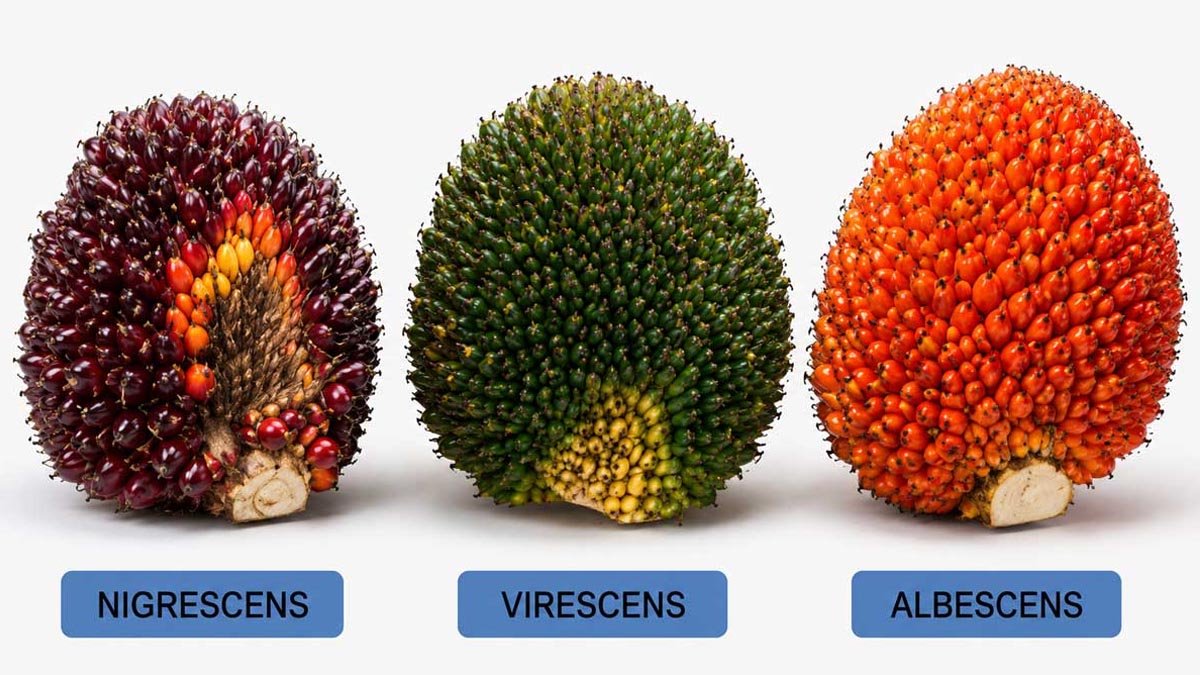
PALMOILMAGAZINE, JAKARTA – Differences in oil palm fruit color are often misunderstood in the field, leading some harvesters to incorrectly judge bunch maturity based solely on appearance. However, fruit color is primarily determined by genetics, not by tree age, fertilization practices, or environmental conditions, according to Herwin Butarbutar, a member of the Indonesian Planters Society (IPS).
“Many planters and harvesters still assume that every ripe oil palm fruit should turn red. That is a misconception because each palm inherits a specific fruit color type,” Herwin explained in a statement shared through the IPS WhatsApp Group on Tuesday (June 30, 2026).
He stressed that understanding fruit color genetics is essential to avoid harvesting bunches either too early or too late, both of which can reduce oil quality and plantation productivity.
Aslso Read: Riau Plasma Palm Fruit Prices Rise for July 1–7 Period, 9-Year-Old Trees Reach IDR 3,831.76/kg
Three Genetically Inherited Fruit Color Types
Herwin explained that oil palm fruit is generally classified into three fruit color types—Nigrescens, Virescens, and Albescens. These are not commercial seed varieties such as Socfindo DxP, Sriwijaya DxP, Topaz DxP, Dami Mas DxP, Lonsum DxP, or PPKS DxP. Instead, they simply describe how fruit color changes during the ripening process.
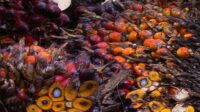
Nigrescens, the most common type, produces immature fruits that appear dark purple to nearly black because of high anthocyanin pigmentation. As the fruit ripens, the color gradually shifts to dark red or reddish-black, although the change is often subtle. For this reason, maturity is more accurately determined by the number of naturally detached loose fruits rather than color alone.
In contrast, Virescens palms produce green immature fruits due to high chlorophyll content. As ripening progresses, chlorophyll breaks down while carotenoid pigments become dominant, causing the fruit to change from green to yellow, orange, and eventually reddish-orange. The more noticeable color transition makes this type easier for harvesters to recognize.
The rarest type is Albescens, whose immature fruits appear ivory white or cream-colored because anthocyanin formation is minimal and chlorophyll levels are very low. As the fruit matures, carotenoids develop, turning the fruit yellow to orange. Because of this unusual appearance, ripe Albescens fruit is frequently mistaken for unripe fruit by workers unfamiliar with the characteristic.
Also Read: Palm Oil as a Renewable Natural Resource
Fruit Color Is Determined by Genetics
According to Herwin, the differences in fruit color originate from genes that regulate pigment formation in the fruit’s outer skin, or exocarp.
Anthocyanins are responsible for purple, dark red, and black coloration, making them dominant in Nigrescens fruit. Chlorophyll creates the green color found in young Virescens fruit, while carotenoids produce the yellow and orange hues that emerge during ripening across all fruit color types, although with varying intensity.
Also Read: BRIN Advances Pyrolysis Technology to Turn Oil Palm Empty Fruit Bunch Waste into Renewable Energy
Because these traits are genetically inherited, neither fertilizer application nor plantation management can change one fruit color type into another.
“No amount of fertilization can transform Nigrescens into Virescens or Albescens. Fertilizers improve plant growth, bunch size, yield, oil content, and overall tree health, but they do not alter genetically inherited fruit color,” he said.
Similarly, environmental factors—including soil type, rainfall, climate, and tree age—may influence the brightness or intensity of fruit color but cannot change the underlying fruit color type. A Nigrescens palm will remain Nigrescens throughout its life cycle, just as Virescens and Albescens retain their respective characteristics.
Also Read: Indonesia’s KPBN CPO Price Falls to IDR 15,485/kg on Friday as Malaysia Futures Extend Decline
Fruit Color Does Not Determine Oil Extraction Rate
Herwin also dismissed the assumption that one fruit color type naturally produces a higher Oil Extraction Rate (OER) than another.
“To date, there is no scientific evidence showing that Nigrescens, Virescens, or Albescens inherently delivers a higher OER than the others,” he said.
Instead, OER is influenced far more by the genetic quality of the planting material, the maturity of harvested bunches, crop management practices, plant health, the speed of fresh fruit bunch (FFB) processing at palm oil mills, and the quality of harvesting and grading operations.
As a result, if all three fruit color types originate from the same genetic variety, are harvested at the same maturity level, and processed under identical conditions, their oil extraction potential should be essentially the same.
Also Read: Indonesia’s Palm Oil Stocks Edge Lower as Biodiesel Consumption Accelerates
Do Not Confuse Fruit Color with Seed Variety
Herwin further reminded plantation workers not to confuse fruit color types with commercial seed varieties.
Seed varieties such as Socfindo DxP, Sriwijaya DxP, Topaz DxP, Dami Mas DxP, Lonsum DxP, and PPKS DxP determine important agronomic traits, including yield potential, oil extraction rate, growth performance, disease resistance, and environmental adaptability.
Also Read: IPB Professor: Sustainable Palm Oil Growth Depends on Intensification, Not Plantation Expansion
Fruit color types, on the other hand, merely describe the pattern of color development as the fruit matures.
To illustrate the distinction, Herwin compared fruit color to human skin color.
“Skin color is genetically determined from birth. Sunlight may make it appear lighter or darker, but it does not change the underlying genetic trait. The same principle applies to oil palm fruit,” he explained.
He concluded by emphasizing that harvesting decisions should always follow established plantation maturity standards—particularly the number of naturally detached loose fruits and other recognized ripeness indicators—rather than relying solely on fruit color.
“Fruit color is the plant’s genetic identity, while fruit maturity is its physiological condition. They are not the same. Understand the genetic identity, assess maturity correctly, and harvest according to standard procedures to maximize productivity and oil extraction,” Herwin said. (P2)