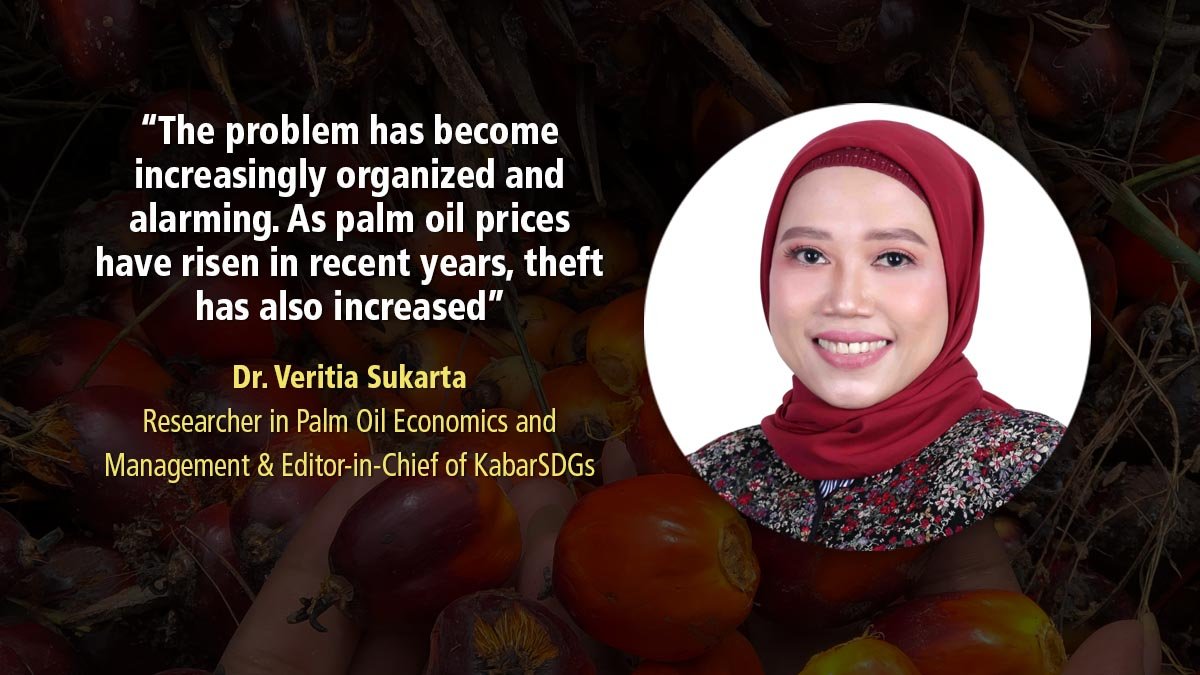
Dr. Veritia Sukarta
Researcher in Palm Oil Economics and Management & Editor-in-Chief of KabarSDGs
PALMOILMAGAZINE, JAKARTA – One of the most pressing challenges facing Indonesia’s oil palm plantation sector today, following ongoing debates over legal certainty and the activities of the Forest Area Enforcement Task Force (PKH), is the widespread theft of Fresh Fruit Bunches (FFB).
Unfortunately, in many industry and government forums, this phenomenon is almost always discussed solely from the perspectives of criminality, law enforcement, and physical security. Discussions rarely address the much broader, more fundamental, and structural issues of social governance at the village level.
FFB theft is not an isolated problem. Rather, it is a symptom of failures in production governance, particularly within the ecosystems of company-owned plantations and independent smallholders, as well as fragile social relationships between plantation companies and surrounding communities.
The problem has become increasingly organized and alarming. As palm oil prices have risen in recent years, theft has also increased. Assuming average losses from theft or looting amount to approximately 2% of total production, the potential economic loss reaches around IDR 12 trillion.
Table 1. Potential Losses from FFB Theft
| Item | Value |
| Total oil palm area (ha) | 16,300,000 |
| Company plantations | 58% |
| Smallholders | 42% |
| FFB yield (tons/year/ha) | 15 |
| Company production | 141,810,000 tons |
| Smallholder production | 102,690,000 tons |
| FFB price | IDR 2,500,000/ton |
| Company FFB value | IDR 354.525 trillion |
| Smallholder FFB value | IDR 256.725 trillion |
| Total value | IDR 611.250 trillion |
| Estimated average theft | 2% |
| Company losses | IDR 7.09 trillion |
| Smallholder losses | IDR 5.13 trillion |
| Total losses | IDR 12.23 trillion |
Source: Author’s calculations.
In certain areas where land ownership is fragmented and access is relatively open, losses can climb to 20–30%. Informal discussions with several plantation companies indicate that losses can even reach 50%, based on comparisons between potential and actual harvests.
The economic value lost through theft is enormous, and ironically, the greatest burden often falls on smallholder farmers.
For plantation companies and palm oil mills (POMs), FFB theft damages productivity and oil quality. One increasingly common practice involves the theft of loose fruits, which reduces the Oil Extraction Rate (OER) at mills.
Furthermore, stolen fruits are often harvested before reaching maturity, resulting in lower oil quality. Fear of theft also encourages farmers to harvest immature fruit prematurely in an attempt to prevent losses.
Also Read: BGA Strengthens Independent Smallholder Capacity in Ketapang Through Sustainable Palm Oil Training
Plantation Security Systems
According to Libert et al. (2024) in the Agroforetech Instiper Journal, plantation security systems generally consist of two approaches:
- Administrative Security Systems
- Technical Security Systems
Administrative measures include:
- Implementing harvest rotation schedules for smallholder plantations.
- Requiring permits for harvesting and transporting FFB, especially when using company roads.
- Applying stamps or markings to FFB to facilitate traceability and verification.
- Other administrative control mechanisms.
Technical security measures include:
- Constructing elephant trenches.
- Building security ditches.
- Installing gates and barriers at plantation access roads.
These measures aim to restrict unauthorized movement within plantation areas and along external boundaries.
However, conventional security approaches—including additional security personnel and law enforcement involvement—have proven insufficient to address the problem effectively.
Experience suggests that stronger farmer organizations and community development programs are essential. Many smallholder plantations remain scattered, poorly coordinated, and dependent on intermediaries or middlemen. As long as these supply chains remain unchanged, theft is likely to continue.
Also Read: Jambi FFB Prices Hold Steady for June 26–July 2, 2026 Pricing Period
Farmer Corporatization as a Strategic Solution
At this point, the concept of farmer corporatization becomes increasingly important.
Corporatization does not mean marginalizing or eliminating smallholders. Instead, it seeks to organize fragmented independent farmers into strong institutional structures such as cooperatives, farmer groups, or village-owned enterprises (BUMDes), functioning as collective economic entities.
Through stronger institutions, upstream and downstream challenges can be addressed systematically through three pillars of production governance.
- Good Agricultural Practices (GAP)
Collective organizations enable:
- Procurement of quality fertilizers.
- Better crop maintenance.
- Technical assistance from professional agronomists.
- More efficient and standardized farming practices.
Farmers no longer operate individually under uncertain cost structures, allowing them to reduce input costs and significantly improve productivity.
- Harvest and Labor Management
Corporatization facilitates:
- Scheduled harvesting systems.
- Trained harvesting workers.
- Mandatory uniforms.
- Identification cards.
These measures serve as both administrative and social controls, ensuring that authorized individuals harvest at designated times and locations. Such systems naturally reduce opportunities for theft.
- Logistics and Distribution Management
When all FFB sales are coordinated through a single entity, supply chains become transparent and traceable.
Village governments can implement transportation permits, delivery documentation, and joint monitoring systems involving village authorities and partner mills. This centralized system can be more effective in disrupting markets for stolen fruit than individual security measures by companies or farmers.
This becomes especially important in areas where nearby mills operate without their own plantations or specialize in processing loose fruits.
Beyond Production Governance: Social Sustainability
Strengthening production governance and farmer corporatization alone will not be sufficient if companies neglect the most fundamental aspect of business sustainability: fulfilling the social needs of surrounding communities.
Modern and sustainable conflict management requires a major transformation. Communities living near plantations should no longer be viewed as potential security threats but rather as active partners in safeguarding plantation operations.
Communities willingly become natural protectors of plantation businesses when they:
- Feel respected and valued.
- See a promising future alongside the company.
- Experience direct socioeconomic benefits.
- Face common social challenges such as drug abuse and rural crime.
The first pillar is strengthening plasma cooperatives and independent farmer organizations so that they operate transparently, fairly, and provide tangible economic benefits.
The second pillar focuses internally on company employees. Workers should no longer be viewed merely as production tools but as strategic partners.
Companies can foster emotional engagement programs that build a strong sense of ownership among employees. When workers feel respected, valued, and supported through adequate welfare and future opportunities, loyalty and commitment increase naturally.
Employees who possess a strong sense of ownership become the frontline defenders of company assets while reducing the risk of internal involvement in theft.
From Security Approach to Social Approach
The key to successful theft mitigation lies in a company’s consistency in maintaining social infrastructure and positive human relationships with surrounding communities and employees.
Rather than relying primarily on a repressive security approach, companies should shift toward a collaborative social approach.
This can be achieved by establishing and maintaining local dialogue institutions through which companies can proactively implement programs that address community needs, including:
- Employment opportunities for local youth.
- Contract opportunities for farmer organizations without intermediaries.
- Development of non-palm businesses supplying goods and services to companies and employees.
- Improvement of village infrastructure.
- Support for religious activities.
- Respect for local customs, culture, and indigenous wisdom.
A Strategic Issue in the Global Context
Today, social governance carries considerable strategic importance. Sustainability standards such as the Indonesian Sustainable Palm Oil (ISPO), the Roundtable on Sustainable Palm Oil (RSPO), NDPE (No Deforestation, No Peat, No Exploitation), and the EU Deforestation Regulation (EUDR) increasingly require evidence of harmonious social relationships and the absence of exploitation.
Therefore, strengthening social governance and farmer corporatization is no longer merely a tool for mitigating theft and social conflict. It has become a prerequisite for ensuring that Indonesia’s palm oil industry remains competitive and relevant within an increasingly sustainable global supply chain. (*)