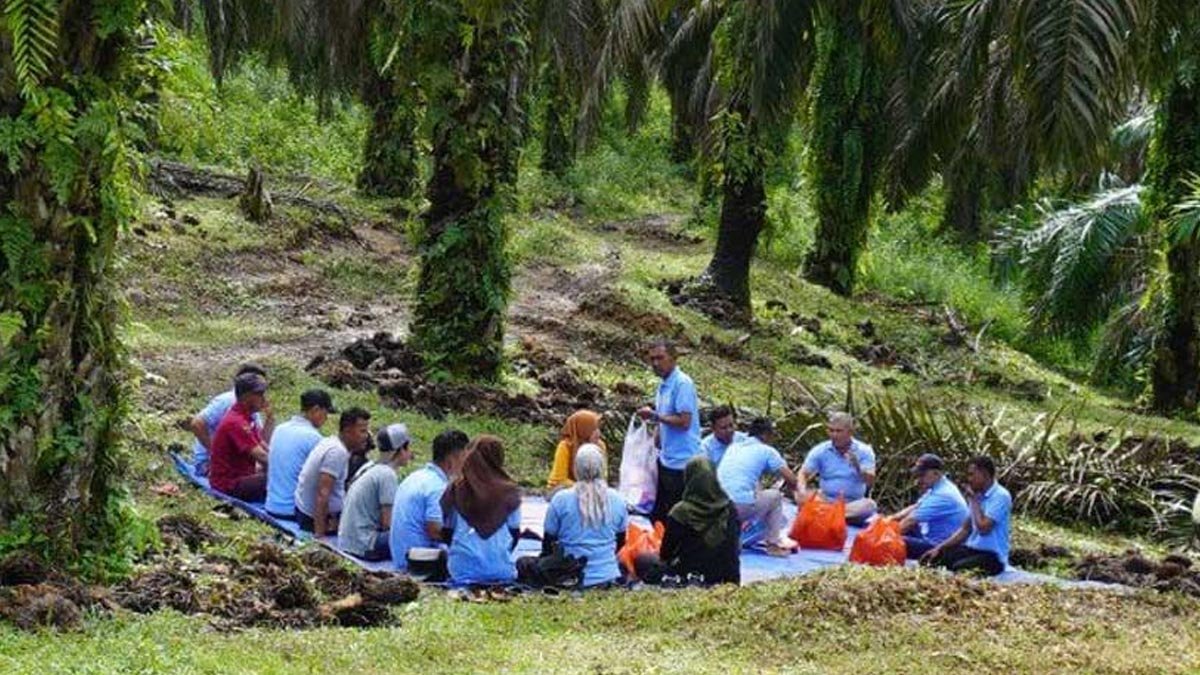
FORTASBI is calling for faster and simpler issuance of the Surat Tanda Daftar Budidaya (STDB), arguing that legal documentation—not farmers’ technical capacity—remains one of the biggest barriers preventing independent smallholders from accessing sustainability certification, government support and global markets.
PALMOILMAGAZINE, JAKARTA, INDONESIA — Efforts to bring more independent oil palm smallholders into sustainable production systems continue to face significant obstacles, with land and business legality emerging as one of the main barriers to certification.
The Indonesian Sustainable Palm Oil Smallholders Forum (FORTASBI) said the challenge is not primarily whether farmers can meet sustainability standards, but whether they can obtain the administrative and legal documentation required to enter certification schemes.
Also Read: FORTASBI Empowers Certified Smallholders as KUD Tani Subur Showcases RSPO Success Story
One of the most important documents is the Surat Tanda Daftar Budidaya (STDB), or Cultivation Registration Certificate, which serves as a key entry point for independent smallholders seeking access to sustainability certification, government programs and increasingly demanding international markets.
According to FORTASBI, the process for obtaining STDB still needs to be simplified and accelerated to make it more accessible to farmers across Indonesia.
The path toward sustainable palm oil certification remains challenging for independent smallholders. In addition to volatile commodity prices, rising production costs and the effects of climate change, farmers must participate in training programs and comply with a range of technical and administrative requirements.
Also Read: High Costs and Land Status Issues Hinder Smallholders’ Path to ISPO, Fortasbi Says
A study by the Center for Indonesian Policy Studies (CIPS) also highlighted the relatively low level of certification across Indonesia’s palm oil sector.
Under the Indonesian Sustainable Palm Oil (ISPO) scheme, certified plantations cover around 5.86 million hectares, or approximately 37% of Indonesia’s total oil palm area. Private companies account for about 84% of the certified area, followed by state-owned plantations at 9%, while independent smallholders contribute only around 7%.
Meanwhile, certification under the Roundtable on Sustainable Palm Oil (RSPO) covers approximately 2.6 million hectares, equivalent to about 16.6% of Indonesia’s total oil palm plantation area.
Also Read: KPBN CPO Price Rises to IDR 15,702/Kg on Aug. 11, 2026
FORTASBI Chairman Sutiyana said the low certification rate among independent smallholders is largely linked to institutional and governance issues rather than farmers’ ability to comply with technical requirements.
Based on FORTASBI’s experience in assisting smallholders, he said most farmers are capable of meeting certification standards and government regulations when they receive adequate guidance.
“The biggest challenge lies in institutional and governance issues at the regional level, particularly in administrative processes such as the issuance of STDB,” Sutiyana said, as quoted by PalmOilMagazine on Wednesday (August 12).
Also Read: Indonesian Palm Oil Farmers Reject Jambi Mill Moratorium Plan, Warn of Higher Costs
FORTASBI noted that although the government has introduced the electronic STDB, or e-STDB, system as part of efforts to digitalize administrative services, its implementation has not yet fully accelerated the process.
Farm data are often still collected manually before being verified and re-entered into the digital system by government officers, creating repetitive administrative procedures.
Limited budgets at regional governments have also constrained plantation mapping, field verification and administrative assistance for independent smallholders.
Also Read: Indonesia’s Palm Oil Exports Rise 7.32% in H1 2026, Supporting Trade Growth
Yet STDB serves a much broader role than simply providing business legality. The document can open access to government assistance programs, sustainability certification and markets that increasingly require supply chain traceability.
To accelerate the legalization of independent smallholders, FORTASBI has proposed several strategic measures, including expanding farmers’ access to the e-STDB system, strengthening the capacity of regional governments through additional funding and human resources, and increasing training and technical assistance.
Support is also needed for plantation mapping, including the collection and verification of farm coordinates, which remain essential components of the registration process.
Also Read: Vision AI Transforms Palm Oil Monitoring from Nursery to Harvest
FORTASBI further called for the optimization of the Palm Oil Revenue Sharing Fund (DBH Sawit) received by regional governments, with greater focus on administrative services, business legalization and smallholder assistance at the district and municipal levels.
The organization stressed that digitalization alone will not solve the problem unless it is accompanied by stronger institutional capacity.
By simplifying legal and administrative procedures, independent oil palm smallholders could gain wider access to sustainability certification, improve their competitiveness and strengthen Indonesia’s position in the global palm oil market. (P2)