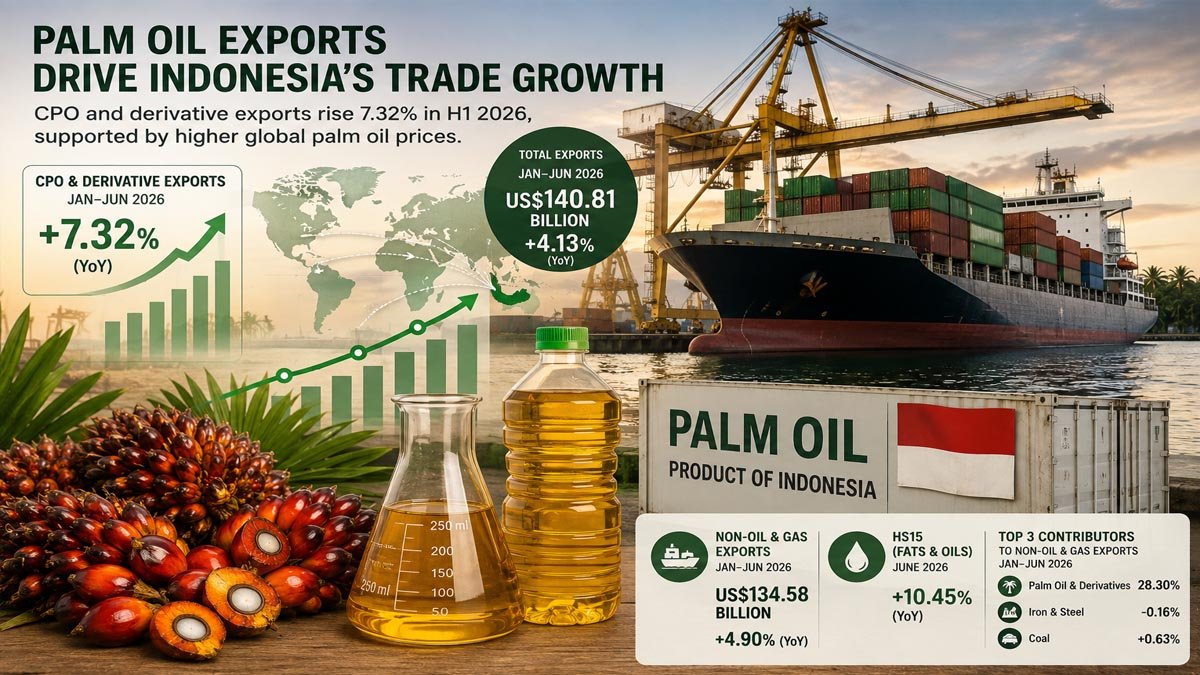
Higher global palm oil prices lifted Indonesia’s CPO and derivative exports by 7.32% in the first half of 2026, reinforcing palm oil’s role as a key contributor to national export growth.
PALMOILMAGAZINE, JAKARTA — Indonesia’s exports of crude palm oil (CPO) and its derivatives rose 7.32% in the first half of 2026 from a year earlier, supported by higher global palm oil prices and reinforcing the commodity’s role as one of the country’s main export growth drivers.
Ateng Hartono, Deputy for Distribution and Services Statistics at Statistics Indonesia (BPS), said stronger international CPO prices were a key factor behind the increase in export value.
Also Read: Indonesia Cuts August CPO Reference Price to USD 996.52/MT as Export Charges Adjust
“From January to June 2026, the export value of CPO and its derivatives grew 7.32% compared with the same period last year. Higher crude palm oil prices in the global market were among the factors supporting the increase,” Ateng said in BPS’ Official Statistics Report.
BPS data showed that exports of Indonesia’s agriculture, forestry and fisheries sector reached US$485.8 million in June 2026. Cumulatively, exports from the sector reached US$2.59 billion in January–June, up 1.84% from the first half of 2025.
Indonesia’s total exports reached US$140.81 billion in the first half of 2026, up 4.13% year on year. Non-oil and gas exports grew faster, rising 4.90% to US$134.58 billion.
Also Read: Indonesia Sets August Biodiesel Market Index Price at IDR14,924 per Liter
Within the non-oil and gas export basket, fats and oils of animal or vegetable origin under HS Code 15—which includes CPO and its derivatives—were among the main contributors to export growth.
In June alone, exports of HS15 products increased 10.45%, reflecting the strengthening trend in international palm oil prices.
BPS data also showed that CPO and its derivatives, together with iron and steel and coal, accounted for around 28.30% of Indonesia’s total non-oil and gas exports during January–June 2026.
Also Read: China GACC Audit Boosts Indonesia’s Palm Oil Export Prospects
Among the three commodities, palm oil recorded the strongest growth. Iron and steel exports declined 0.16%, while coal exports increased only 0.63%.
The performance highlights the continued importance of palm oil to Indonesia’s external trade, particularly as higher commodity prices boost export earnings.
Agriculture Minister Andi Amran Sulaiman said the export performance demonstrates the palm oil industry’s potential as a major source of foreign exchange for Indonesia. However, he said higher exports should be accompanied by stronger downstream development to generate greater value for the economy and improve smallholder welfare.
Also Read: Indonesia’s 50% DHE Policy Raises Liquidity Concerns for Palm Oil Industry
Amran said Indonesia still has significant room to strengthen its position as the world’s largest palm oil producer through the development of downstream industries.
“Indonesia is number one in the world. Indonesia and Malaysia together control around 80% of global CPO production. Therefore, downstream processing of CPO is a strategic weapon for Indonesia,” Amran said.
The Agriculture Ministry, he added, will continue to promote downstream investment so that Indonesia’s palm oil exports grow not only in volume and value but also through higher-value products that can strengthen the competitiveness of the national palm oil industry in global markets. (P2)