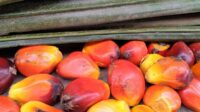
PALMOILMAGAZINE, JAMBI – Fresh fruit bunch (FFB) prices in Jambi remained largely stable during the June 26–July 2, 2026 pricing period, reflecting limited movements in the province’s palm oil market.
The Jambi provincial FFB pricing committee set the benchmark price for oil palm trees aged 10 to 20 years at IDR 3,708.55 per kilogram, representing a modest increase of only IDR 1.97 per kilogram from the previous pricing period.
According to data obtained by Palmoilmagazine.com from the Jambi Plantation Agency, FFB prices for three-year-old trees were set at IDR 2,891.63 per kilogram. Four-year-old plantations were priced at IDR 3,089.83 per kilogram, while five-year-old trees reached IDR 3,231.81 per kilogram.
Also Read: SPKS Urges Stronger BPDP Funding to Expand Palm Oil Certification and Boost Smallholder Productivity
Meanwhile, six-year-old trees were valued at IDR 3,366.70 per kilogram, seven-year-old plantations at IDR 3,451.62 per kilogram, and eight-year-old trees at IDR 3,525.23 per kilogram.
FFB from nine-year-old plantations was priced at IDR 3,594.51 per kilogram, while the key productive age category of 10 to 20 years reached IDR 3,708.55 per kilogram.
For older plantations, trees aged between 21 and 24 years were valued at IDR 3,595.81 per kilogram, while 25-year-old plantations received IDR 3,432.41 per kilogram.
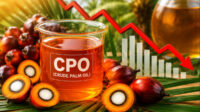
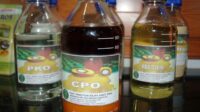
For the current pricing period, the reference crude palm oil (CPO) price was set at IDR 14,988.82 per kilogram, while palm kernel prices reached IDR 12,078.65 per kilogram. The K index was established at 94.64%.
The marginal increase in Jambi’s FFB prices indicates that the provincial market remains relatively stable despite ongoing fluctuations in domestic and international palm oil prices.
Also Read: FORTASBI Highlights Independent Smallholders’ Role in Emissions Reduction and Forest Conservation
Industry participants are closely monitoring developments in global CPO markets, as recent improvements in palm oil prices and Indonesia’s upcoming B50 biodiesel implementation could provide additional support to farmer prices in the coming weeks. (P2)