PALMOILMAGAZINE, JAKARTA – PT Citra Borneo Utama Tbk (CBUT), a downstream palm oil company controlled by PT Sawit Sumbermas Sarana Tbk (SSMS), reported improved financial performance during the first quarter of 2026, demonstrating the benefits of its integrated downstream business strategy amid a dynamic Indonesian palm oil market.
Backed by large-scale processing facilities and a diversified downstream portfolio, the company managed to increase profitability while maintaining stable sales performance. CBUT’s strategy to strengthen its palm oil value chain—from refining and fractionation to kernel crushing and packaged cooking oil production—has begun to generate positive results.
According to the company’s Public Expose presentation obtained by Palmoilmagazine.com on June 23, 2026, CBUT recorded sales of IDR 3.377 trillion in the first quarter of 2026. Despite relatively flat revenue growth compared with the same period last year, the company succeeded in significantly improving its profitability.
Also Read: STAA Joins RSPO as Sustainability Standards Become a Gateway to Global Palm Oil Markets
Operating profit reached IDR 89 billion during the January–March period, representing a 19.02% increase from IDR 75 billion in the first quarter of 2025. Net profit rose to IDR 45 billion from IDR 41 billion a year earlier, reflecting growth of 11.57%.
Historically, CBUT has maintained a strong growth trajectory. In 2025, the company generated sales of IDR 13.97 trillion, up 43.05% from IDR 9.77 trillion in 2024. Operating profit surged to IDR 366 billion from IDR 103 billion in the previous year, while net profit increased to IDR 106 billion from IDR 68 billion.
On the operational side, CBUT operates refinery and fractionation facilities with capacities of 2,500 tons per day each. These facilities provide annual production capacity of approximately 807,500 tons of Refined, Bleached and Deodorized Palm Oil (RBDPO), 646,000 tons of palm olein, 161,500 tons of palm stearin, and 38,250 tons of Palm Fatty Acid Distillate (PFAD).
Also Read: Indonesia to Launch B50 in July as Prabowo Pushes Palm Oil-Led Energy Transition
The company also runs a kernel crushing plant with a processing capacity of 600 tons per day, capable of producing 83,520 tons of Crude Palm Kernel Oil (CPKO) and 101,760 tons of Palm Kernel Expeller (PKE) annually.
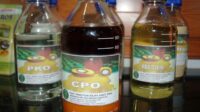
In the consumer segment, CBUT operates a moulding and filling facility with a capacity of 200 tons per day, producing packaged cooking oil under the Hanau and Minyakita brands, with combined annual capacity exceeding 68,000 tons.
During the first quarter of 2026, RBDPO production reached 578,928 metric tons, while sales volume totaled 799,999 metric tons. Palm olein production amounted to 467,921 metric tons, with sales volume reaching 476,457 metric tons. Palm stearin production stood at 101,320 metric tons, while sales reached 110,983 metric tons.
Also Read: KPBN CPO Price Rises 2.19% on June 24 as Malaysian Palm Oil Market Remains Under Pressure
PFAD production totaled 21,898 metric tons, with sales volume of 17,699 metric tons. Meanwhile, packaged cooking oil production reached 9,166 metric tons, with sales volume of 8,870 metric tons.
CBUT’s balance sheet also showed improving financial health. As of the end of the first quarter of 2026, total assets stood at IDR 4.035 trillion, while liabilities declined to IDR 2.870 trillion. Equity increased to IDR 1.164 trillion, compared with IDR 1.110 trillion at the end of 2025.
The combination of higher equity and lower liabilities indicates stronger financial fundamentals. Supported by raw material supplies from the SSMS group and a growing focus on value-added products, CBUT is considered well positioned to capitalize on the expanding opportunities in Indonesia’s downstream palm oil industry, driven by rising domestic consumption and export demand. (P2)