Commercializing Indonesia’s abundant oil palm biomass is no longer simply a question of technology. The greater challenge lies in building profitable business models, efficient supply chains, and sustainable plantation management that preserves long-term soil health while creating new sources of economic value.
PALMOILMAGAZINE, JAKARTA — Converting Indonesia’s vast oil palm biomass resources into commercially viable renewable energy and bio-based products will require far more than abundant feedstock, according to Dimas H. Pamungkas, Senior Researcher at the Indonesian Palm Oil Strategic Studies (IPOSS). He argues that investment-ready business models, efficient logistics, and careful management of soil fertility will determine whether biomass can become a new engine of green economic growth.
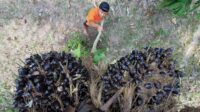
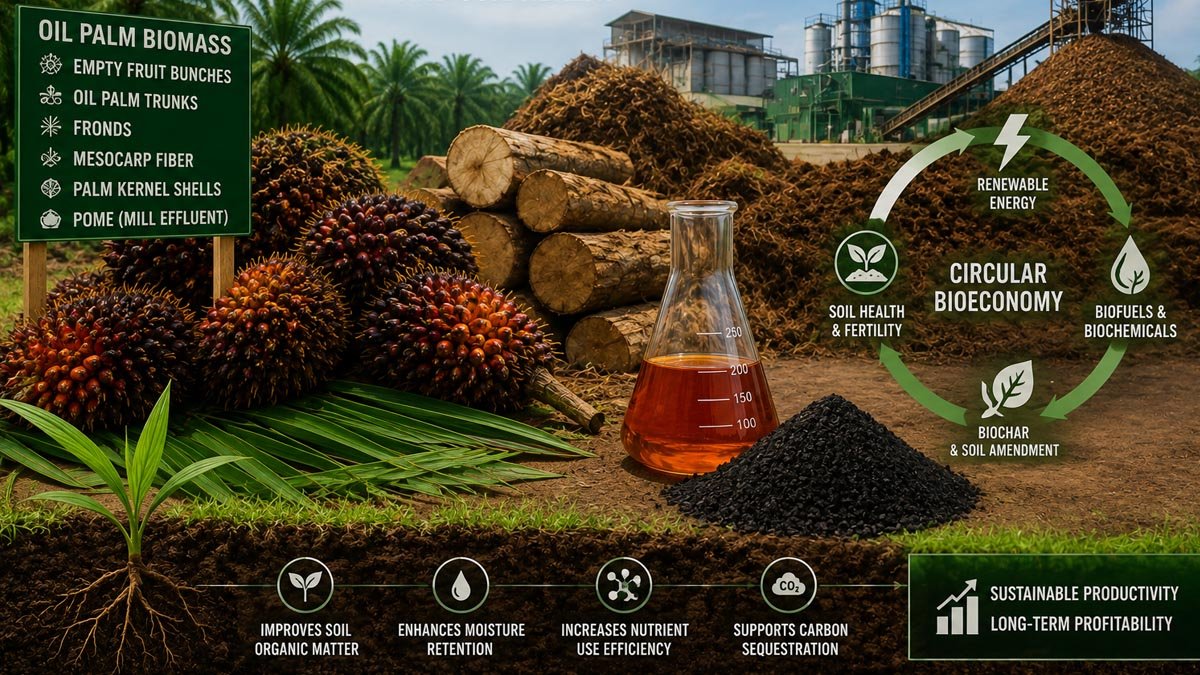
Indonesia produces millions of tonnes of oil palm biomass every year, including empty fruit bunches (EFB), trunks, fronds, fibers, shells, and palm oil mill residues. While these materials offer significant potential for renewable energy, sustainable aviation fuel (SAF), biochar, and other high-value bio-based products, much of the resource remains underutilized.
Also Read: EU Exempts Palm Oil Waste from EUDR, Creating New Opportunities for Circular Economy Growth
As the global palm oil industry accelerates its transition toward sustainability and a circular economy, the focus is expanding beyond crude palm oil (CPO) production. Increasingly, attention is turning to how biomass can generate new revenue streams without compromising the long-term productivity of oil palm plantations.
In an article shared with PalmOilMagazine on Wednesday (August 5), Dimas notes that abundant biomass alone does not guarantee successful commercialization.
“Biomass abundance does not automatically translate into commercial availability.”
Also Read: Can Indonesia’s Oil Palm Residues Power the Future of Aviation?
According to Dimas, commercially viable biomass projects require far more than sufficient feedstock. Investors also seek reliable raw material supply, efficient logistics, proven conversion technologies, competitive production costs, and secure long-term markets. In practice, transportation costs and the dispersed nature of plantations often reduce the volume of biomass that can be collected economically.
Balancing Commercial Value with Soil Health
While commercial viability remains essential, Dimas emphasizes that biomass also performs vital ecological functions within oil palm plantations. Removing excessive amounts without replacing those functions could gradually reduce soil organic matter, nutrient availability, moisture retention, and ultimately long-term plantation productivity.
This presents one of the industry’s most important sustainability challenges: how can biomass create additional economic value while preserving the health of the soils that sustain future palm oil production?
Rather than viewing biomass solely as industrial feedstock, Dimas argues that utilization strategies should integrate carbon balance, nutrient recycling, and soil conservation into overall plantation management.
Also Read: Closing the Biomethane Loop: Why POME Must Become Part of Indonesia’s Energy Strategy
Conventional Practices Face Practical Constraints
Returning empty fruit bunches (EFB) to plantations remains one of the industry’s most common approaches to improving soil quality. However, Dimas says logistical limitations and scale reduce its overall effectiveness.
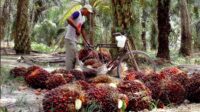
A plantation producing around 20 tonnes of fresh fruit bunches (FFB) per hectare annually generates only about 4.5 tonnes of EFB. At recommended application rates, biomass from nearly nine hectares of production would be required to treat just one hectare, making widespread application both operationally and economically challenging.
Similarly, retaining chipped oil palm trunks during replanting helps recycle nutrients and organic matter back into the soil. However, this practice can also delay field preparation, increase the risk of pests such as Oryctes rhinoceros, and limit opportunities to recover higher-value products from cellulose, fibers, and fermentable sap.
Biochar Offers a Promising Alternative
Among the technologies discussed, Dimas identifies pyrolysis as one of the most promising pathways for balancing biomass utilization with environmental sustainability.
Through controlled heating in a low-oxygen environment, biomass can be converted into biochar, renewable gases, and bio-oil. Properly produced biochar can stabilize carbon, improve soil moisture retention, increase nutrient-use efficiency, and enhance cation exchange capacity. It is also lighter, easier to transport, and less susceptible to pest infestation than untreated biomass.
Nevertheless, Dimas cautions that biochar is not a universal solution. Commercial success will depend on feedstock preparation, processing costs, technology performance, plant scale, and the ability to maximize value from co-products.
Also Read: BPDP Chief: Palm Oil Research Must Deliver Real Innovation for Farmers and Industry
From Research to Commercial Scale
According to Dimas, the industry’s next challenge is no longer demonstrating that biomass technologies work in research settings, but proving they can succeed under commercial operating conditions.
Achieving that goal will require coordinated investment, reliable feedstock supply chains, supportive regulations, robust carbon accounting, and continuous monitoring of soil health and plantation productivity.
If these challenges can be addressed, oil palm biomass could evolve into an entirely new value chain supporting renewable energy, sustainable aviation fuel, carbon markets, bio-based materials, and green finance—strengthening Indonesia’s position in the global bioeconomy.
Also Read: Airlangga: Research and Downstream Innovation Will Shape the Future of Indonesia’s Palm Oil Industry
Yet Dimas stresses that commercial success should never come at the expense of long-term plantation sustainability.
“The challenge is ensuring that biomass commercialization does not become circular extraction.”
Removing valuable biomass without adequately returning carbon, nutrients, and other ecological functions to plantation soils would ultimately undermine the very resource base that supports Indonesia’s palm oil industry.
Whether Indonesia can transform its abundant biomass into a competitive green industry while safeguarding soil fertility may ultimately determine the next phase of sustainable palm oil development. This balance between economic opportunity and ecological stewardship is likely to shape the sector’s long-term competitiveness in an increasingly sustainability-driven global market. (P3)