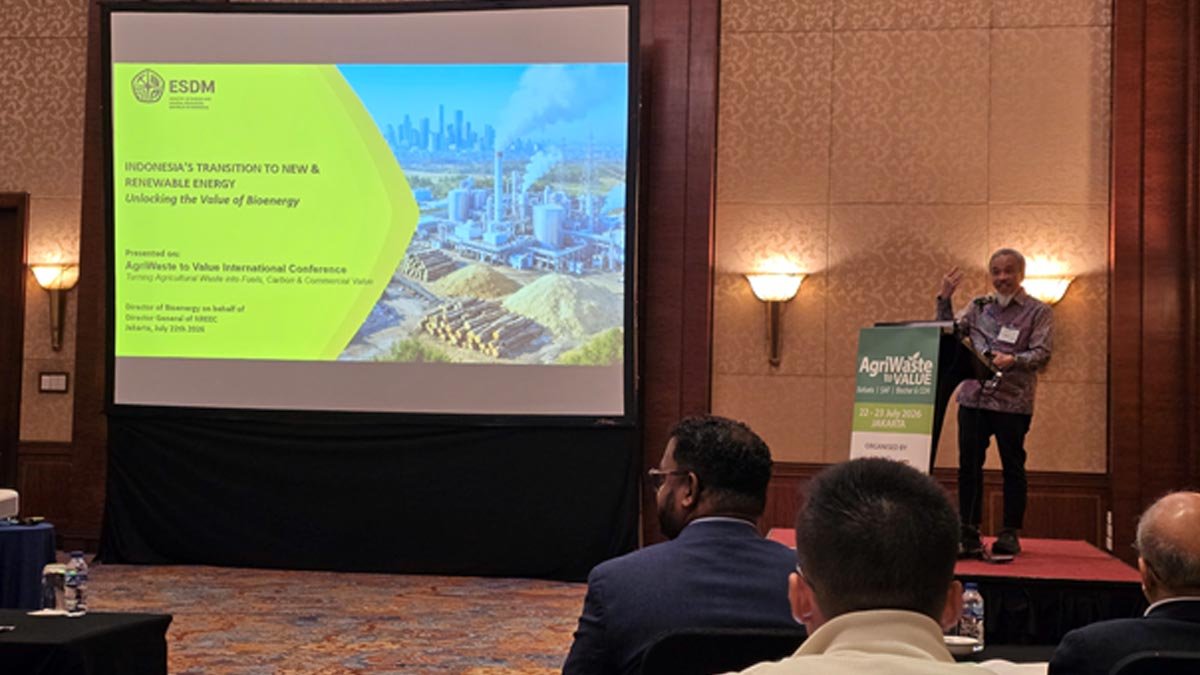
PALMOILMAGAZINE, JAKARTA – Palm oil mill effluent, or POME, is commonly treated as a wastewater problem. During the AgriWaste to Value Conference at the JW Marriott Hotel Jakarta, 22-23 July 2026, however, Dr. M. Windrawan Inantha argued that this view is too narrow. POME is also a major source of methane emissions and, if properly captured and upgraded, a potentially valuable source of biomethane.
According to information received by Palmoilmagazine.com on Friday (July 2), Dr. Windrawan chaired the conference session on sustainable aviation fuel and feedstock realities, bringing together industry and technical perspectives on how agricultural residues can move from theoretical potential to commercially viable energy supply. In an interview during the conference, he said the same reality check must now be applied to POME.
“POME should no longer be seen only as an environmental liability at the back of the mill. It is a concentrated source of methane, and that methane can become useful energy. The opportunity is to prevent emissions and create value at the same time.”
A large and concentrated emissions source
An indicative assessment of Indonesia’s 2024 palm oil residue streams estimates annual POME generation at around 120 million to 181 million cubic metres, with a central estimate of approximately 144.5 million cubic metres. The estimate is based on crude palm oil production of 48.16 million tonnes and a POME generation factor of 2.5 to 3.75 cubic metres per tonne of CPO.
POME contains a high organic load. When it decomposes anaerobically in open or uncovered ponds, it produces biogas containing methane. If that gas is released directly into the atmosphere, the mill loses a usable fuel while adding a potent greenhouse gas to its emissions profile.
“The key advantage is that POME methane is generated at a fixed industrial location. It is not a diffuse emission spread across a landscape. That makes it measurable, technically recoverable and, in principle, financeable.”
Methane capture can begin with covered lagoons or digesters. The resulting biogas can be used on-site for heat or electricity. With additional cleaning and upgrading to remove carbon dioxide, hydrogen sulphide, moisture and other impurities, it can be converted into biomethane with properties similar to conventional natural gas.
Closing the biomethane loop
A demand-side presentation at the conference projected that biomethane demand in Southeast Asia could grow from roughly 1 TWh in 2025 to about 32–55 TWh by 2040. Malaysia, Indonesia and Singapore are expected to form the core of this market, with demand driven by maritime transport, hard-to-abate industries, power generation and data centres.
For Dr. Windrawan, this is where the phrase “closing the biomethane loop” becomes important. Capturing methane at the mill is only the first step. A functioning market must connect feedstock, technology, certification, logistics, buyers and finance.
“We already know how to produce biogas from POME. The unresolved question is how to connect hundreds of dispersed mills with reliable buyers. The loop is only closed when the gas is captured, upgraded, certified, transported and purchased under a bankable contract.”
Industrial users could replace part of their fossil gas consumption with biomethane for process heat. Power producers could use it in gas-fired generation. Maritime users could potentially access renewable gas in compressed or liquefied form. Data-centre operators, facing pressure to secure dependable low-carbon energy, may also emerge as large and creditworthy buyers.
Also Read: Unila and South Korea’s Naysor Collaborate on Low-Ash Palm Biomass Pellets for Green Energy
Why projects remain difficult to finance
The conference discussion highlighted three persistent barriers: infrastructure and aggregation gaps, uncertain offtake, and limited regulatory clarity. These constraints reinforce one another. A mill may be reluctant to invest in upgrading equipment without a committed buyer, while a buyer may hesitate without proof of volume, quality and environmental integrity.
Many existing methane-capture projects therefore remain focused on immediate on-site energy use. This can reduce electricity or fuel costs, but it does not always provide enough revenue to justify gas upgrading, compression, storage or transport infrastructure.
“The business case cannot rely on technology alone. Investors need secure demand, credible monitoring and clear ownership of the green attributes. Without those elements, even a technically sound project may remain unbankable.”
Also Read:Indonesia’s Oil Palm Biomass: A Renewable Energy Opportunity
Three possible revenue routes
The conference identified three broad monetisation routes. First, suppliers can sell biomethane molecules through pipelines, compressed-gas transport or liquefied bio-LNG, supported by proof of sustainability or a guarantee-of-origin system. Second, captured gas can be converted into renewable electricity and sold together with eligible renewable-energy certificates. Third, avoided methane emissions may create carbon value, provided that additionality, baseline, monitoring and double-counting requirements are met.
Dr. Windrawan cautioned that these attributes cannot simply be stacked without rules. The same environmental benefit must not be sold more than once.
“The integrity of the claim is as important as the energy itself. A buyer must know where the POME came from, how much methane was captured, who owns the renewable attribute and whether the same reduction has already been claimed elsewhere.”
Also Read: Alleged POME Fraud in Indonesia Raises Red Flags Across Global Biofuel Supply Chains
What Indonesia should do next
Indonesia has signalled support for renewable gas within its broader energy policy, but a dedicated operational framework for biomethane is still needed. Dr. Windrawan proposed beginning with a national POME methane baseline that maps mills, pond systems, current capture facilities, gas potential and distance to major energy users.
He also recommended developing regional biomethane hubs rather than expecting every mill to build a complete standalone supply chain. Mills located near industrial estates, gas infrastructure, ports or major transport corridors could aggregate volumes and share upgrading, compression, storage and distribution facilities.
“Indonesia should think in clusters. One mill may not produce enough upgraded gas to justify export infrastructure, but several mills in the same region can create scale, improve supply security and lower the cost per unit.”
A further priority is standardisation. Buyers and financiers need clear rules on lifecycle emissions, chain of custody, monitoring, reporting and verification, proof of sustainability and the transfer of green attributes. Long-term offtake contracts, demand aggregation or other price-support mechanisms could then help convert technical potential into investable projects.
Also Read: ICAO Officially Approves POME as a Certified Feedstock for Sustainable Aviation Fuel
A practical sustainability test for the palm oil sector
POME biomethane offers the palm oil industry an opportunity to demonstrate measurable climate action at mill level. The feedstock already exists, the emissions are concentrated and the technology is commercially understood. The challenge is now institutional and commercial rather than purely technical.
“The palm oil sector is often asked to show where sustainability creates real, measurable outcomes. Capturing POME methane is one of the clearest examples. It can reduce emissions today, supply renewable energy and create a new revenue stream from something that was previously treated as waste.”
The opportunity extends beyond individual mills. If Indonesia can build credible certification, aggregation and cross-border trading systems, POME-derived biomethane could become part of a regional renewable-gas market linking palm oil-producing areas with industrial centres, ports and the rapidly expanding digital economy.
“The strategic question is no longer whether POME can produce biogas,” he concluded. “The question is whether Indonesia can organise the market. If we can do that, we will turn a major emissions source into a domestic energy resource and potentially a regional export product.” (P3)