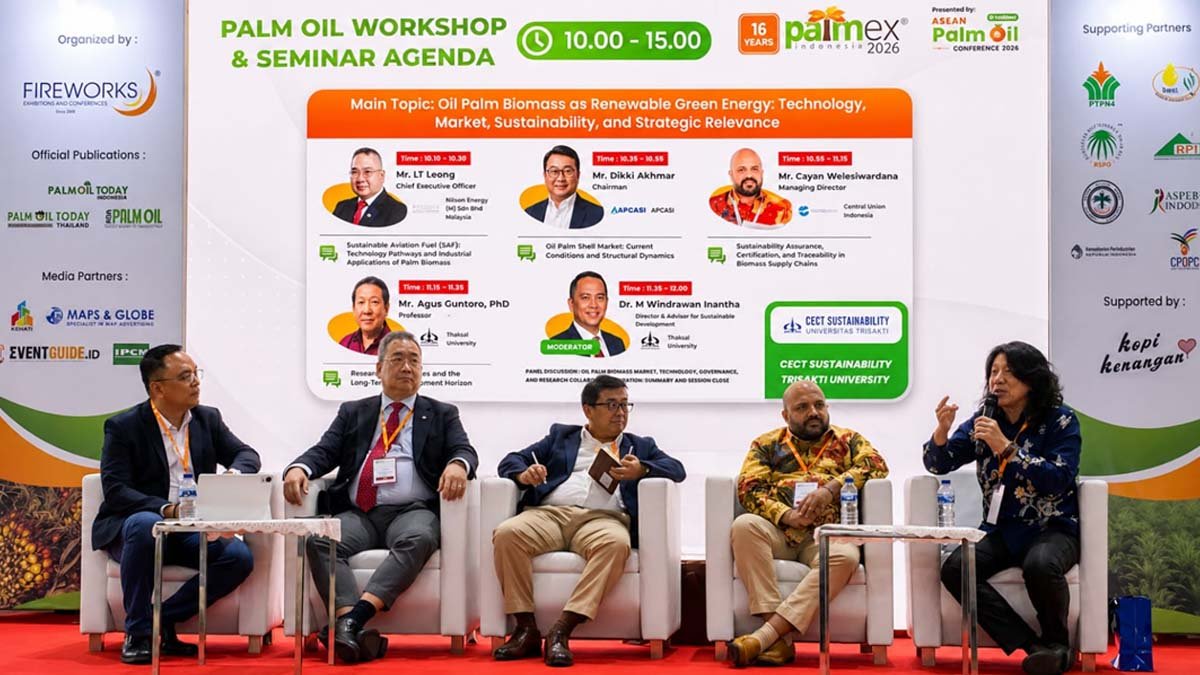
PALMOILMAGAZINE, JAKART – The global palm oil industry operates under a level of scrutiny that few agricultural sectors have experienced. Questions about deforestation, biodiversity, smallholder welfare and greenhouse gas emissions have shaped trade policy, consumer behaviour and investor decisions for more than a decade. At PALMEX Jakarta 2026, the session on oil palm biomass as renewable green energy presented a different frame: not palm oil as a problem to be managed, but oil palm biomass as a sustainability initiative to be led.
The session argued that Indonesia’s palm oil sector holds a unique opportunity to demonstrate, through the responsible development of its residue streams as verified renewable energy, that large-scale tropical agriculture can be governed to deliver environmental, economic and social benefits simultaneously and that the governance tools, market incentives and technology pathways to do so are all available now.
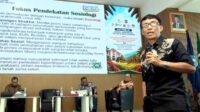
Dr. M. Windrawan Inantha, also known as Dr. Win, moderating the session from CECT Sustainability at Universitas Trisakti, opened with a characterisation of the oil palm biomass sector as Indonesia’s most strategically important sustainability platform. His setting-stage material established the resource dimensions: oil palm fronds at approximately 208 million dry metric tonnes per year, empty fruit bunches at around 51.6 million metric tonnes, palm kernel shells at approximately 14 million metric tonnes, mesocarp fibre at some 29.8 million metric tonnes and palm oil mill effluent at approximately 144.5 million cubic metres.
Also Read: PTPN IV PalmCo and ITS Launch Five-Year Partnership to Develop Palm-Based Green Fuel
Dr. Win’s framing was deliberate and ambitious: “The most important message from this session is that palm biomass is no longer a side story of the palm oil sector. It is now part of Indonesia’s energy security, industrial competitiveness and sustainability credibility.” Credibility, in this context, is the operative word. Indonesia’s palm oil sector has spent years defending its sustainability credentials. Developing palm biomass as governed, verified and certified green energy is the most tangible demonstration available that the sector is moving from defence to leadership.
Prof. Agus Guntoro of Universitas Trisakti connected the sustainability initiative to Indonesia’s national development vision. His presentation argued that energy sustainability is a fundamental asset for national development, and that Indonesia must approach energy transition not as a compliance obligation but as a strategic capability. Regional comparative advantage, he explained, means matching energy development to the resource endowments and industrial structures of each region: palm-producing areas develop palm biomass energy, geothermal-rich provinces develop geothermal, and coastal regions develop ocean energy.
This approach does not treat sustainability as an add-on to development. It treats it as a design principle of development, ensuring that each region’s energy future is built on the renewable resources it already has rather than the fossil fuels it must import. In palm-producing regions, that design principle leads directly to the sustainable development of the biomass streams generated by the oil palm sector, creating energy independence, local employment, reduced environmental liability and a platform for verified renewable energy exports.
Also Read: CPOPC and Papua New Guinea Advance Partnership for Sustainable Palm Oil Development
Dikki Akhmar of APCASI gave the sustainability initiative a commercial grounding that demonstrates it is not an idealistic overlay on a commodity business but an economic strategy with proven market validation. Palm kernel shell exports to Japan, Thailand, China and Poland have demonstrated that certified sustainable biomass from Indonesia commands market access and buyer relationships that uncertified biomass cannot.
APCASI’s estimate of approximately 150 million metric tonnes of annual palm biomass availability, with a potential contribution of approximately 15.74 percent to national electricity demand, represents a scale of sustainable energy production that would be visible in Indonesia’s national energy accounts and in its international sustainability reporting.


Dikki Akhmar’s argument that domestic use of palm biomass deserves greater policy priority alongside export development is itself a sustainability argument: a sector that generates renewable energy for its own communities and industries, while also supplying certified sustainable energy to international buyers, embodies the integrated sustainability model that development finance institutions, ESG investors and international trade partners increasingly require as a condition of engagement.
Also Read: Indonesia Sets May 2026 Biodiesel Market Index Price at IDR 14,917 per Liter
LT Leong of PMP situated the sustainability initiative within the global decarbonisation agenda that is reshaping the economics of every energy-consuming sector. His SAF presentation identified Indonesia and Malaysia as holding an abundance of sustainable aviation fuel feedstocks that the international aviation industry urgently needs: used cooking oil, palm oil mill effluent, spent bleaching earth oil and palm fatty acid distillate.
The aviation sector’s sustainability commitments, formalised through CORSIA and a growing number of airline net-zero strategies, are creating a demand for verified sustainable feedstocks that will only intensify as the 2027 CORSIA compliance phase approaches. LT Leong’s argument that smaller modular SAF plants are more appropriate than mega-refineries in the near term reflects a sustainability initiative logic: instead of waiting for a single transformative project that may take a decade to build, Indonesia should deploy a distributed network of smaller, faster, bankable facilities that begin delivering verified SAF and the emission reductions it represents within the current policy window. This is the sustainability initiative translated into investment strategy.
Gayan Wejesiriwardana of Control Union Indonesia articulated the governance foundation that any credible sustainability initiative must rest on. Sustainability, he argued, is not a claim. It is a verified state, confirmed through independent assessment of environmental performance, social compliance and governance quality.
Also Read: From Tanzania to Indonesia: A Joint Effort to Develop More Resilient Palm Oil
In the palm biomass context, sustainability assurance means tracing the physical supply chain from origin to energy output, calculating and verifying greenhouse gas performance against a recognised methodology, confirming legal compliance in land use, labour practices and environmental management, and issuing certification under standards such as GGL, ISCC or RSB that are recognised by the target markets and regulatory frameworks for which the biomass is destined.
Gayan Wejesiriwardana made a point that is fundamental to the sustainability initiative framing: the governance gap that currently exists in parts of Indonesia’s palm biomass supply chain — fragmented logistics, non-integrated smallholders, inconsistent data and documentation deficiencies — is not simply a market access problem. It is a credibility gap that undermines the entire sustainability narrative of the sector. Closing that gap through investment in traceability, data systems, certification and continuous compliance management is the most important single action that the palm oil industry can take to demonstrate that its sustainability initiative is real.
Dr. Win closed the session with a formulation that captured the ambition of the sustainability initiative while keeping it grounded in practical governance reality. “Circular economy becomes real when residues are converted into measurable energy, measurable emissions benefits and measurable value for producers and communities,” he said, in a statement received by Palmoilmagazine.com on Sunday (May 10).
Also Read: Palm Oil as a Self-Sufficiency Model and Engine of Economic Growth
It is a coordinated programme of technical deployment, governance investment, market engagement and social integration that, if pursued with the seriousness that Indonesia’s resource base and policy ambitions warrant, could establish the country’s palm oil sector as a global reference for how large-scale tropical agriculture transitions from a sustainability liability to a verified, market-credible and community-beneficial renewable energy platform. The resource is in place. The markets are ready. The governance tools are available. What the sector now needs is the initiative to use them. (P3)