PALMOILMAGAZINE, JAKARTA – It is built through systems that work consistently over time. Indonesia’s 8 percent growth target has once again raised an important question: why are successful models such as palm oil not being used as references for other sectors?
The 8 percent growth target set by President Prabowo Subianto is more than a macroeconomic ambition. It is a test of development strategy—whether Indonesia will rely on rhetoric or on sectors that have already proven their resilience. Amid growing noise over food self-sufficiency, palm oil offers a quieter but more meaningful lesson: the power of consistent policy, long-term investment, and trust in market mechanisms.
That target sounds both attractive and challenging. It represents a threshold. Indonesia must decide whether it can break out of the middle-income trap or continue moving in circles. But growth does not emerge from speeches. It requires engines of expansion—sectors strong enough to pull the broader economy forward. Palm oil is one of those engines.
Also Read: Polemic Over Land Use Rights Becomes an Obstacle to Palm Oil Investment
Recent controversy surrounding food policy has highlighted the gap between official claims and market realities. Public criticism over differences between rice reserve data and actual market conditions should have been treated as useful feedback, not as a threat. When data-driven criticism is silenced, public trust is weakened.
The central question remains simple: if self-sufficiency has been achieved, why is it not reflected in stable food prices for households? That disconnect between reports and real markets is where uncertainty begins.
Palm oil provides a useful contrast. It did not grow through claims or slogans. It developed through decades of cultivation, investment, market expansion, and policy continuity. In the most practical sense, self-sufficiency is not about terminology—it is about building productive and sustainable systems.
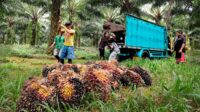
For years, palm oil has often been reduced to an extractive industry stereotype. That view overlooks the complexity of the sector. Palm oil is a cultivated industry that combines economic, environmental, and social dimensions within a broad ecosystem. Its contribution to gross domestic product and its support for around 16.5 million farming families make it far more than a commodity. It is a national economic pillar.
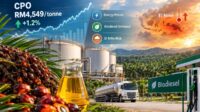
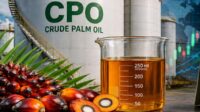
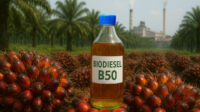
Industry projections show that Indonesia’s palm oil output in 2026 could reach around 57 million tons of crude palm oil (CPO). That figure is not only about volume. It reflects strategic value. Palm oil supports national energy security through the B40 biodiesel mandate, with further movement toward B50. Domestic consumption is rising, diesel imports are being reduced, and export earnings continue to flow, supported by global prices near US$1,100 per ton.
One conclusion is clear: achieving 8 percent growth cannot rely on the state budget alone. It requires sustained private investment on a large scale. Palm oil has already demonstrated that when policy creates room for business, the private sector can build integrated ecosystems from upstream plantations to downstream manufacturing.
Also Read: Agrinas and the Future of Sustainable Palm Oil in Indonesia
Other commodities provide a sobering comparison. Rubber and coconut once held leading positions but gradually lost momentum amid inconsistent policies and weaker competitiveness. Palm oil endured because its market structure remained dynamic and because private enterprise was treated as a strategic partner rather than an afterthought.
This leads to a larger question: if Indonesia wants to replicate this model in other food and commodity sectors, are the foundations ready?
Legal certainty is non-negotiable. Without it, long-term investment will remain hesitant. Ease of doing business, risk-based licensing, and predictable regulation are not bureaucratic slogans—they are core economic requirements. Agriculture and plantations need time to mature, and uncertainty destroys long planning cycles.
Law alone, however, is not enough. Integration from upstream production to downstream processing is equally essential. Without it, the same cycle will repeat: bumper harvests, collapsing prices, and farmers carrying the greatest burden. Industrial infrastructure must be built with long-term vision, not changed every time political leadership shifts.
Productivity must also be at the center of strategy. Higher yields, especially on smallholder land, are not merely technical goals. They are national priorities.
The long-term sustainability of Indonesia’s commodity sectors will depend on balanced cooperation among all stakeholders. Government must act as regulator and facilitator, ensuring legal certainty and efficient governance. The private sector must serve as the main growth driver, bringing professionalism, efficiency, and technological innovation. Most importantly, farmers and smallholders must be positioned as the main beneficiaries of value creation across the supply chain.
Also Read: Indonesia Raises May 2026 CPO Reference Price to USD 1,049.58/MT, Export Duty Set at USD 178
Commodity sectors remain an irreplaceable backbone of the national economy. Recent data show agriculture and plantations consistently contribute around 12 to 13 percent of Indonesia’s GDP while generating vital non-oil-and-gas export earnings during periods of geopolitical uncertainty. By employing nearly 29 percent of the national workforce, the sector is not just an economic statistic—it is a social safety net for millions of households.
Ultimately, criticism should be treated as an entry point for evaluation, not a reason for criminalization. If Indonesia is serious about reaching 8 percent growth, it cannot depend on fragile narratives of self-sufficiency. It needs models that work—and palm oil has already shown one.
Also Read: KPBN CPO Prices Rise Despite Withdrawals, Bursa Malaysia Weakens Ahead of Long Holiday Break
The sector has proven that production surpluses, energy security, and economic growth can move together when investment conditions are protected and confidence in enterprise is genuine. Without that, the 8 percent target risks becoming not an achievement, but a repeated statistical illusion. (*)
By Edi Suhardi, Sustainability Analyst & Head of Positive Campaigns at GAPKI