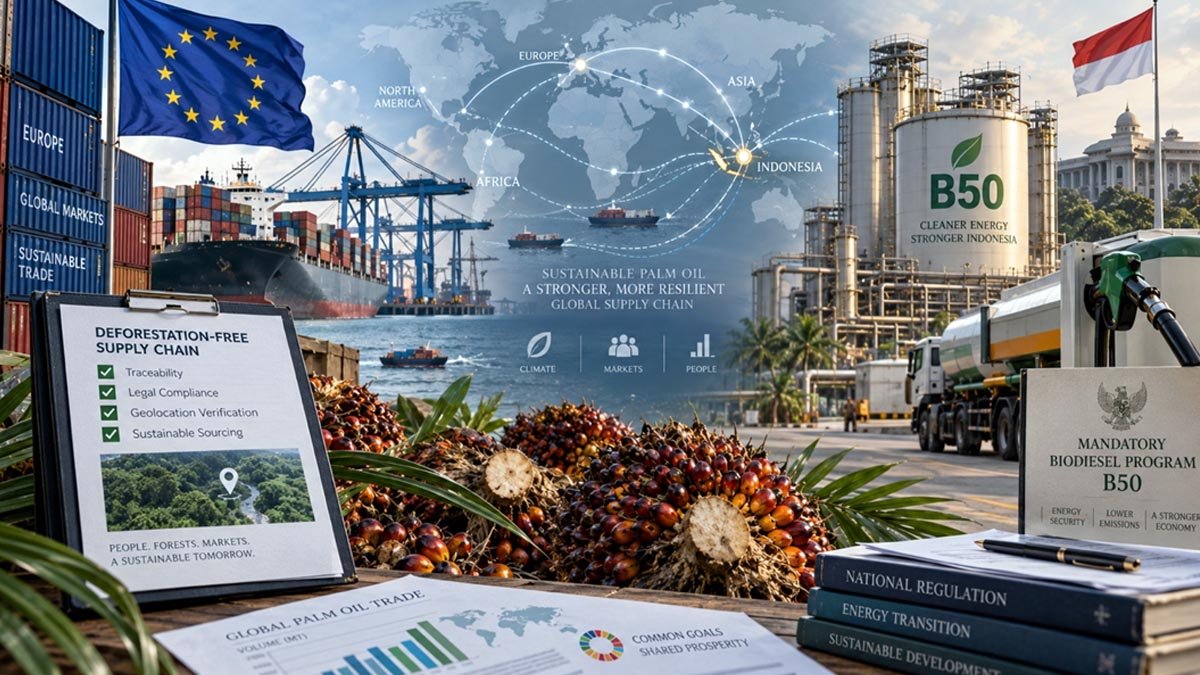
Why palm oil sustainability is shifting from buyer commitments to government mandates, on both ends of the supply chain
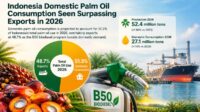
PALMOILMAGAZINE, JAKARTA – Look at how fast Indonesia’s unconditioned demand for crude palm oil has grown, meaning demand that carries no requirement for deforestation-free or geolocation-verified sourcing, and the scale of the shift is hard to miss. Energy-related consumption stood at roughly 11 million tonnes under the B35 blend in 2024. It rose to a projected 13.9 million tonnes under B40 in 2025. With B50 launched nationwide on 1 July 2026, industry estimates put first-year consumption at 16.3 to 17 million tonnes, climbing toward 18 million tonnes a year once the mandate reaches steady state. In the space of roughly three years, one domestic policy will have added more than 6 million tonnes of annual CPO demand, all of it flowing outside the certification system that has defined sustainable palm oil for two decades.
That trajectory is worth sitting with. RSPO reported 16.2 million tonnes of Certified Sustainable Palm Oil sold globally in 2025, representing about 20 percent of world supply, the product of nearly two decades of certification building. Indonesia’s biodiesel mandate alone is now absorbing a comparable volume every year, and doing it through a law that carries no equivalent sustainability bar. The two numbers are not really in competition. They simply show that a single domestic energy policy can move as much palm oil as an entire global certification system, without needing to answer to any of the same questions about deforestation, traceability, or smallholder inclusion.
Also Read: Beyond Certification: The Next Chapter of Indonesia’s Sustainable Palm Oil
A CEILING, NOT A FAILURE
The instinct, when a voluntary system runs into a demand shift this large, is to ask whether sustainability requirements asked too much of the sector. The evidence points the other way. RSPO reports CSPO uptake above 90 percent in Europe and North America, proof that where buyers were required or incentivised to reward certification, the market responded. The issue is not that certification demanded too much but that the sector built its sustainability architecture around the assumption that buyer demand, expressed through price premiums and procurement commitments, would eventually pull the rest of the market along with it. That assumption does not hold where the growth is now happening.
Indonesia controls roughly 60 percent of the global crude palm oil market, according to figures cited by the country’s Agriculture Minister when the B50 mandate was confirmed, with national output projected at around 53 million tonnes in 2026. Under B50, a growing share of that output is committed to domestic biodiesel by law, not by a buyer’s sustainability policy. Indonesia’s Ministry of Energy and Mineral Resources introduced a regulation earlier this year requiring ISPO certification for palm oil bioenergy businesses, and ISPO certification has technically been mandatory for producers since 2020. However, a domestic mandate exists on paper, while the verified, traceable, deforestation-free supply chain behind the fuel it produces largely does not.
Also Read: Indonesia Sees B50 Biodiesel as Catalyst for Higher Palm Oil Productivity
Current ISPO certification records make the imbalance concrete. According to National Standardization Agency (BSN), as per June 2026, 909 companies hold ISPO certification, covering 7,168,042 hectares, or 43.76 percent of Indonesia’s national palm oil area. Independent smallholders account for a fraction of that reach: 144 certified smallholders, covering 355,122 hectares, or 2.17 percent of the national area. The certification system built to bring smallholders into compliant, traceable supply is, in practice, almost entirely a corporate system. Smallholders supply a large share of the fruit going into Indonesia’s expanding biodiesel programme, yet remain almost invisible within the one domestic standard meant to certify it.
The contrast is not a coincidence and is the clearest evidence available that market-driven sustainability, on its own, was never going to be sufficient once demand growth moved to a market that does not require it. The tool worked as designed within its own boundaries, which turned out to be narrower than the sector planned for.
GOVERNMENT IS DOING THE WORK THE MARKET COULD NOT
The more interesting story is what is filling the gap, and it is government, on both ends of the chain, not the market. On the demand side, the European Union Deforestation Regulation is the clearest example. Unlike certification, EUDR does not rely on buyers choosing to pay for a claim. It ties market access directly to verified, geolocated, deforestation-free sourcing, backed by financial penalties for non-compliance. According to research cited in IDH’s Global Palm Oil Outlook 2025, EUDR had already triggered more than 60 government-led initiatives across 25 producing countries before the regulation came fully into force, a scale of governance reform that two decades of voluntary certification had not achieved on its own.
On the supply side, the same pattern holds in reverse. The structural barriers that keep independent smallholders out of certified, traceable supply chains, incomplete land registries, unclear forest-zone classification, the absence of national geolocation systems, are not problems any single company or certification body can resolve. They are public governance functions. IDH’s report is explicit on this point: land registration, legality systems, plot-level traceability, and smallholder financing all depend on systems that only producing-country governments can build. Malaysia’s experience with MSPO makes the case directly. Certification became mandatory there in 2020, the same year as Indonesia’s ISPO, and reached 85 percent of independent smallholders by early 2026 because the government paired the mandate with MPOB-led clustering, extension services, and subsidy support. Indonesia’s ISPO, without comparable state-led delivery, has certified fewer than 1 percent of its smallholders over the same period.
Also Read:East Kutai Accelerates Palm Oil Replanting, 1,900 Hectares Target ISPO Certification
Landscape and jurisdictional programmes point in the same direction. In Aceh, coordinated public-private action delivered productivity gains of 69 to 104 percent and two to four times income growth over five years, results that came from government-led coordination across land use planning, licensing, and smallholder support, not from a certification scheme or a buyer commitment.
A GOVERNANCE MODEL, NOT A MARKET MODEL
Put together, the picture that emerges is not one where sustainability asked too much and the market pushed back. It is one where sustainability was, for two decades, built almost entirely on market mechanisms, certification, buyer commitments, price premiums, and those mechanisms are now visibly insufficient on their own to cover a sector whose demand centre has moved. What is replacing that model, on both sides of the transaction, is public governance. EUDR enforces demand-side requirements through law rather than buyer preference. Malaysia’s MSPO shows what supply-side government investment in smallholder inclusion can achieve when it is backed by public money and institutional delivery, not left to certification bodies alone.
This has a direct implication for how the sector should read Indonesia’s B50 mandate alongside certification’s continued growth. They are not competing signals about whether sustainability is working but evidence of the same underlying shift. The market-driven model reached a ceiling, roughly a fifth of global supply certified, uptake above 90 percent in the two regions that adopted binding or near-binding requirements, and comparatively little penetration everywhere else, while an uncertified biodiesel mandate in a single country now moves a comparable volume every year.
Also Read: Indonesia Pushes Value Addition and Sustainability in Cocoa, Palm Oil Exports
Whether the sector moves past that ceiling depends less on whether more buyers choose to pay for a claim, and more on whether producing-country governments build the land registries, traceability infrastructure, and jurisdictional systems that a voluntary market was never going to build on its own, and on whether importing governments follow the EU’s lead in making sustainability a condition of access rather than a matter of preference.
The next phase of palm oil sustainability is likely to be judged less by how many companies sign a commitment, and more by how many governments, on the producing and consuming side alike, are willing to legislate what the market spent twenty years asking for voluntarily. (*)
By Dr. M. Windrawan Inantha