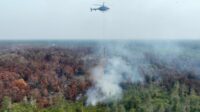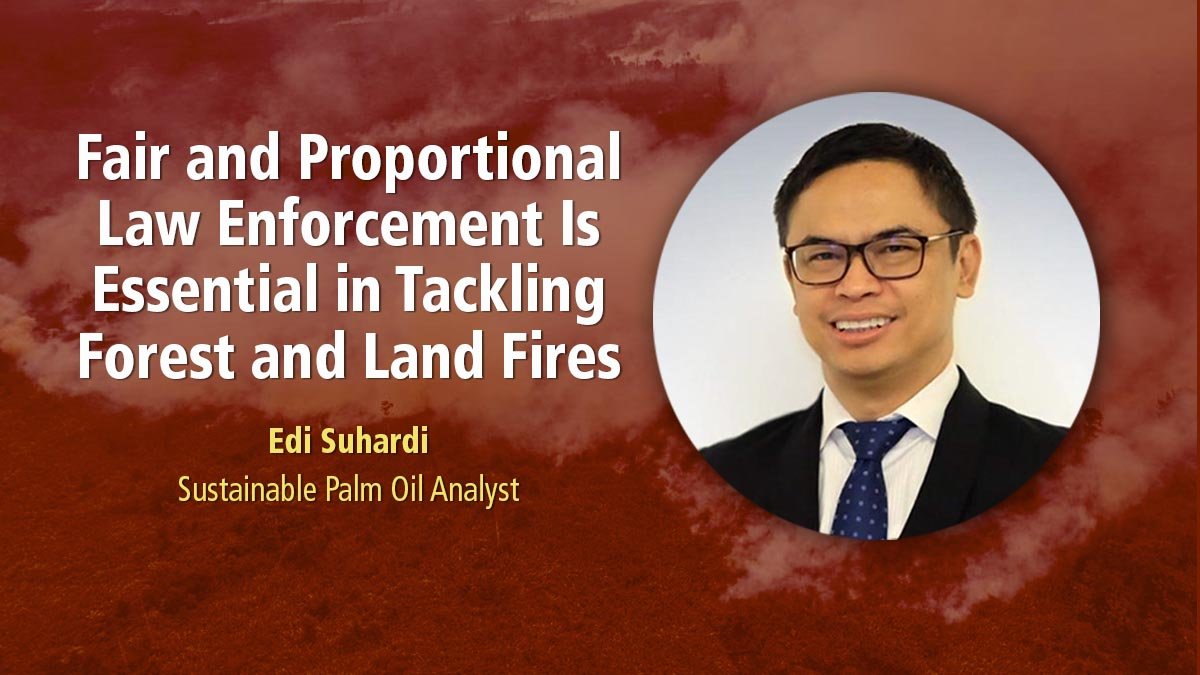
PALMOILMAGAZINE, JAKARTA — Every time the dry season arrives and forest and land fire (karhutla) hotspots once again spread across parts of Kalimantan and Sumatra—as they have in recent days—a familiar narrative quickly emerges: the palm oil industry is portrayed as the primary culprit.
The stigma has been reinforced by premature judgments circulating across social media and allegations from some non-governmental organizations (NGOs) that are sometimes made without sufficient empirical verification on the ground. Once such accusations gain public attention and go viral, they can rapidly shape public opinion.
Law enforcement agencies can then come under pressure to respond quickly, creating a risk that enforcement measures are taken before the facts have been fully established. The fundamental problem is a tendency to generalize every forest and land fire as a corporate crime. When satellite imagery detects thermal anomalies inside a concession boundary, the public—and sometimes law enforcement—can overlook one of the most basic principles of justice: establishing objective causality.
Also Read: Industry and Public Accountability in Efforts to Mitigate Forest and Land Fires
Palm Oil as an Easy Target
The palm oil sector is often positioned as an easy target without adequately examining the specific social dynamics, historical circumstances and local causes at the site of a fire.
A recent case in Central Kalimantan illustrates the concern. Plantation management was reportedly summoned by police after satellite sensors detected indications of elevated temperatures in a company’s conservation area.
Also Read: GAPKI Strengthens Fire Prevention Efforts as Indonesia Faces 2026 Dry Season
Yet on the ground, the company’s emergency response team had moved quickly to contain the fire and worked with neighboring parties until the flames were completely extinguished. Evidence indicating that the fire had originated outside the company’s area, along with the efforts of the firefighting team, should therefore form part of a comprehensive investigation.
A simplistic enforcement approach—where the presence of a hotspot and evidence of burned land automatically trigger criminal proceedings—risks overlooking the actual cause of the incident.
The assumption that “the origin of the fire does not matter as long as concession land has burned” would be a serious mistake in fair law enforcement. Legal proceedings should be grounded in scientific and factual evidence rather than driven by public pressure.
Investigators must carefully establish whether a fire resulted from deliberate action (dolus), negligence (culpa), or an external source beyond the company’s control.
Also Read: APHI-GAPKI Urge Joint Protocol to Speed Up Forest and Land Fire Response
Systemic Economic Impact
Unilateral sealing of plantation areas or suspension of operations without an accountable investigation can create further legal uncertainty, with potentially significant consequences for the national economy.
When a plantation that forms part of a major supply chain is suddenly shut down, the effects can quickly spread. Thousands of workers could face disruptions to their livelihoods, fresh fruit bunches (FFB) supplied by smallholder partners could be left stranded, and export supply chains that contribute foreign exchange earnings could be affected.
More broadly, arbitrary or disproportionate enforcement could send a negative signal to international investors.
Also Read: BMKG Warns of Higher Forest Fire Risk in September 2026, Jambi Among Key Hotspots
Investors who prioritize legal certainty and compliance with environmental, social and governance (ESG) principles could perceive Indonesia as a higher-risk investment environment. Such uncertainty could undermine years of efforts by Indonesia’s palm oil industry to strengthen regulatory compliance and build its reputation in international markets.
At the same time, karhutla enforcement is often perceived as being tougher on companies than on local communities, despite the complex social realities surrounding plantation concessions.
Relations between corporations and local communities are embedded in a complicated economic landscape. Traditional land-clearing practices involving fire remain present in some areas, partly because local residents may lack the capital needed to clear land mechanically and because enforcement against illegal burning can be uneven.
In some cases, illegal land encroachment driven by land speculation can also trigger fires outside concessions. Strong winds may then cause those fires to spread into nearby plantation areas.
Reducing these long-standing social and economic problems to a simple accusation against the palm oil industry would be misguided. The industry is not seeking special privileges. It needs law enforcement that is fair, evidence-based and proportionate.
Also Read: CPO Prices Slide as Bursa Malaysia Falls 1.88%, KPBN Tender Withdraws
Indonesia Already Has Tough Fire Regulations
Indonesia’s regulatory framework already provides strong legal instruments and severe penalties for those responsible for forest and land fires.
The Environmental Protection and Management Law and the Plantation Law impose serious sanctions on parties that clear land by burning, including imprisonment of up to 10 years and fines of up to IDR 10 billion.
The Forestry Law provides even tougher penalties. Intentional burning can result in imprisonment of up to 15 years, while negligence can carry a prison sentence of up to five years along with substantial fines.
Plantation companies also face the principle of strict liability, under which certain environmental responsibilities are attached to business activities within their licensed areas.
Where it is proven that a corporate actor deliberately burned land for land clearing or failed to implement required fire-prevention measures, criminal and financial sanctions should be imposed firmly.
However, treating a company whose concession was affected by a fire originating outside its area—and whose emergency teams worked to contain the blaze—in the same manner as the party that deliberately started the fire would be disproportionate.
Such an approach could undermine the broader objective of building effective partnerships between companies, communities and authorities in preventing karhutla.
Compliance Must Be Demonstrated
At the same time, the palm oil industry has an obligation to demonstrate strict regulatory compliance and provide transparent evidence that it has fulfilled its fire-prevention responsibilities.
At least three key areas require attention.
First, compliance with Minister of Agriculture Regulation No. 06/2025. Companies must ensure adequate types and quantities of firefighting equipment and sufficient personnel for Plantation Land Fire Control (Pengendalian Kebakaran Lahan Perkebunan or Dalkarlabun), in accordance with the size of their licensed areas.
Second, monitoring groundwater levels in peatlands. Plantation operators in peat ecosystems are required to install automatic groundwater-level monitoring instruments or loggers connected to the Ministry of Environment’s server, alongside manual measurements at designated compliance points.
Third, implementation of the 3R program—rewetting, revegetation and revitalization. The program involves rewetting peatlands, restoring vegetation and strengthening local economic activities in villages surrounding concession areas, including communities covered by the Desa Mandiri Peduli Gambut (DMPG) program within a five-kilometer radius outside company concession boundaries.
When plantation companies have fulfilled these regulatory obligations and their emergency response teams have made every reasonable effort to contain fires entering their concessions from outside, law enforcement should assess the circumstances proportionately.
Fire investigations should examine the history and location of ignition points, wind direction and conditions, as well as factual evidence collected at the site. Satellite imagery can be an important investigative tool, but it should not be treated as conclusive evidence on its own.
Forest and land fires are a multidimensional issue shaped by climate anomalies, geological and ecological conditions, land management practices and the social dynamics of surrounding communities.
Reducing the problem to indiscriminate blame against palm oil plantations risks obscuring the underlying causes. Law enforcement should return to its fundamental principles: fairness, objectivity, non-discrimination and decisions based on scientifically verifiable evidence. (*)
By: Edi Suhardi / Sustainable Analyst
Disclaimer: This article represents the author’s personal opinion and is entirely the responsibility of the author.