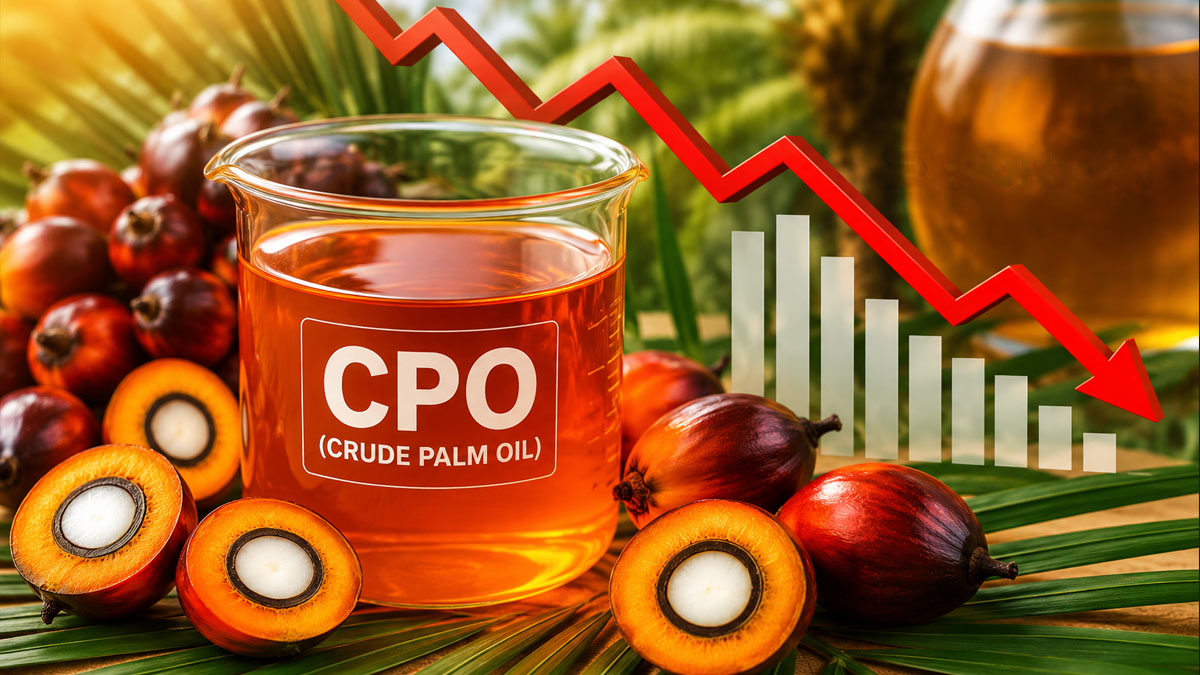
PALMOILMAGAZINE, JAKARTA – The crude palm oil (CPO) market remained under pressure on Tuesday (23/6/2026), with both domestic and international benchmarks weakening amid softer vegetable oil sentiment and currency movements.
In Indonesia, the tender conducted by KPBN (Kharisma Pemasaran Bersama Nusantara) once again ended in a withdrawal (WD), as the highest bid was recorded at Rp15,315/kg. This marked a decline of Rp100/kg, or around 0.65%, compared to the previous trading session on Monday (22/6), when the top offer reached IDR15,415/kg.
Market data showed mixed pricing across domestic delivery points. At Franco Dumai, CPO opened at IDR15,550/kg but was withdrawn with the highest bid at IDR15,315/kg. At FOB Talang Duku, the tender opened at IDR15,350/kg and also ended WD with a peak offer of IDR15,089/kg. Meanwhile, FOB Teluk Bayur opened at IDR15,420/kg before closing withdrawn at a highest bid of IDR15,165/kg.
Also Read: Strong El Niño Threatens Global Palm Oil Output, CPO Prices Expected to Strengthen
For derivative products, crude palm kernel oil (CPKO) Franco Dumai was set at IDR26,330/kg. CPKO FOB Palembang was recorded at IDR25,530/kg, while CPKO FOB Lampung opened at IDR25,609/kg but also ended WD with the highest bid at IDR25,100/kg. Palm kernel (PK) Franco Belawan was recorded at IDR12,745/kg.
On the international front, palm oil futures on the Bursa Malaysia Derivatives moved lower during Tuesday’s trading session. According to Reuters, the benchmark September 2026 contract fell RM33 per tonne, or 0.71%, to RM4,639 per tonne at midday break, according to Reuters.
The decline came after two consecutive sessions of gains, which had previously pushed prices to their highest level in around six weeks. Market participants attributed the weakness largely to pressure from competing vegetable oils.
Soybean oil on the Chicago Board of Trade (CBOT) declined about 0.49%, while the most actively traded soybean oil contract on the Dalian Commodity Exchange fell 0.29%. Palm oil contracts on the same exchange also slipped 0.34%, signaling broader softness across the vegetable oil complex.
Adding further pressure, the Malaysian ringgit strengthened against the US dollar, reducing export competitiveness by making palm oil relatively more expensive for overseas buyers.
Despite the price correction, export data provided a supportive undertone. Cargo surveyors Intertek Group reported that Malaysian palm oil product exports rose 19.1% during 1–20 June 2026 compared to the previous month. Meanwhile, AmSpec Group estimated a stronger increase of 25% over the same period.
Also Read: Jambi Palm Oil FFB Prices for June 19–25, 2026 Remain Stable with Minimal Movement
The market is now closely watching soybean oil trends, currency movements, and export demand signals to determine short-term price direction. While current sentiment remains weak, steady export performance and potential regional supply tightening may still provide a cushion for palm oil prices in the coming weeks. (P3)