PALMOILMAGAZINE, PALEMBANG – Strengthening the legal framework of Indonesia’s palm oil sector has become increasingly urgent, as overlapping regulations and legal uncertainty continue to challenge the industry’s development.
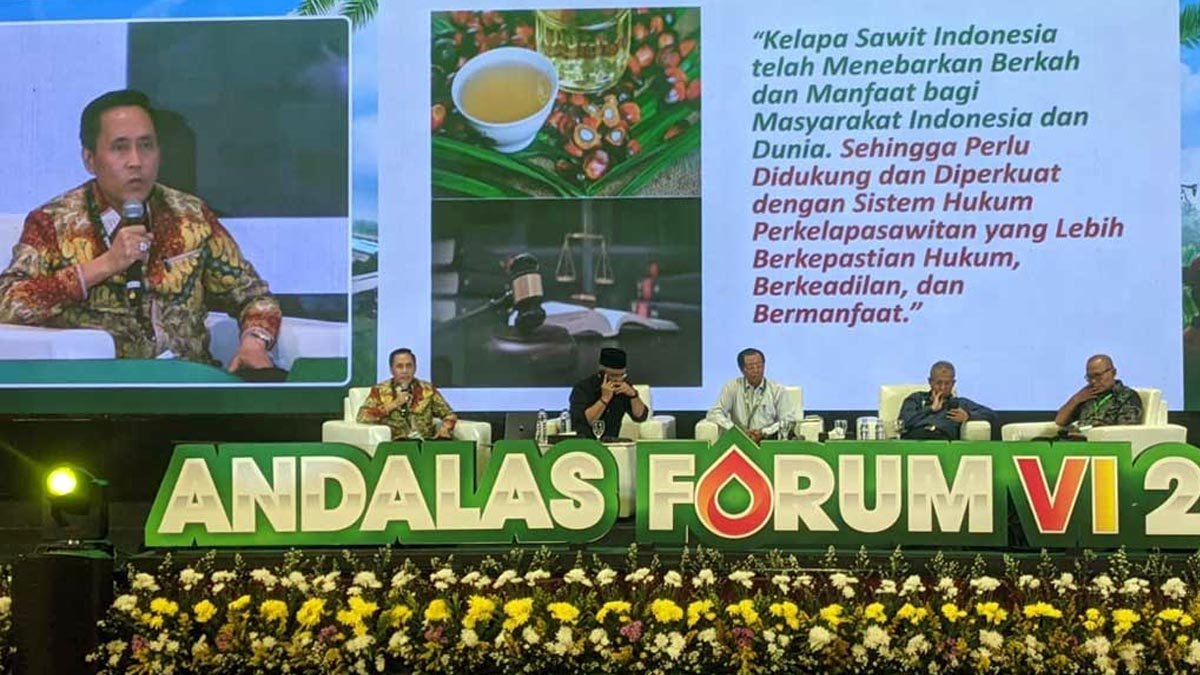
This was emphasized by Ermanto Fahamsyah, Professor of Economic Law at the University of Jember and advisor to the Indonesian Palm Oil Association (GAPKI), during the “Andalas Forum VI” held at Aryaduta Hotel in Palembang on April 16–17, 2026.
He noted that while the regulatory landscape governing the palm oil sector appears comprehensive on paper, implementation in the field remains problematic. Key issues include regulatory disharmony and weak coordination among institutions.
Also Read: Andalas Forum VI: ISPO Gains Momentum, Indonesia Targets Global Market Trust
According to him, the involvement of multiple stakeholders—ranging from ministries and state agencies to regional governments and private sector players—offers opportunities to strengthen institutional capacity. However, without effective coordination, cross-sectoral interventions often lead to overlapping regulations and fragmented governance.
“Unsynchronized regulations create legal uncertainty and risk disrupting the management of the palm oil industry from upstream to downstream,” Ermanto stated in his presentation.
He explained that Indonesia’s palm oil sector spans a wide range of sub-sectors, including plantation cultivation, primary and downstream processing industries, services, and trade. This complexity requires an integrated legal system capable of accommodating the entire value chain.
Also Read: GAPKI Pushes for Palm Oil Industry Synergy Through the 6th Andalas Forum
Ermanto stressed the importance of a comprehensive approach in drafting the Palm Oil Bill, which should incorporate three key dimensions: philosophical, juridical, and sociological. Philosophically, the law must reflect social justice and sustainability. Juridically, it should provide a strong, unified legal basis applicable nationwide. Sociologically, it must address real challenges faced by communities and industry players.
He also pointed out that despite palm oil being a strategic national commodity, Indonesia still lacks a comprehensive legal umbrella that governs the sector from upstream to downstream. This is particularly significant given the industry’s major contribution to state revenue, exports, and employment.
“Palm oil management cannot rely solely on market mechanisms. A legal framework is needed to ensure fairness, transparency, sustainability, and equitable welfare distribution,” he added.
Also Read: Agrinas Palma Nusantara Advances Cooperative-Based Downstreaming for Smallholder Palm Oil
Furthermore, the proposed Palm Oil Bill is expected to strengthen Indonesia’s legal sovereignty in setting its own standards for palm oil governance amid global pressures and evolving market dynamics.
As a concrete step, Ermanto proposed the establishment of a centralized body—such as the Indonesian Palm Oil Management Agency (BPPI)—to integrate policies, harmonize regulations, protect smallholders, and enhance the global competitiveness of the national palm oil industry.
Through these measures, Indonesia’s palm oil legal system is expected to become more robust, integrated, and capable of addressing long-standing structural challenges in this vital sector. (P2)