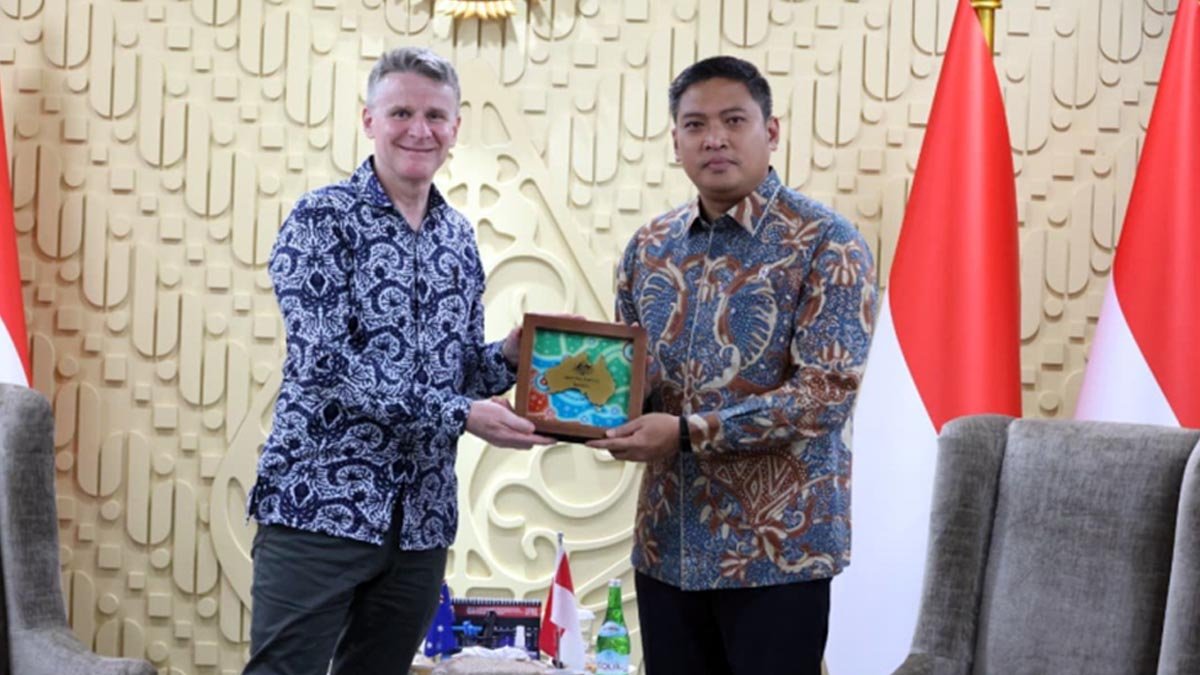
PALMOILMAGAZINE, JAKARTA — Indonesia is opening the door to fertilizer trade cooperation with Australia as global supply chains face increasing pressure. The issue was highlighted during a meeting between Vice Minister of Agriculture Sudaryono and Australian Ambassador to Indonesia Rod Brazier at the Ministry of Agriculture office on Wednesday (April 15).
The discussion focused on Australia’s interest in importing urea from Indonesia, driven by rising global demand following disruptions in international fertilizer distribution.
Sudaryono explained that ongoing geopolitical tensions, including disruptions along strategic routes such as the Strait of Hormuz, have significantly affected global fertilizer supply. The route has long served as a critical corridor for roughly one-third of global fertilizer distribution.
Also Read: SPKS Calls for Fairer Palm Oil Revenue Share as Regions Receive Minimal Returns
“Due to this disruption, many countries are seeking urea. Indonesia has a competitive advantage as we produce urea from domestic natural gas, making us independent from imports for this commodity,” Sudaryono said, as quoted Palmoilmagazine.com from the Ministry of Agriculture on Sunday (April 19).
Indonesia’s national urea production capacity, managed by state-owned PT Pupuk Indonesia (Persero), currently ranges between 9.36 million and 9.4 million tons annually. In 2026, production is projected to reach 7.8 million tons, with subsidized fertilizer needs estimated at 6.3 million tons, leaving a potential export surplus of around 1.5 million tons.
This surplus creates opportunities to supply international markets, including Australia. However, Sudaryono stressed that domestic needs remain the government’s top priority.
Also Read: KPBN CPO Remains Withdrawn on Friday (April 17), Bursa Malaysia Extend Losses on Weak Demand
“Fertilizer supply for Indonesian farmers is our top priority. Only after fulfilling domestic demand will the remaining production be allocated for export,” he emphasized.
He also noted that interest in Indonesian urea extends beyond Australia, with countries such as India, the Philippines, and Brazil also showing demand. Despite this, the government remains cautious about overcommitting exports beyond national production capacity.
Sudaryono further highlighted the reciprocal nature of fertilizer trade between Indonesia and Australia. While Indonesia exports urea, it also imports key raw materials such as phosphate, including Diammonium Phosphate (DAP), from Australia.
Also Read: India Cuts Palm Oil Imports by 19% in March as Buyers Hold Back Amid Price Surge
“This is a mutually beneficial relationship. We depend on each other, and the key is to safeguard national interests while maintaining healthy trade relations,” he said.
He assured that domestic fertilizer availability, particularly subsidized fertilizer, remains secure. Strong fertilizer uptake by farmers reflects increasing planting activity across regions.
“If farmers cannot find fertilizer at kiosks, it is usually due to rapid distribution cycles. Within one to two days, supplies are typically replenished. This means availability is sufficient,” he explained.
Looking ahead, the government plans to revitalize aging fertilizer plants to improve efficiency and expand production capacity. This effort is expected to strengthen domestic supply resilience while maximizing export opportunities amid robust global demand.
With these measures, Indonesia is not only maintaining its fertilizer security but also positioning itself as a stronger player in the global fertilizer market. (P3)