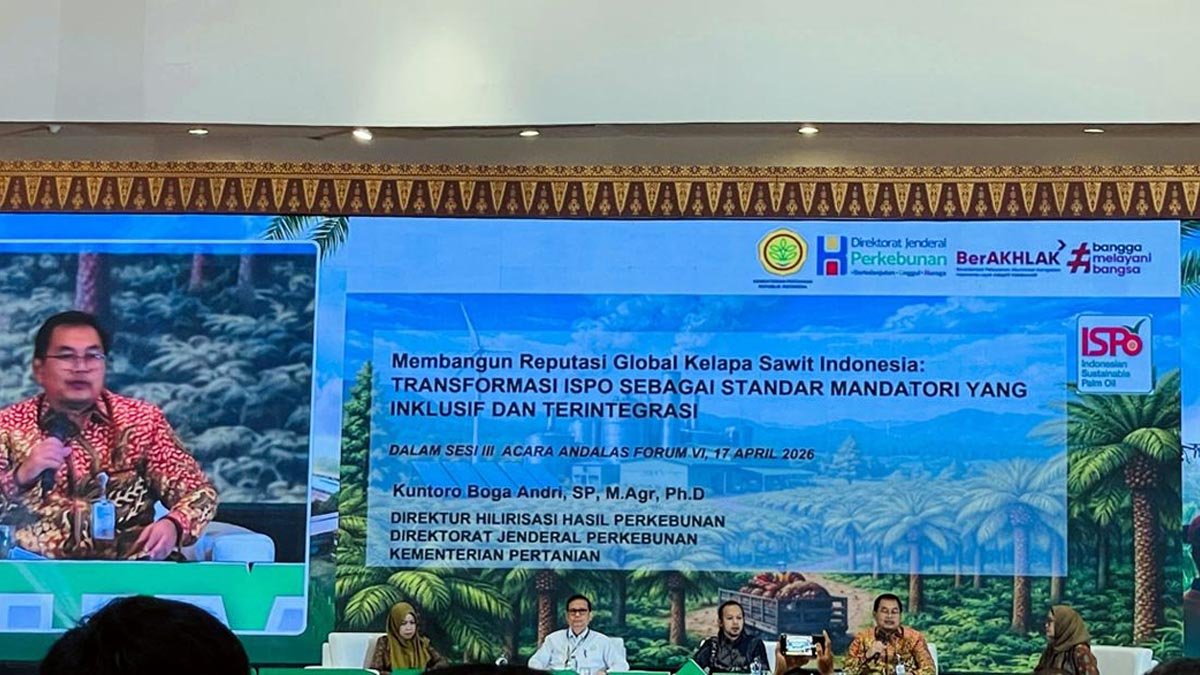
PALMOILMAGAZINE, PALEMBANG — The Indonesian government has reaffirmed its commitment to strengthening the Indonesia Sustainable Palm Oil as a national standard aimed at boosting competitiveness and improving the global acceptance of Indonesian palm oil.
The statement was delivered during the third seminar session of Andalas Forum VI, organized by Gabungan Pengusaha Kelapa Sawit Indonesia in Palembang on April 16–17, 2026. The session focused on the positioning and global acceptance of ISPO amid increasing international demands and challenges.
Director of Downstream Plantation Products at the Directorate General of Plantations, Ministry of Agriculture, Kuntoro Boga Andri, noted that ISPO implementation in the private sector has reached a significant milestone. He stated that more than 70 percent of companies have adopted the certification, reflecting strong industry commitment to sustainable practices.
Also Read: GAPKI Pushes for Palm Oil Industry Synergy Through the 6th Andalas Forum
“ISPO implementation in the private sector has reached over 70 percent. This demonstrates the strong commitment of businesses to supporting the sustainability of the national palm oil industry,” he said in a statement received by Palmoilmagazine.com on Friday (April 17).
However, he emphasized that strengthening ISPO implementation among smallholder farmers remains a key priority moving forward. Ensuring broader participation across the supply chain is seen as essential for maximizing the benefits of the certification system.
The government also expects ISPO to gain wider global recognition and meet international sustainability standards. In the long term, ISPO is envisioned to serve as a primary reference, where compliance would align with various global certification schemes.
Also Read: Agrinas Palma Nusantara Partners KPBN to Boost CPO Market Efficiency
“Going forward, ISPO is expected not only to be accepted but also to meet global standards. In fact, ISPO is expected to become the primary benchmark, so that compliance with it reflects alignment with various global certification schemes,” he explained.
Kuntoro further highlighted Indonesia’s strategic position as the world’s leading palm oil producer. With this advantage, Indonesia has strong potential to take the lead in shaping global sustainability standards for the palm oil industry.
“Going forward, ISPO is expected not only to be accepted but also to meet global standards. In fact, ISPO is expected to become the primary benchmark, so that compliance with it reflects alignment with various global certification schemes,” he explained.
Also Read: Attorney General Returns IDR11.42 Trillion, Forest Task Force Accelerates Massive Asset Recovery
Meanwhile, GAPKI expressed its full support for the government’s efforts to strengthen ISPO as a key instrument in advancing the national palm oil sector.
Representing GAPKI, Ismu Zulfikar underscored the importance of collaboration between the government and industry players. He noted that such synergy would reinforce Indonesia’s position as a competitive and sustainable palm oil producer in the global market. (P3)