CPO futures on Bursa Malaysia Derivatives declined as profit-taking pressured the market, while weaker vegetable oil prices in Dalian added pressure and El Niño concerns provided support.
PALMOILMAGAZINE, JAKARTA — Malaysian crude palm oil (CPO) futures extended their decline for a second consecutive session on Wednesday (Sept. 9, 2026), as market participants took profits despite concerns that El Niño could affect palm oil production.
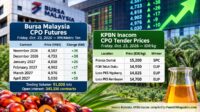
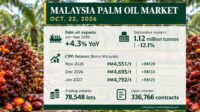
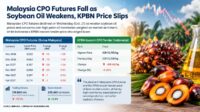
The benchmark Malaysian CPO contract for November 2026 delivery on Bursa Malaysia Derivatives Exchange fell RM9 per metric ton, or about 0.18%, to close at RM4,967 per ton.
Also Read: Malaysia CPO Futures Rise for Third Session, November Contract Nears RM5,000
Pressure on CPO prices also came from weaker vegetable oil markets in China. The most-active soybean oil contract on the Dalian Commodity Exchange fell 0.73%, while the most-active palm oil contract declined 1.09%.
In contrast, soybean oil prices on the Chicago Board of Trade (CBOT) rose 0.35%, providing some support to the broader vegetable oil complex.
The mixed performance across major vegetable oil markets continued to shape sentiment in palm oil trading. Losses in Dalian added pressure to Malaysian CPO futures, while gains in Chicago soybean oil helped limit the downside.
Also Read: KPBN Inacom CPO Price Falls IDR 57/Kg to IDR 15,900, CIF Rotterdam at US$1,600/Ton
Indonesia’s CPO Tender Price Also Falls
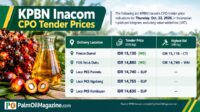
In Indonesia’s domestic market, the CPO tender price at PT Kharisma Pemasaran Bersama Nusantara (KPBN) was set at IDR 15,900 per kg on Wednesday (Sept. 9).
The price was down IDR 57 per kg, or approximately 0.36%, from the highest bid of IDR 15,957 per kg recorded in the previous session on Tuesday (Sept. 8).
Also Read: Indonesia Raises September CPO Reference Price 1.10% to US$1,007.51/MT
The decline in both Malaysian futures and Indonesia’s domestic CPO tender market pointed to broadly softer sentiment across the two major palm oil-producing countries.
However, concerns over the potential impact of El Niño on palm oil production continued to provide a floor for prices. A shift toward drier weather conditions could affect yields and tighten supply, potentially limiting the scope for further declines.
Market participants are expected to monitor production and export developments in major producing countries, as well as movements in competing vegetable oils, for further clues on the direction of CPO prices. (A3)