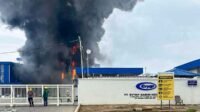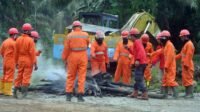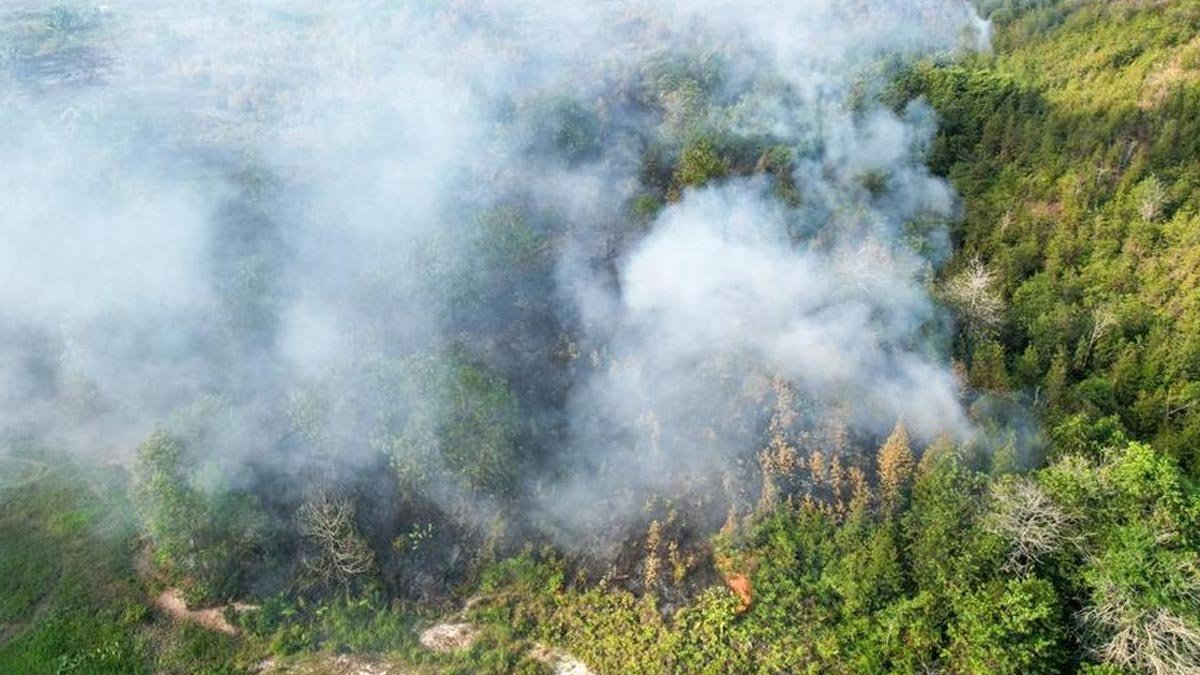
PALMOILMAGAZINE, PONTIANAK — Forest and land fires have again affected West Kalimantan throughout August 2026, prompting civil society organization Link-AR Borneo to raise concerns over land governance, plantation expansion and unequal control of land and forest resources.
According to an official statement received by PalmOilMagazine on Thursday (Sept. 3, 2026), Link-AR Borneo cited data from Indonesia’s Ministry of Forestry’s SiPongi monitoring system showing 6,526 hotspots in West Kalimantan as of Aug. 29, 2026, nearly double the number recorded a day earlier.
The figure placed West Kalimantan as the province with the second-highest number of hotspots nationally after Central Kalimantan, out of 20,378 hotspots recorded across six provinces identified as wildfire-priority areas.
Also Read: Indonesia Palm Oil Companies Strengthen Fire Prevention Ahead of 2026 Dry Season
The fires have also contributed to severe air pollution. According to IQAir monitoring cited by Link-AR Borneo, Pontianak’s air quality index reached 987 on Aug. 30, 2026, a level categorized as hazardous. PM2.5 concentrations reportedly reached 570 micrograms per cubic meter.
Link-AR Borneo said the fires had spread into residential areas, destroying homes, while fires in forest areas threatened orangutan habitats and other wildlife. Smoke was also reported to have crossed the border into Sarawak, Malaysia.
Recurring Fires Raise Land Governance Concerns
Link-AR Borneo said forest and land fires are not a new phenomenon in West Kalimantan. Large-scale fires have repeatedly occurred since the 1997–1998 period, 2015 and 2019, and have returned in 2026.
The organization argues that the recurring pattern indicates that wildfire management has yet to address underlying problems, particularly unequal control over land and forest resources.
Also Read: LinkAR Borneo Alleges PT ESR Cleared Nearly 1,000 Hectares, Raising Orangutan Habitat Concerns
According to Link-AR Borneo, the expansion of oil palm plantations and industrial timber plantations since 2000 has significantly altered forest cover. The organization considers the changes a contributing factor to deforestation, land degradation and increased fire vulnerability during dry periods.
The issue is particularly complex in peatland areas. Land clearing accompanied by canal and drainage construction can lower groundwater levels, leaving peat drier and more susceptible to fire. Once a fire starts, flames can also spread beneath the surface, making peat fires more difficult to control.
3.8 Million Hectares of Non-Forest Area Allocated to Oil Palm
The scale of land allocated for plantations is another major concern raised by Link-AR Borneo.
West Kalimantan covers approximately 14.68 million hectares, of which around 8.39 million hectares, or 57.2%, are classified as forest and water conservation areas. Within production forest areas, 63 Forest Utilization Business Licensing (PBPH) concessions cover approximately 2.77 million hectares.
Also Read: GAPKI Backs Inpres 11/2026, Calls for Stronger Collaboration to Prevent Forest and Land Fires
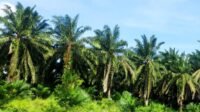
Outside forest areas, the province has approximately 6.3 million hectares of Other Land Use Areas (APL). Citing 2025 data from the West Kalimantan Plantation Agency, Link-AR Borneo said around 59.95%, or 3.8 million hectares, of the APL has been allocated to oil palm plantations.
The organization said 366 companies hold plantation business permits (IUPs) covering a combined 2.94 million hectares, of which approximately 2.14 million hectares have been planted.
Link-AR Borneo also highlighted a target to expand oil palm plantations in West Kalimantan to 3.797 million hectares. This would imply potential additional development of around 1.65 million hectares compared with the area currently planted, according to the organization.
Also Read: KPBN CPO Price Rises to IDR 16,098/Kg on Thursday (Sept. 3), Rotterdam Holds at US$1,600/Ton
Link-AR Borneo said the expansion plan should be comprehensively reviewed given that West Kalimantan continues to face recurring forest and land fires and haze.
Mining activities, particularly bauxite mining, are also a concern. The organization said mining operations are spread across several areas, including Ketapang, Sanggau, Mempawah and parts of Landak.
Link-AR Borneo said some of the hotspots detected this year were located within or directly adjacent to large-scale forestry, plantation and mining concessions.
Also Read: Malaysia CPO Futures Rise 0.55% as November Contract Climbs to RM4,931 per Ton
The organization called for inspections and evaluations of concession holders to determine the causes of fires in their respective areas.
Smallholders Should Not Be Made Scapegoats
Link-AR Borneo also questioned the pattern of law enforcement against those accused of land burning.
Based on data cited by the organization, Indonesia’s Criminal Investigation Agency (Bareskrim Polri) has named 72 people as suspects in land-burning cases, most of whom were reportedly small-scale individual farmers.
Also Read: Riau Independent Smallholder FFB Price Jumps IDR 50.57 per Kg for September 2–8
At the same time, Link-AR Borneo said investigations involving large-scale companies remained limited.
The organization argued that wildfire management should not rely solely on law enforcement, water bombing and weather modification. It said the government also needs to address unequal land ownership and concession governance.
Calls for Oil Palm Governance Review
Link-AR Borneo urged the government to review policies governing traditional land-clearing practices among indigenous communities.
The organization specifically raised concerns over an instruction to revoke West Kalimantan Regional Regulation No. 1/2022 on Land Clearing for Cultivation Based on Local Wisdom.
According to Link-AR Borneo, the regulation governs limited land clearing using fire, including a maximum area of two hectares per household, the use of mineral soils, firebreaks and monitoring measures.
The organization argued that traditional, small-scale cultivation practices by indigenous communities should be distinguished from large-scale land clearing that could generate fires and haze across wider areas.
Link-AR Borneo therefore called on the government to classify the 2026 forest and land fires and haze disaster as a national disaster, while maintaining and strengthening oversight of traditional land-clearing practices based on local wisdom.
It also called for evaluations of companies holding PBPH, HGU and mining IUP concessions where fires are found to have occurred, as well as an end to what it described as the criminalization of small farmers.
The organization further urged the government to restore damaged peatland hydrological systems, protect forest areas and review licensing governance in forestry, oil palm plantations and bauxite mining across West Kalimantan.
Link-AR Borneo said that without improvements in land governance and the management of natural resources, forest and land fires as well as haze disasters could continue to recur, placing further pressure on communities and the environment in West Kalimantan. (P2)