

PALMOILMAGAZINE, BRUSSELS, BELGIUM — Indonesia and the European Union (EU) have signed the Indonesia-European Union Comprehensive Economic Partnership Agreement (I-EU CEPA), concluding a decade of negotiations and paving the way for wider access for Indonesian exports, including palm oil and its derivatives, to the European market.
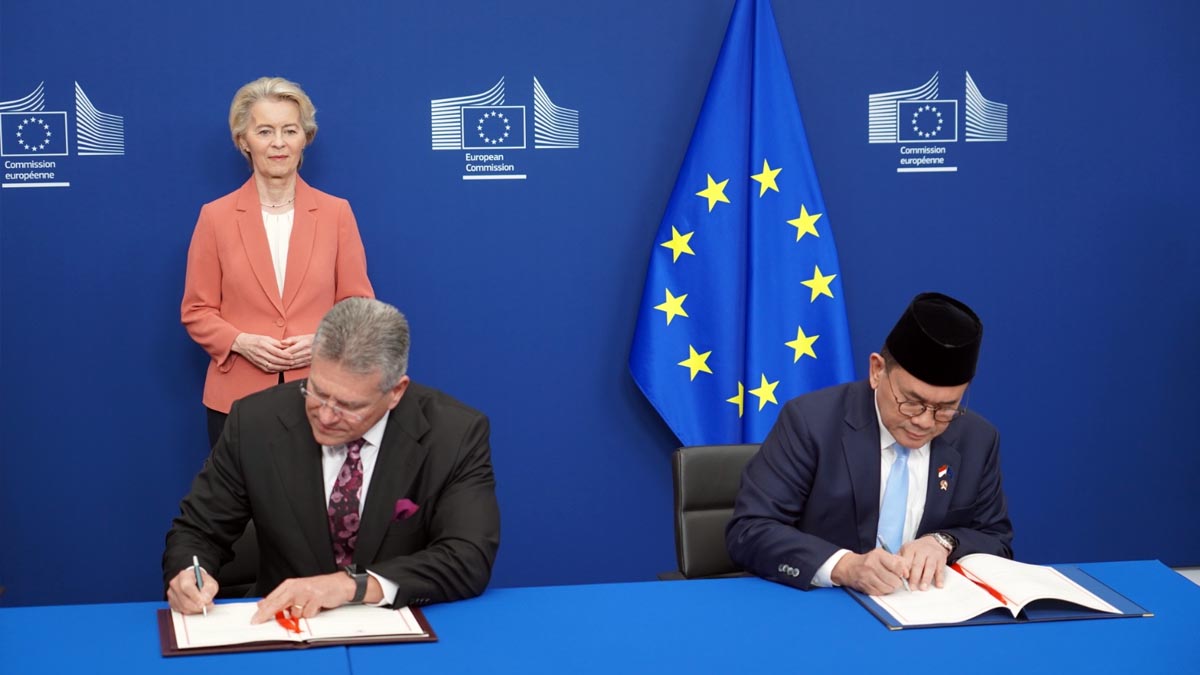
Indonesian Trade Minister Budi Santoso, widely known as Mendag Busan, signed the agreement in Brussels on Saturday (Nov. 21, 2026), alongside European Commissioner for Trade and Economic Security Maroš Šefčovič. European Commission President Ursula von der Leyen witnessed the signing ceremony.
The agreement marks a significant milestone in Indonesia-EU economic relations following ten years of negotiations involving at least 19 rounds of talks. It is also regarded as a major achievement in Indonesia’s trade diplomacy under President Prabowo Subianto’s administration.
Also Read: Indonesia Secures 1.9 Million-Ton CPO Export Quota to EU Under IEU-CEPA, Effective January 1, 2027
“After a decade-long journey and at least 19 rounds of negotiations, Indonesia and the EU have finally signed the I-EU CEPA in Brussels. This marks an important milestone in our economic relations and represents one of Indonesia’s key trade diplomacy achievements under President Prabowo Subianto,” Budi said in a statement cited by PalmOilMagazine on Monday (Nov. 23).
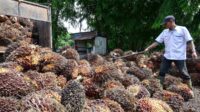
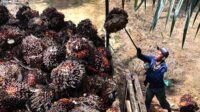
For Indonesia’s palm oil industry, the agreement offers an important opportunity to strengthen its position in the EU market through improved tariff access for crude palm oil (CPO) and downstream products.
Under the agreement, 90.4% of the EU’s total tariff lines will immediately be reduced to zero upon the I-EU CEPA’s entry into force. The coverage includes palm oil and its derivatives, rubber and rubber products, footwear, textiles and textile products, among other Indonesian exports.
Also Read: Indonesia Accelerates IEU-CEPA Process to Expand Access to European Market
A further 7.92% of tariff lines will be eliminated gradually over a period of three to 15 years, bringing the total coverage of preferential tariff treatment to 98.35% of EU tariff lines.
“More than 98% of EU tariff lines will provide preferential market access for Indonesia’s leading export products, including palm oil and its derivatives, footwear, textiles, fisheries products, rubber, furniture and various other manufactured goods,” Budi said.
Beyond tariff reductions, the agreement covers a broader range of economic cooperation, including trade in goods and services, investment, intellectual property, government procurement, competition policy and sustainable development.
Also Read: Indonesia Strengthens Palm Oil Traceability Under EUDR, Alongside Cocoa and Coffee
Budi said the commitments were expected to stimulate investment, strengthen domestic industries, generate employment and improve Indonesia’s competitiveness in international markets.
He described the I-EU CEPA as Indonesia’s most modern and comprehensive trade agreement to date, setting a new benchmark for the scope and depth of trade commitments and economic cooperation.
The agreement is also expected to create opportunities for European investment in Indonesia’s manufacturing, automotive, renewable energy and digital economy sectors.
Stronger legal certainty and greater transparency are expected to provide businesses with a more stable and predictable operating environment, supporting long-term investment and commercial partnerships.
Budi added that inclusivity was an important element of the agreement, ensuring that its benefits would extend to businesses across different scales and sectors, including micro, small and medium enterprises (MSMEs) and young entrepreneurs.
Following the signing, the Indonesian government will pursue the ratification process to enable the agreement to enter into force and be implemented by both parties.
“The Government of Indonesia is committed to ensuring that the I-EU CEPA is implemented effectively and delivers tangible benefits to the Indonesian people,” Budi said.
Broader Economic and Investment Cooperation
Indonesia’s Coordinating Minister for Economic Affairs Airlangga Hartarto also attended the ceremony. He signed the Indonesia-European Union Investment Protection Agreement (I-EU IPA) and a joint press statement with Commissioner Šefčovič.
Other Indonesian officials attending the event included Indonesian Ambassador to Belgium Andy Rachmianto, Deputy Minister of Investment and Downstreaming Todotua Pasaribu, and Deputy Minister of Industry Faisol Riza.
Also Read: Riau Independent Smallholder FFB Prices Fall IDR 117 to IDR 3,602/kg for November 18–24
European Commission President Ursula von der Leyen said the agreements would connect the EU’s 450 million citizens with Southeast Asia’s largest economy and the world’s fourth-most populous country.
She emphasized that the agreements would provide businesses with greater certainty through clear rules, expanded market access and a stable long-term environment for trade and investment, supporting prosperity for approximately 730 million people across both economies.
In a joint press statement with Commissioner Šefčovič, Airlangga described the signing as the beginning of a new chapter in Indonesia-EU economic relations.
Also Read: North Sumatra FFB Prices Drop IDR 109.36/kg to IDR 3,576.33 for Nov. 18–24
He expressed hope that both sides would continue working together to ensure the agreement becomes a practical catalyst for shared prosperity.
Šefčovič, meanwhile, stressed that signing the agreements was not the final step. Their ultimate success, he said, would depend on how effectively they were promoted and implemented.
Smooth implementation would translate into greater opportunities for businesses and communities on both sides.
For Indonesia’s palm oil sector, the I-EU CEPA represents a significant development in trade relations with one of the world’s major consumer markets. The elimination of tariffs on palm oil and derivative products could strengthen export competitiveness, although the agreement’s commercial benefits will depend on its ratification, implementation and compliance with applicable EU trade and sustainability requirements. (P3)