

PALMOILMAGAZINE, JAKARTA – Strengthening Indonesia’s fertilizer and seed industries is becoming increasingly important to maintaining the country’s food self-sufficiency ambitions. Beyond ensuring the availability of subsidized fertilizers, the government is seeking to improve distribution systems, expand the use of certified seeds and reinforce the domestic seed industry.
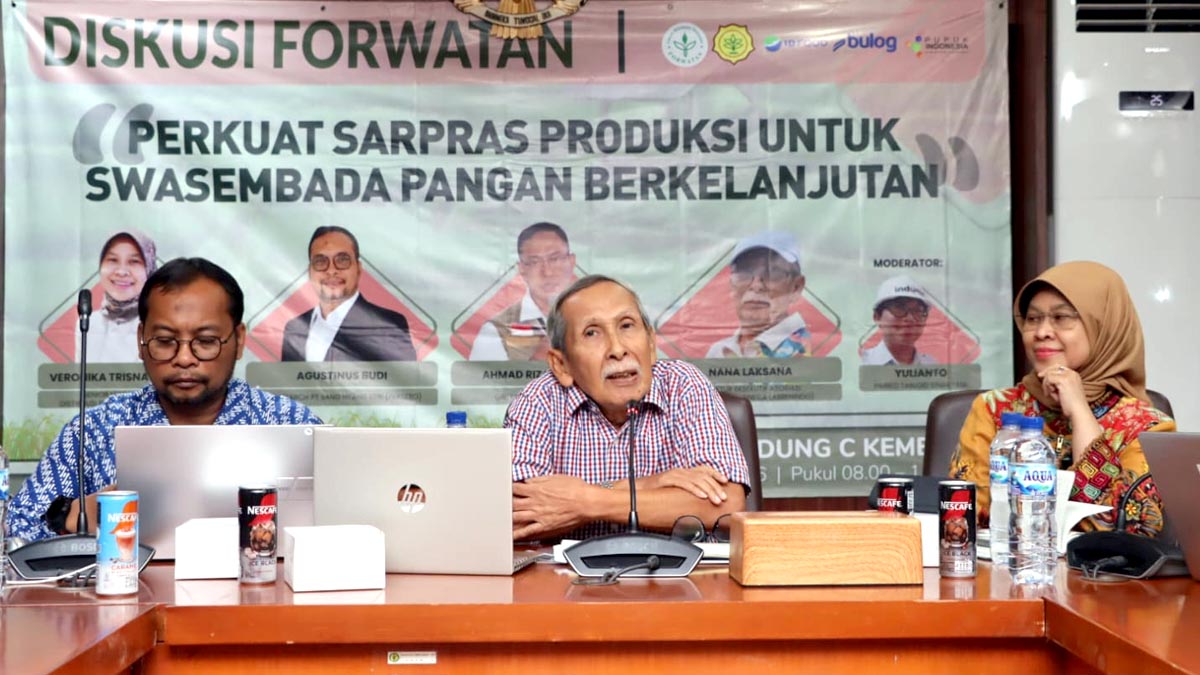
The issue was highlighted during a discussion organized by the Agricultural Journalists Forum (Forum Wartawan Pertanian/Forwatan), titled Strengthening Agricultural Inputs for Sustainable Food Self-Sufficiency, at the Ministry of Agriculture in Jakarta on Wednesday (Nov. 18, 2026).
The discussion brought together representatives from state-owned fertilizer producer PT Pupuk Indonesia (Persero), state-owned seed company PT Sang Hyang Seri (Persero), and the Indonesian Seed Association (Asbenindo).
Also Read: Oil Palm Smallholders Urged to Choose Certified Seedlings for Higher Productivity
President Prabowo Subianto declared Indonesia’s food self-sufficiency for 2025 on Jan. 7, 2026, in Karawang, West Java. The government is now aiming to maintain that achievement through sustainable production growth.
Statistics Indonesia (BPS) projects national rice production at 33.11 million tonnes in 2026, an increase of 8.11% compared with 2024.
One of the government’s key policy measures has been the reform of fertilizer distribution through Presidential Regulation No. 6/2025 on the Governance of Subsidized Fertilizer Distribution, subsequently revised under Presidential Regulation No. 113/2025.
Fertilizer Plays a Critical Role in Agricultural Productivity
PT Pupuk Indonesia Senior Vice President of Distribution Veronika Trisna Sukmawati said fertilizer accounts for approximately 60% of rice crop productivity, making reliable fertilizer availability a critical factor in boosting national food production.
“Fertilizer Indonesia supports food sovereignty. Fertilizer contributes around 60% to rice productivity. Just as energy is essential for humans, fertilizer is an essential requirement for plants,” Veronika said.
Also Read: Minister Amran: Pupuk Kaltim Revamp Boosts Efficiency by 16%, Strengthens Indonesia’s Food Security
She noted that the government’s commitment to strengthening domestic food production was reflected in the allocation of 9.5 million tonnes of subsidized fertilizer for the 2026–2027 period.
Pupuk Indonesia, she added, is prepared to meet the requirement through its existing production capacity and nationwide distribution network.
The company’s manufacturing facilities are spread across several regions, including PT Pupuk Iskandar Muda in Lhokseumawe, PT Pupuk Sriwidjaja Palembang, PT Pupuk Kujang in Cikampek, PT Petrokimia Gresik and PT Pupuk Kalimantan Timur in Bontang.
Also Read: KPBN Inacom CPO Price Falls IDR 110 to IDR 14,490/kg on Tuesday (Nov. 17), Rotterdam Gains
Petrokimia Gresik has an NPK fertilizer production capacity of 3.2 million tonnes and urea capacity of 1 million tonnes. Meanwhile, Pupuk Kalimantan Timur has the country’s largest urea production capacity, at 3.4 million tonnes.
Overall, Pupuk Indonesia’s production capacity stands at approximately 14–15 million tonnes.
Beyond subsidized fertilizer, the company also supplies non-subsidized products to meet demand from other agricultural segments, including the oil palm plantation industry.
Also Read: Indonesia-EU Trade Deal Could Boost Indonesian Palm Oil Access to European Market
This capacity is supported by a nationwide logistics infrastructure comprising approximately 2.7 million tonnes of warehouse capacity, four dedicated port complexes, 236 sea transportation routes and around 1,084 land transportation routes.
“We have approximately 2.7 million tonnes of warehouse capacity to support fertilizer distribution, along with 236 sea transportation routes and more than 1,000 land transportation routes. This network is dynamic and continuously evaluated,” Veronika said.
Subsidized Fertilizer Stocks Reach 1.9 Million Tonnes
Veronika assured that national fertilizer supplies remained adequate. As of Nov. 17, 2026, Indonesia’s fertilizer stocks stood at approximately 1.9 million tonnes, comprising around 1.55 million tonnes of subsidized fertilizer, equivalent to 56 days of requirements.
The available stocks could support demand through the end of December if necessary, she said, while production continues on a daily basis.
Also Read: Indonesia’s B50 Biodiesel Plan Faces Export, Fiscal and Environmental Risks, Expert Warns
Non-subsidized fertilizer stocks were recorded at approximately 362,716 tonnes, intended to meet agricultural and plantation demand outside the government subsidy program.
To improve distribution transparency and efficiency, Pupuk Indonesia has also developed a digital monitoring system through a command center at its headquarters in Tanah Abang, Jakarta.
The system monitors the movement of more than 1,000 trucks, port activities and inventory levels at distribution warehouses.
Also Read: MPOB Says Malaysia’s CPO Supply Remains Stable as El Niño Risks Build
Veronika explained that the monitoring system uses four color-coded indicators: red, yellow, green and blue. A red indicator signals that inventory has fallen below 50% of safety stock, prompting the company to prioritize supplies to the affected area.
Approximately 70% of distribution warehouses are also equipped with CCTV surveillance, while vehicle-tracking technology helps ensure that fertilizer deliveries follow designated transportation routes.
The company can monitor deviations and impose sanctions, including contract termination, on distribution partners found violating their obligations.
Also Read: Airlangga: Indonesia’s Palm Oil Industry Key to Food and Energy Security
Addressing concerns about fertilizer shortages, Veronika said eligibility requirements under the subsidy program must also be considered.
Subsidized fertilizer is allocated to 10 strategic agricultural commodities: rice, corn, soybeans, chili, shallots, garlic, coffee, sugarcane, cocoa and cassava.
Farmers who have not been registered in the electronic Definitive Plan for Group Needs (e-RDKK) can seek assistance through coordination between Pupuk Indonesia and local agricultural authorities.
Also Read: Indonesia Expands Urea Exports to Australia as Subsidized Fertilizer Prices Fall 20%
Currently, approximately 14.68 million farmers are registered in the e-RDKK system. Beneficiary data are updated every four months to reflect changing requirements and farmers’ conditions.
Strengthening Indonesia’s Domestic Seed Industry
Beyond fertilizer availability, access to quality seeds remains another critical component of agricultural productivity.
PT Sang Hyang Seri (SHS) Vice President of Research Agustinus Budi said seeds were not merely the foundation of agricultural production but also an essential pillar of national food sovereignty.
Also Read: Indonesia Prepares B50 Biodiesel Framework as Infrastructure and Financing Take Centre Stage
He identified several challenges facing Indonesia’s seed industry, including supply-demand mismatches, delays in the availability of source seeds and inconsistent seed quality.
According to Agustinus, only around 62% of farmers currently use certified seeds, while the remaining 38% continue to rely on uncertified seeds.
PT Sang Hyang Seri is seeking to expand access to quality seeds, including among farmers in remote areas.
Also Read: North Sumatra FFB Prices Reach IDR 3,689.80/kg for 21-Year-Old Palms in November 11–17, 2026 Period
He outlined five priorities for strengthening national seed independence: better seed demand planning, stronger domestic plant breeding capabilities, development of a healthy seed industry, establishment of national seed reserves, and closer cooperation between the government and private sector.
Unlike fertilizer production, seed production requires a considerably longer preparation period. Depending on the variety and production process, it can take at least four months and up to one year.
“This is different from fertilizer production. Seed production requires at least four months and can take up to a year. This creates challenges when unexpected demand emerges, for example following natural disasters,” Agustinus said.
PT Sang Hyang Seri currently operates 42 seed production units with an installed capacity of approximately 150,000 tonnes.
The company also manages the 3,200-hectare Sukamandi agricultural complex and maintains around 1,500 genetic collections to support variety development.
As part of its business strategy, SHS is strengthening its position as a national seed producer, with a target of reaching annual seed sales of 150,000 tonnes by 2029.
Also Read: Jambi FFB Prices Fall by IDR 102.85/kg for November 13–19, 2026
The company also plans to strengthen partnerships with seed growers and guarantee market absorption through its role as an offtaker.
Agustinus said SHS intended to increase its network of partner seed growers beyond the current 5,000 farmers and expand seed production areas to 15,000 hectares.
Partner farmers are expected to receive purchase prices above prevailing consumption-grade paddy prices, making seed production more economically attractive.
Also Read: Riau Plasma FFB Prices Rise to IDR 3,786.79/kg for 9-Year-Old Palms in November 11–17 Period
Seed Industry Calls for Greater Business Certainty
Meanwhile, Indonesian Seed Association (Asbenindo) Executive Director Nana Laksana Ranu emphasized that the seed industry is fundamentally built on trust.
Maintaining quality throughout the production process and ensuring that farmers receive reliable products are therefore essential for business sustainability.
Also Read: Bangka Regency Halts New CPO Mill Permits Amid Plans for Seven Additional Factories
“The seed industry is a business built on trust. If a company sells poor-quality seeds, its business will not survive. That is why quality must be maintained carefully,” Nana said.
He explained that seeds are living products requiring specialized handling. Each variety also has its own identity and characteristics, which must be established through variety release procedures, certification and labeling before commercial distribution.
However, the industry continues to face regulatory complexity. Asbenindo is therefore calling on the government to simplify seed regulations without compromising the quality of products reaching farmers.
Also Read: DSI to Launch Palm Oil Export System on January 1, 2027, with Single-Digit Dollar Service Fee
Nana also highlighted uncertainty surrounding government procurement and agricultural support programs.
Seed producers frequently face sudden demand despite the lengthy production cycle required to prepare supplies. In some cases, companies have already prepared seeds for government programs, only to see the corresponding budgets redirected.
He urged the government to provide stronger support for domestic plant breeding, describing research and variety development as the lifeblood of the seed industry.
Also Read: Oil World: Global Palm Oil Exports to Fall by Up to 3.5 Million Tons in 2027 as Prices Rise
Currently, seed producers often rely on commercial funds to finance research, even though breeding programs require substantial investment and long-term commitment.
Recognition of domestically developed varieties also needs to improve, he added.
Nana argued that information about the varieties and seed producers involved should be communicated alongside production figures whenever the government announces major harvest results.
He further called for stronger oversight of seed distribution and greater business certainty for companies that comply with regulations and invest in research and quality control.
Uncertified and potentially substandard seeds, including products sold through online marketplaces, remain a concern for the industry.
“Many seeds are currently being sold online, but their quality cannot be guaranteed,” Nana said.
He stressed that effective enforcement is necessary to prevent illegal seed distribution from undermining legitimate producers that invest in research, breeding and quality assurance. (P3)