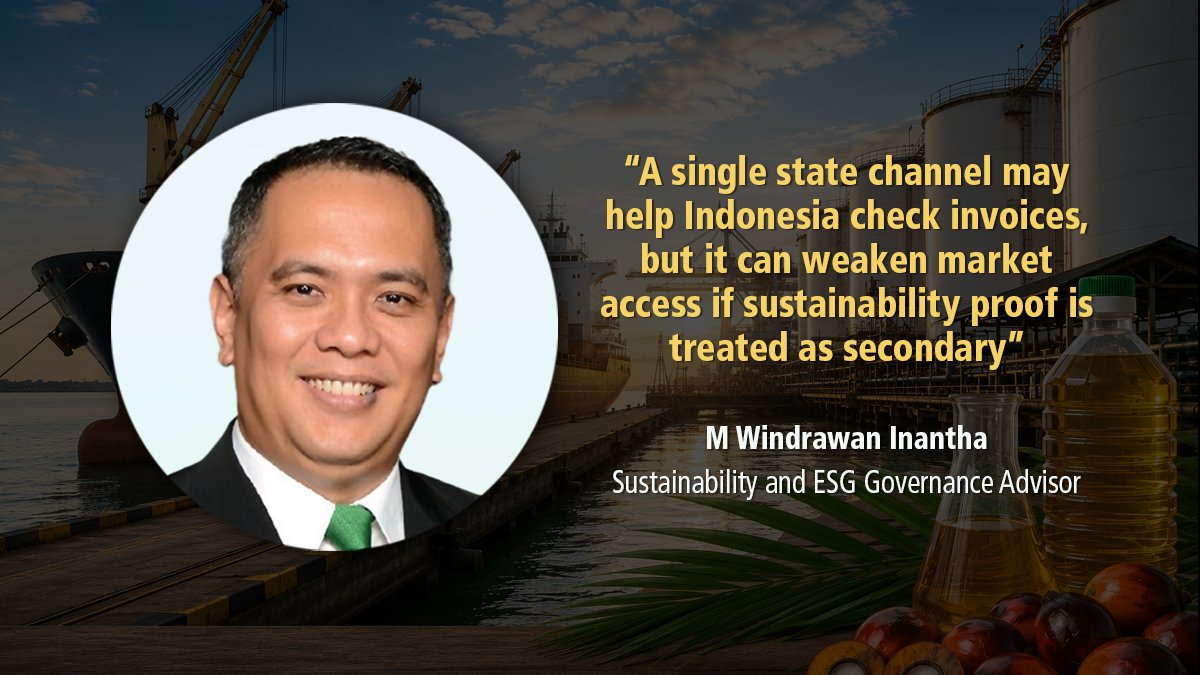
A single state channel may help Indonesia check invoices, but it can weaken market access if sustainability proof is treated as secondary.
M Windrawan Inantha, Sustainability and ESG Governance Advisor
PALMOILMAGAZINE, JAKARTA – Indonesia has decided that valuable commodities should pass through one state channel. Crude palm oil, coal and ferroalloys are being moved toward PT Danantara Sumberdaya Indonesia, known as DSI, during a 2026 transition toward full implementation in 2027. The government wants cleaner export records, stronger control of foreign exchange receipts and less room for invoice manipulation in sectors that matter to state revenue.
The concern is that palm oil is being discussed as if it were merely a cargo of bulk commodity with an invoice attached, while in many markets, especially in Europe, palm oil carries a second identity beyond volume and price. Buyers ask where the oil came from, whether the supply chain is certified, whether the mill and plantation links are known, and whether the claim attached to the shipment can survive audit.
That is where the single gate plan becomes risky, the government may control the domestic exit gate, but importing markets control the entry gate. Under the EU Deforestation Regulation, after the latest postponement, most large and medium operators must comply from Dec. 30, 2026, while many smaller operators have until June 30, 2027. The legal burden falls mainly on operators placing goods on the EU market, yet Indonesian exporters will still be asked for the evidence those operators need, including geolocation data, legality records, mill lists, plantation links, risk assessments and batch documents.
UN Comtrade data compiled through WITS put the EU’s 2024 imports of crude palm oil from Indonesia at about 220,000 tons, worth roughly US$237 million. CPO is only the narrow customs line but when refined palm oil, palm kernel oil, oleochemicals, biodiesel-related flows and other derivatives are included, the exposure is far larger. Indonesian Palm Oil Association (IPOA/GAPKI) estimated that Indonesia’s palm oil exports to the EU were at 3.3 million tons in 2025 and could reach about 4 million tons in 2026. The compliance question is therefore not about a small niche of CPO, but about a wider palm-based trade lane.
Sustainability certification adds another layer such as RSPO supply chain rules, ISCC requirements and buyer due diligence follow legal ownership, physical handling, custody records, transaction documents and auditable controls rather than political intention. If DSI only verifies documents and monitors payment flows, it may be possible to keep certification where it already exists, with exporters and refiners. If DSI later takes title, signs contracts, invoices foreign buyers or becomes the exporter of record, its position in the chain can no longer be treated as clerical.
This is a serious administrative question with commercial consequences. A company may already hold an RSPO supply chain certificate, an ISCC certificate, a mill traceability system and a data package accepted by a European buyer. If that cargo is then routed through a state entity whose role is unclear, whose certification status is missing, or whose invoice breaks the batch identity, the foreign buyer may have a reasonable basis to question whether the sustainability claim still travels with the oil. Indonesia would then have fixed one leakage problem while creating a new market access problem.
Also Read: Indonesia Customs Ready to Enforce New Export Controls for Palm Oil, Coal, and Ferroalloys
The risk is sharper because sustainability data are commercially sensitive. Plot coordinates, supplier lists, mill links, mass balance records and buyer contracts reveal more than compliance status. They reveal sourcing strategy, commercial relationships and, in some cases, the exact location of smallholder plots. No responsible exporter will hand all of that to a central state collector unless access, confidentiality, liability and verification rules are clear.
There is a practical way forward, but it requires the government to treat sustainability as part of export governance from the beginning. First, DSI should separate export lanes according to market requirements. Ordinary cargo can use a standard process, while shipments carrying RSPO, ISCC or EU-related claims need additional protocols that preserve certificate status, chain of custody records and origin evidence. One state gate does not have to mean one flat checklist.
Second, DSI should be made ready for certification before it becomes commercially central. The government should publish whether DSI will act as payment monitor, document verifier, agent, trader, storage operator, buyer or exporter of record. Each role has different consequences under RSPO, ISCC and EUDR-related due diligence. If DSI takes legal ownership or handles certified product, it must have the proper certification, licence, trader status, custody procedures and trained personnel before the system is switched on.
Third, an independent verification layer is needed. This should not be a decorative committee or a self declaration by the new gatekeeper. Accredited inspectors or verification bodies should confirm that each relevant shipment carries the correct certificate status, custody model, batch identity, mill list, origin evidence and declaration before DSI processes it. Sensitive data can be kept in a secure data room or escrow system, where proof is checked, access is logged and DSI receives confirmation without hoarding every farm polygon and contract.
Finally, existing commercial arrangements should be protected during the transition. Exporters that have spent years building certified supply chains and buyer-approved deforestation documentation should not be forced into a format that strips away the very evidence their customers require. DSI should preserve those files, not rewrite them into a domestic template that foreign auditors do not recognise.
Indonesia is right to close gaps in export governance. Palm oil, however, sells into food, fuel, cosmetics and consumer goods supply chains where trust is built through documents that must match the physical flow of product. A state gate that protects revenue while weakening sustainability proof would be a poor bargain. If DSI is going to stand at the front of Indonesia’s palm oil trade, it must guard more than the money. It must guard the proof that keeps Indonesian palm oil welcome in the markets that ask the hardest questions. (P3)