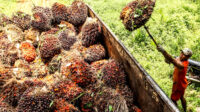

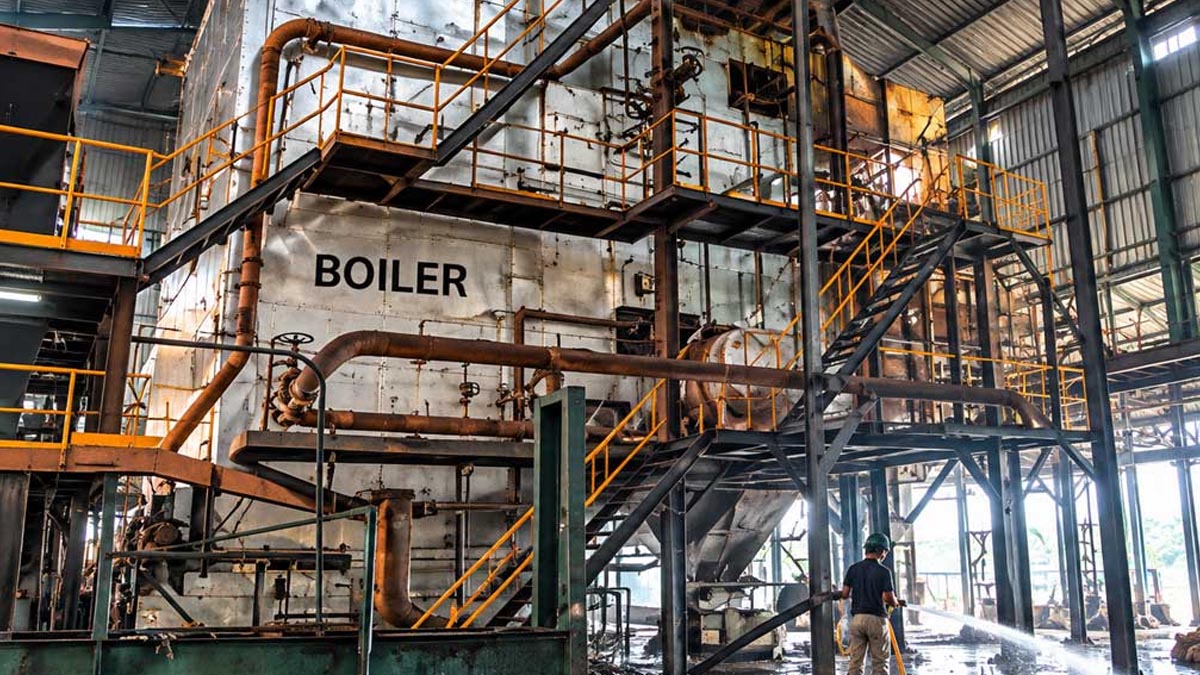
The research combines EFB fuel upgrading, combustion testing and boiler design to enable palm oil mills to use empty fruit bunches without fossil fuels or other biomass feedstocks.
PALMOILMAGAZINE, JAKARTA — Indonesia’s National Research and Innovation Agency (BRIN) and Japan’s Sumitomo Heavy Industries Ltd. (SHI) are developing technology that could allow empty fruit bunches (EFB) from palm oil mills to be used as a 100% boiler fuel, potentially turning one of the industry’s major residues into a source of biomass energy.
The research covers several stages, including fuel upgrading, combustion-characteristic testing and boiler design tailored to the properties of EFB. The approach is intended to enable EFB to be used without blending it with fossil fuels or other biomass feedstocks.
Also Read: BRIN Advances Pyrolysis Technology to Turn Oil Palm Empty Fruit Bunch Waste into Renewable Energy
Tata Sutardi, head of BRIN’s Energy Conversion Research Center, said direct use of EFB as a fuel still presents several technical challenges. The material has relatively low calorific value, while its moisture, alkali and chlorine content can be relatively high.
These characteristics can affect combustion efficiency and potentially accelerate deterioration of boiler systems. Fuel characteristics after upgrading therefore need to be assessed before the material can be applied in combustion systems.
“Each upgrading technology can produce different fuel characteristics. Therefore, in addition to examining changes in fuel properties, we need to evaluate combustion characteristics to determine their suitability for boiler requirements,” Tata said, according to BRIN, as reported by PalmOilMagazine on Sept. 23, 2026.
Also Read: KPBN Inacom CPO Price Holds at IDR 15,515/kg Thursday (Sept. 24), Rotterdam Mixed
Five Methods Tested to Upgrade EFB Fuel
BRIN is examining five biomass fuel-upgrading approaches to improve EFB performance as a boiler fuel: fuel washing, hydrothermal treatment, torrefaction, decarbonization and biological treatment.
The methods are being assessed for their ability to produce EFB fuel with characteristics more suitable for boiler combustion. Results from the upgrading processes have indicated higher calorific value and lower moisture, alkali and chlorine content.
Taopik Hidayat, a junior expert engineer at BRIN’s Energy Conversion Technology Research Center, said the research is focused on a full-firing concept, in which boilers operate using 100% EFB without fossil fuels or other biomass materials.
Also Read: Indonesia’s B50 Biodiesel Push Puts Smallholder Access to CPO Supply Chain in Focus
Following upgrading, each fuel type is being tested at laboratory scale using a fluidized-bed boiler simulator at the B.J. Habibie Science and Technology Park in Serpong.
The tests are designed to compare the performance of the different upgrading methods while assessing their technical and economic suitability.
SHI Equipment Used for Combustion Tests
The testing program has been expanded through a Fuel Analysis Module supplied by SHI. The system consists of an Ashing Furnace and a Fluidizing Furnace, which are being used to assess the combustion characteristics of biomass after fuel upgrading.
Installation and commissioning of the equipment took place from Aug. 11 to 28, 2026, at the Energy Laboratory of the B.J. Habibie Science and Technology Park in Serpong, Banten.
Also Read: Desacralizing Local Wisdom to Mitigate Forest and Land Fires
Following the evaluation of the five upgrading methods, BRIN and SHI will identify the technology considered most suitable for further development. The selected approach will then be scaled up before being tested at SHI’s Circulating Fluidized Bed (CFB) Boiler Pilot Plant in Niihama, Japan.
“By conducting laboratory-scale combustion tests using BRIN’s fluidized bed and Sumitomo Heavy Industries’ Fuel Analysis Module, we can assess how far different fuel-upgrading methods can improve the characteristics and performance of EFB as a fuel,” Taopik said.
Boiler Design Also Being Adapted to EFB
The BRIN-SHI collaboration extends beyond improving the quality of EFB fuel. The research also includes the development of boiler designs adapted to the characteristics of upgraded EFB.
This means the technology is being developed as an integrated system, covering fuel upgrading, combustion testing and boiler-system design.
Also Read: Malaysia CPO Price Thursday (Sept. 24) Edges Up to RM4,771/Ton as Dalian Oils Gain
The approach could expand the use of EFB as an alternative energy source in the palm oil industry. EFB, which has traditionally been treated as a major palm oil processing residue, could instead be converted into boiler fuel, potentially reducing the industry’s reliance on fossil fuels such as coal.
For palm oil mills, the technology could also provide an additional pathway to utilize EFB internally rather than treating it primarily as a waste or low-value residue.
BRIN-SHI Cooperation Dates Back to 2024
The EFB-based boiler project is part of a broader research partnership between BRIN and SHI that has been developed in stages.
The two organizations signed a Memorandum of Understanding on Research and Innovation Collaboration in Low Carbon Technology and Manufacturing on Oct. 22, 2024.
Also Read: Indonesia Accelerates IEU-CEPA Process to Expand Access to European Market
The partnership continued with an Agreement on the Development of Biomass Boilers Based on Empty Fruit Bunches (EFB) Fuel signed on Feb. 26, 2025.
The supply of the Fuel Analysis Module was subsequently formalized through an Agreement on Supply of Fuel Analysis Module signed on May 18, 2026.
The collaboration is aimed at establishing a technology base for using EFB as boiler fuel, from selecting appropriate upgrading technologies and evaluating combustion characteristics to developing boiler systems specifically suited to the upgraded biomass.
Also Read: Indonesia Renames BRAN as LPRA Under Agrarian Reform Bill, Agency to Report to President
For Indonesia’s palm oil industry, the research could create another pathway to increase the value of plantation and milling residues. In addition to providing an alternative energy source, EFB utilization is being positioned within broader efforts to diversify energy supplies and develop lower-carbon technologies.
Taopik said the technology development is also intended to support Indonesia’s goal of achieving Net Zero Emissions by 2060 through greater use of biomass resources and lower-carbon energy technologies. (P2)