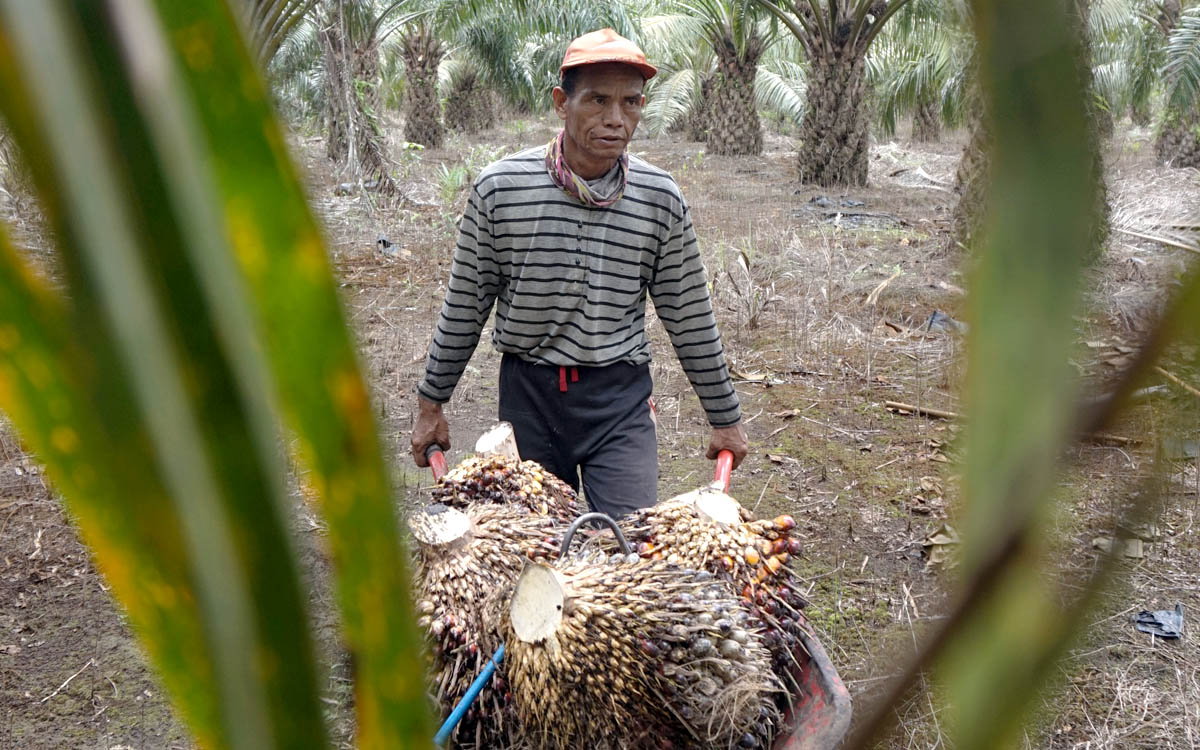
Higher palm oil yields depend not only on production potential but also on harvest timing, field access, labor availability, equipment, rotation and operating systems tailored to plantation conditions.
PALMOILMAGAZINE, JAKARTA — Improving oil palm productivity requires more than maximizing the production potential of plantations. Field execution, harvest timing, labor availability, access to trees and the effectiveness of harvesting systems all play a critical role in determining both yield and quality.
Soemanto Sastro, a plantation practitioner, highlighted the importance of operational discipline during IPS Planters Talk 2026, held under the theme “From High Yield Estate to Sustainable Excellence” on Saturday (Sept. 26, 2026).
Also Read: IPS Planter Talks 2026 Flags Oil Palm Harvester Shortage as Productivity Risk
According to Soemanto, plantations targeting high production must ensure that operational strategies remain aligned with company budgets. At the same time, achieving maximum output requires the right combination of work methods and disciplined execution.
“The right method determines production quantity, while the right timing determines production quality,” he said.
Maintaining consistent harvest rotation is also essential. When harvest intervals are managed according to established standards, plantations can better maintain fruit quality while ensuring that production potential is captured.
Also Read: Planters Push Productivity Drive to Strengthen Indonesia’s Palm Oil Output
Plantation Access Supports Harvest Efficiency
Soemanto said harvesting efficiency begins with ensuring workers have adequate access to oil palm trees.
He introduced the concept of the “3A,” referring to access to blocks and individual palms, supported by adequate roads, bridges, harvesting paths and field access.
Also Read: CPO Price Today (Sept. 29): KPBN Inacom Falls to IDR 15,050/Kg, Rotterdam Market Moves Mixed
Good field access facilitates maintenance activities and helps ensure harvesting can be completed on schedule.
Harvest maturity standards are another critical component. Fruit maturity should be determined according to company-established criteria to ensure that only properly mature bunches are harvested.
Rather than relying excessively on theoretical approaches, Soemanto said plantation teams should focus on applying clear and consistent maturity standards in the field.
Also Read: Malaysia CPO Futures Drop RM35 to RM4,629, Hit Lowest Level in 8 Weeks
Harvest rotation must also be determined according to plantation conditions. Some companies use a seven-day rotation, while others operate on 10-day cycles.
Soemanto said there is no single harvest-rotation system that can be universally applied across plantations. The appropriate approach depends on field conditions, labor availability and each company’s operational capacity.
Harvesting Systems Need to Match Field Conditions
The harvesting system itself also affects operational efficiency. Plantation operators may use different approaches, including ancak giring, fixed ancak systems or combinations involving mandoran management.
Each system has advantages and limitations, Soemanto said. Management therefore needs to understand the weaknesses of the selected system and develop measures to minimize their impact.
Also Read: Riau Plasma FFB Price Falls to IDR 3,948.70/Kg for Sept. 23–29
“No system is perfect. What matters is how we eliminate the weaknesses of the system being applied,” he said.
The same principle applies to incentive or premium systems for workers. According to Soemanto, harvesting premiums should encourage higher output while providing workers with an appropriate increase in income.
An effective incentive system, however, cannot compensate for shortcomings in other operational requirements.
Also Read: West Sumatra FFB Prices Fall to IDR3,987.27/kg for Sept. 22–30
Labor and Equipment Remain Critical
Soemanto also stressed the importance of maintaining adequate labor capacity, both in terms of workforce numbers and skills.
Even a well-designed harvesting organization will struggle to achieve its targets if sufficient workers are unavailable.
Harvesting equipment is equally important. Some plantations, he said, still treat harvesting tools as a relatively minor operational consideration, meaning equipment quality does not always receive sufficient attention.
Yet the condition and suitability of harvesting equipment directly affect the speed and accuracy of field operations.
Worker attendance and discipline should also be monitored continuously. Productivity should be reviewed regularly, preferably on a monthly basis, allowing management to determine whether operational targets are actually being achieved.
Also Read: North Sumatra FFB Prices Fall for Sept. 23–29, Highest at IDR3,974.88/kg
Supporting Indonesia’s 35:26 Palm Oil Productivity Vision
Soemanto linked improved plantation operations to efforts to achieve Indonesia’s 35:26 Palm Oil Vision, which seeks to increase productivity through comprehensive plantation management.
He said productivity improvements must begin with planting material. High-quality seeds form the foundation of plantation performance because oil palm trees remain productive over a long period.
Also Read: CELIOS: Sulawesi Exceeded Environmental Limits as Mining, Palm Oil Expand
“Superior planting material determines the 25-year journey of an oil palm plantation,” he said.
After planting, companies must ensure that plant populations are complete and uniform, without significant gaps in the field.
Maintenance activities should also follow established standards covering application rates, timing, methods and placement, as well as proper execution.
According to Soemanto, these measures must be supported by competent teams, good access to individual palms, adequate harvesting paths, harvesting at the right maturity and time, transportation that meets operational targets, and mill processing designed to minimize oil losses.
The entire production chain should ultimately be supported by disciplined administration and plantation management systems capable of generating accurate information quickly.
“Planting must be done correctly, plants must be uniform with no empty spots, maintenance must meet quality standards, teams must be competent, access to palms must be easy, harvesting must be done using the right method and at the right time, transportation must meet targets, mill processing must minimize losses, and administration must be fast and accurate,” Soemanto said. (P2)