PALMOILMAGAZINE, JAKARTA – Improving the productivity of Indonesia’s smallholder oil palm plantations has become a critical agenda in strengthening the national palm oil industry. With smallholders managing nearly 7 million hectares, or around 42% of the country’s total oil palm plantation area, productivity challenges remain one of the sector’s most urgent issues.
PT Agrinas Palma Nusantara has reaffirmed its commitment to accelerating productivity gains among smallholder farmers through partnership programs and technical support, particularly via the Smallholder Palm Oil Replanting Program (PSR), which is seen as a key driver of upstream transformation.
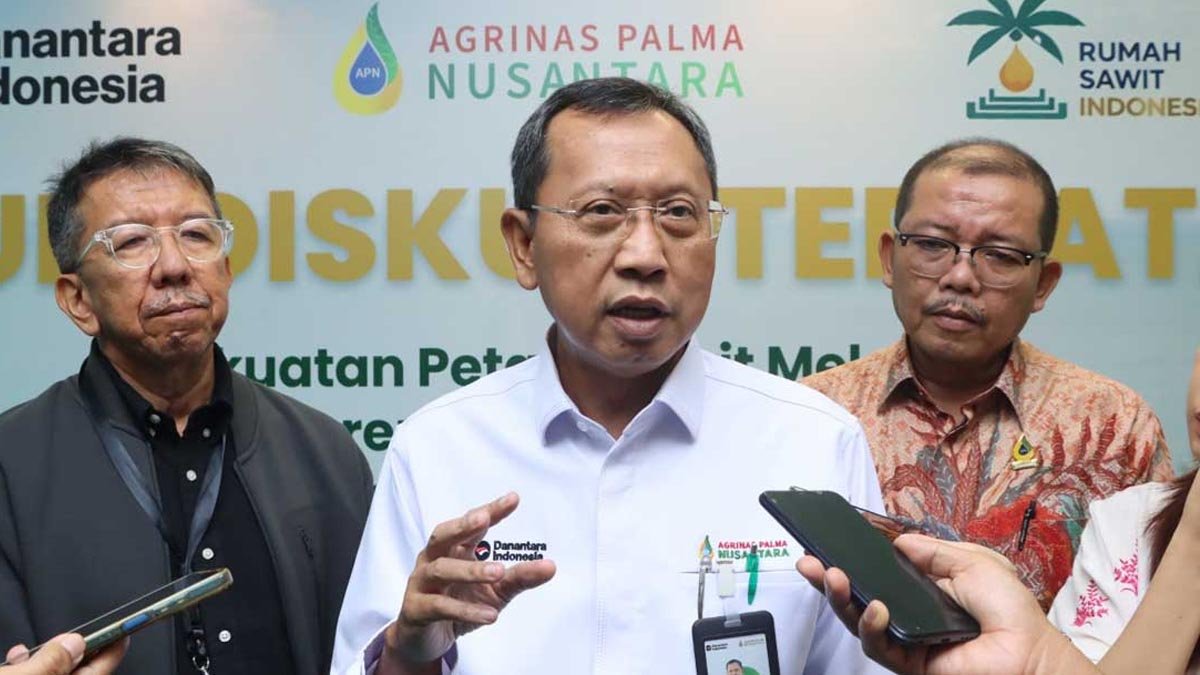
Seger Budiardjo, Director of Partnership and Plasma at PT Agrinas Palma Nusantara, said oil palm remains a strategic commodity with a vital role in supporting national economic growth while driving downstream industrial development.
“Palm oil is a leading strategic commodity that contributes significantly to national economic growth and the expansion of downstream industries,” Seger said during a closed-door discussion forum at Menara Agrinas Palma in Jakarta on Monday (April 27, 2026).
Data presented by Agrinas showed that current productivity of smallholder plantations averages only 2.6 tons per hectare per year, below private estates at 3.4 tons per hectare and state-owned plantations at 4.8 tons per hectare.
One major factor behind the low productivity is the limited progress of the PSR program in recent years. Over the past three years, replanting implementation has averaged only 20,000 hectares annually, far below national requirements.
Also Read: INSTIPER and BGA Introduce Autonomous Fertilizer Tractor to Boost Efficiency in Oil Palm Plantations
Seger noted that plantations older than 25 years now account for around 40% of smallholder estates, equivalent to 2.8 million hectares involving approximately 1.1 million farming households.
The situation highlights that accelerating PSR is no longer just a policy initiative, but an urgent necessity to maintain long-term productivity and sustainability in Indonesia’s palm oil sector, especially among smallholders.
Agrinas Prepares Three Key Strategies
To speed up implementation, Agrinas Palma has introduced three core strategies focused on governance, regulation, and farmer support.
The first is the adoption of a single management system, aimed at integrating PSR implementation to improve effectiveness, efficiency, and coordination.
Also Read: KPBN CPO Price Falls to IDR 15,459/kg as Global Palm Oil Market Softens
The second is regulatory simplification, achieved through stronger coordination among ministries and institutions to streamline administrative requirements that have long delayed replanting progress.
The third is end-to-end farmer assistance, covering institutional strengthening, financing access, and technical as well as operational support throughout the replanting process.
This comprehensive support model is expected to help transform smallholder plantations into more productive, modern, and sustainable operations.
Also Read: Agrinas Palma Nusantara Partners KPBN to Boost CPO Market Efficiency
New Momentum for Collaboration
The closed-door forum, themed Accelerating Smallholder Palm Oil Replanting as a Path to Bring Farmers into the Industrial Era, also marked an important milestone by bringing together four state institutions directly involved in the PSR ecosystem for the first time.
These included the Ministry of Agriculture, Ministry of Forestry, Ministry of Agrarian Affairs and Spatial Planning/National Land Agency (ATR/BPN), and the Plantation Fund Management Agency (BPDP), alongside palm oil industry stakeholders.
Also Read: From Plantations to Energy: Downstreaming Becomes Key to National Self-Reliance
Kacuk Sumarto, Chairman of Rumah Sawit Indonesia (RSI), said the cross-agency gathering sent a strong signal for faster PSR implementation on the ground.
“This is an important moment to accelerate PSR so that palm oil farmers can enter a more productive and competitive industrial era,” he said.
With stronger policy backing, financing support, and integrated mentoring, faster PSR implementation is expected to become a key foundation for improving farmer welfare while reinforcing Indonesia’s position as the world’s largest palm oil producer. (P2)