Authorities intercepted 75,992 counterfeit oil palm seeds in Lampung following a two-month surveillance operation, warning that illegal planting materials could inflict billions of rupiah in losses on farmers and threaten plantation productivity.
PALMOILMAGAZINE, Bandar Lampung — Indonesia’s Quarantine Agency (Barantin), through its Lampung office, has intercepted 75,992 illegal oil palm seeds destined for distribution across the country, preventing what authorities estimate could have resulted in up to IDR42 billion (US$2.3 million) in annual economic losses for farmers.
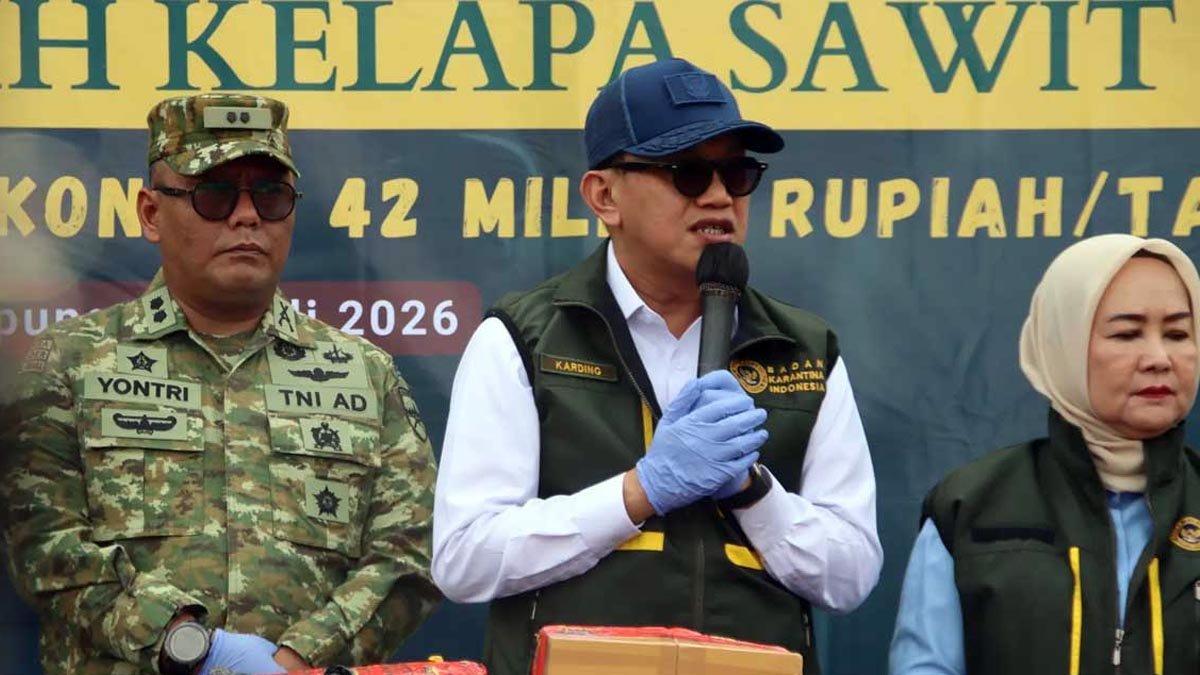
In a statement cited by PalmOilMagazine on Sunday (Aug. 2), Head of the Indonesian Quarantine Agency Abdul Kadir Karding said the operation underscores the government’s commitment to safeguarding the quality of planting materials and protecting the country’s plantation sector from counterfeit seed distribution.
Also Read: Indonesia’s KPBN Inacom CPO Price Rises to IDR 15,800/kg as Malaysian Palm Oil Futures Rebound
“The state must not lose or become complacent. We urge all businesses to comply with existing regulations. Anyone found intentionally violating the law will face firm enforcement, and criminal charges will be pursued where applicable,” Karding said while announcing the case in Bandar Lampung on July 31.
According to Karding, the confiscated seeds could have been planted across approximately 500 hectares of oil palm plantations. The greatest risk would emerge only after the trees reached their productive stage, typically three to four years after planting, when counterfeit seeds often produce significantly lower yields—or fail to bear fruit altogether.
Estimates from the Lampung Provincial Plantation Agency suggest such poor-quality planting materials could generate economic losses of around IDR3.5 billion per month, equivalent to IDR42 billion annually, through reduced productivity.
Also Read: Pakistan’s Palm Oil Imports Hit Record 3.48 Million Tons in FY2026 Despite Higher Tax Burden
Counterfeit Seeds Detected During Cargo Inspection
The case originated from a surveillance operation conducted by the Lampung Quarantine Office between Feb. 11 and Apr. 10, 2026. During the operation, inspectors detained 170 cargo packages containing nearly 76,000 oil palm seeds at the cargo terminal of Raden Inten II International Airport.
Initial inspections uncovered irregularities in both the packaging and certificates, which falsely claimed to originate from the Indonesian Oil Palm Research Institute (PPKS). Investigators also found that none of the shipments carried the mandatory quarantine certificates or official documentation required for transporting planting materials.
Also Read: Viva Yoga: Palm Oil Has Transformed Indonesia’s Transmigration Communities
Further investigation revealed the counterfeit seeds were marketed through several major e-commerce platforms, including TikTok Shop, Shopee, Tokopedia, and Lazada. The products were sold for around IDR1,300 per seed, far below the official PPKS price of approximately IDR8,300, raising immediate suspicion of fraud.
Authorities said the shipments were delivered via J&T Express and Lion Parcel, with senders using false identities. The perpetrators allegedly disguised the package contents, frequently changed shipping locations, and delivered parcels directly to courier counters to avoid detection.
Also Read: Indonesia’s Palm Oil Export Policy Spurs India’s Push for Edible Oil Self-Sufficiency
Seeds and Supporting Documents Confirmed Counterfeit
To verify authenticity, the Lampung Quarantine Office worked with PT Bina Sawit Makmur, the Indonesian Oil Palm Research Institute (PPKS), PT Dami Mas Sejahtera, and the Lampung Seed Quality Control and Testing Center (BP2MB).
The investigation confirmed that both the oil palm seeds and the accompanying certificates were counterfeit.
Karding warned that illegal planting materials pose risks beyond financial losses. Counterfeit seeds may also serve as carriers of plant pests and diseases, increasing the risk of outbreaks that could spread across plantations and reduce productivity on a wider scale.
Also Read: Teladan Prima Agro Posts Higher First-Half 2026 Earnings as Revenue Climbs 6.5%
The investigation is being conducted jointly with the Lampung Regional Police’s Intelligence Directorate, which is tracing what authorities believe to be a coordinated distribution network operating across multiple online marketplaces. Investigators have identified several suspected operational locations and continue field verification.
Since Apr. 10, 2026, no additional shipments of illegal oil palm seeds have been detected through the same distribution channel. However, authorities said the investigation remains ongoing to dismantle the network behind the counterfeit trade.
Barantin said it will continue strengthening inspections of seeds and other regulated biological materials to protect Indonesia’s plantation industry, preserve plant health, and prevent counterfeit oil palm planting materials from reaching farmers. (P3)