

PALMOILMAGAZINE, BRUSSELS, BELGIUM — Indonesia and the European Union (EU) have formally signed the Indonesia-European Union Comprehensive Economic Partnership Agreement (IEU-CEPA) and the Investment Protection Agreement (IPA), marking a significant step toward strengthening bilateral economic ties and expanding Indonesia’s access to the European market.
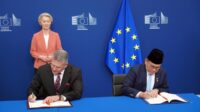
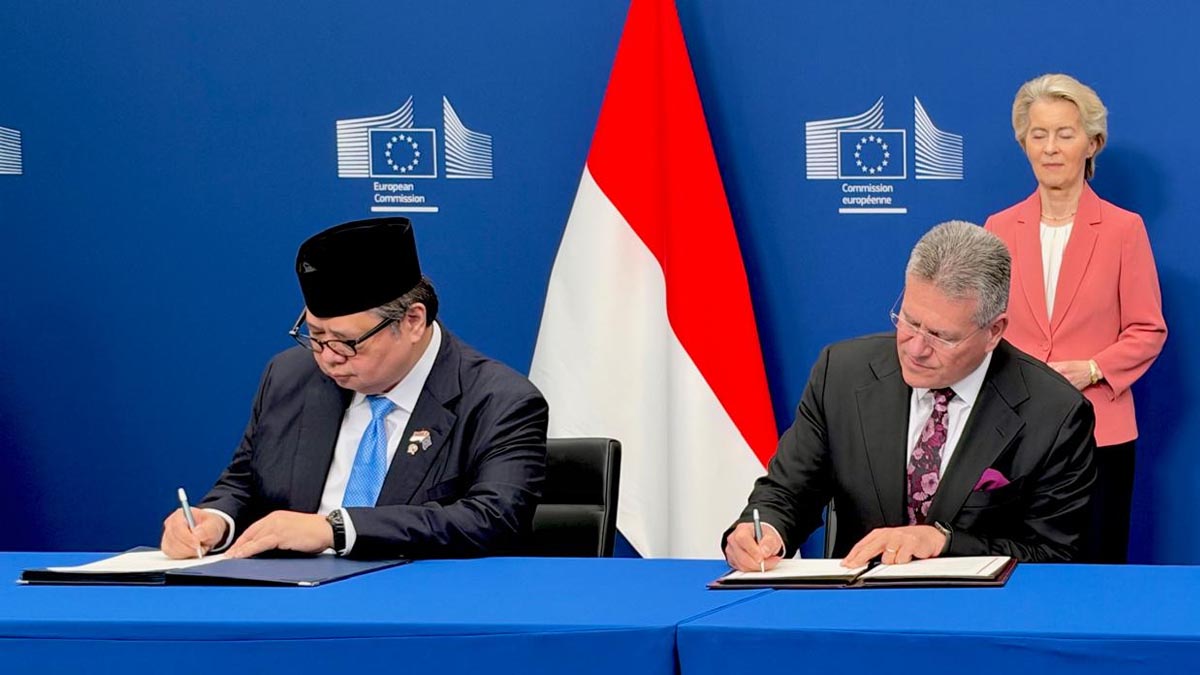
The agreements were signed in Brussels, Belgium, on Saturday (Nov. 21, 2026), by Indonesia’s Coordinating Minister for Economic Affairs Airlangga Hartarto and European Commissioner for Trade Maroš Šefčovič.
The two agreements are expected to provide greater legal certainty for bilateral trade and investment while creating new opportunities for Indonesian exporters and European investors.
Also Read: KPBN Inacom CPO Price Falls 2.50% to IDR 13,658/kg on Nov. 23 as Malaysia Futures Slide
The signing followed a series of communications earlier that day, including a video conference and telephone conversation between Indonesian President Prabowo Subianto and European Commission President Ursula von der Leyen. The two leaders discussed strengthening the Indonesia-EU strategic partnership, including accelerating the implementation of IEU-CEPA.
Airlangga said the agreement would provide broader opportunities for Indonesian flagship products to enter the European market while enhancing the country’s attractiveness as an investment destination.
“IEU-CEPA opens the gateway for Indonesia’s leading products to enter the European market while attracting quality investment into the country’s strategic sectors. The next step is to ensure that the ratification process and implementing regulations are completed on schedule so that our economic competitiveness can accelerate further,” Airlangga said, according to an official statement from the Coordinating Ministry for Economic Affairs.
Also Read: Indonesia Secures 1.9 Million-Ton CPO Export Quota to EU Under IEU-CEPA, Effective January 1, 2027
90.4% of Indonesian Tariff Lines to Receive Immediate Zero-Tariff Access
One of the agreement’s key benefits is improved market access through preferential tariffs for Indonesian products entering the European Union.
Under IEU-CEPA, 90.4% of Indonesia’s tariff lines in the EU market will immediately receive zero-percent import duties. Another 8.37% will benefit from gradual tariff reductions over three to 15 years or through tariff rate quota (TRQ) arrangements.
Also Read: Indonesia-EU CEPA Signed: Palm Oil Exports Set to Gain Zero-Tariff Access to European Market
The preferential tariff scheme is expected to strengthen the competitiveness of Indonesian export products, including footwear, textiles, and processed commodities, in the European market.
Beyond trade liberalization, the agreement is also expected to encourage European investment and the transfer of environmentally friendly technologies to Indonesia. These developments could support the expansion of domestic processing facilities, strengthen industrial value chains, and create additional employment opportunities.
For Indonesia’s palm oil industry, the improved trade framework could provide opportunities to strengthen the competitiveness of processed palm oil products and other downstream commodities in the European market, subject to the agreement’s applicable tariff schedules, rules of origin, and sustainability requirements.
Also Read: Indonesia and EU Fast-Track IEU-CEPA Ratification, Target Early 2027 Implementation
Ratification Process to Follow Signing
Following the signing, Indonesia and the European Union will proceed with their respective ratification processes and domestic legal procedures before the agreement can formally enter into force, which is targeted for 2027.
In parallel, the Indonesian government and business stakeholders will prepare the necessary implementing regulations to ensure that exporters and domestic industries can make effective use of the agreement.
The government expects IEU-CEPA to become an important instrument for expanding international trade, attracting investment, strengthening domestic industrial capacity, and supporting Indonesia’s efforts to maintain economic growth amid intensifying global competition. (P3)