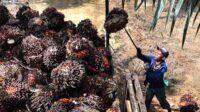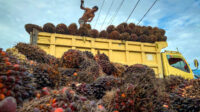
Smallholders manage around 42% of Indonesia’s oil palm plantations, yet many operate farms of only two to four hectares. As global markets demand higher sustainability standards, increasing the economic scale of smallholder plantations could become critical to securing both farmer welfare and the future supply of sustainable palm oil.
PALMOILMAGAZINE, JAKARTA — The global market is demanding increasingly sustainable palm oil. Yet much of that responsibility is falling on smallholders who, in many cases, manage plantations of only two to four hectares. This raises a fundamental question: Can sustainability be achieved without giving smallholders an economically viable scale of operation?
Indonesian oil palm smallholders are facing increasingly demanding requirements. In addition to limited access to capital and financing and persistent marketing challenges, they are now expected to meet sustainability standards that have become increasingly important for accessing global markets.
Also Read: Indonesia Pushes Cooperative-Based Palm Oil Downstreaming to Strengthen Smallholders
The demand is understandable. But another question deserves greater attention: do smallholders have sufficient farm sizes to meet these requirements while also earning a decent livelihood?
Smallholders Already Play a Major Role
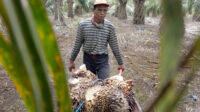
On paper, smallholders are one of the pillars of Indonesia’s palm oil industry. Data from the Ministry of Agriculture show that smallholders manage around 42% of the country’s total oil palm area, or approximately 6.8 million hectares out of 16.8 million hectares.
The figures underline a critical reality: the future of Indonesia’s palm oil industry depends not only on large plantation companies but also on millions of smallholder families who maintain their plantations and contribute to national palm oil production.
Also Read: Agrinas Palma Opens Partnership with Cooperatives to Accelerate Palm Oil Downstreaming
Despite this significant contribution, Indonesia’s palm oil sector remains heavily influenced by large private plantation companies and state-owned plantations.
For decades, these companies have played a major role in developing production areas from Sumatra to Papua, including the construction of roads, bridges and supporting infrastructure in previously remote regions.
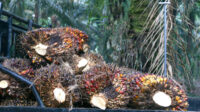
Such infrastructure is not merely a requirement for plantation operations. It is also essential for ensuring that fresh fruit bunches (FFB) reach palm oil mills quickly.
Also Read: Riau Independent Smallholder FFB Prices Fall to IDR 3,874.89 per Kg for Aug. 12-18
Speed matters because FFB quality deteriorates after harvesting. Ideally, harvested FFB should be processed within 24 hours to limit increases in free fatty acid (FFA) levels, which are generally required to remain below 5%.
This is one reason palm oil mills have historically been developed alongside plantation areas—to maintain an efficient supply chain and preserve crude palm oil (CPO) quality.
Companies Have Also Supported Smallholder Financing
The role of plantation companies extends beyond infrastructure.
Under various partnership arrangements, companies have also acted as guarantors or avalists for smallholders seeking financing from national banks.
As third-party guarantors, plantation companies can strengthen the creditworthiness of farmers who may otherwise lack the financial capacity or assets required to meet banking requirements.
But the underlying challenge remains the scale of smallholder operations.
Most Indonesian oil palm smallholders manage only around two to four hectares. At that scale, their ability to improve household welfare while simultaneously investing in better farming practices, replanting and sustainability measures is limited.
Various studies have indicated that household welfare could be substantially stronger when farmers manage plantations of around eight to 10 hectares.
What Malaysia Can Teach Indonesia
The development of Indonesia’s palm oil industry offers an interesting perspective.
Around large plantation areas, local communities gradually began establishing their own oil palm plantations on land they controlled. This process contributed to the growth of independent smallholders, who have gradually become an important part of the national palm oil supply chain.
Malaysia offers another model worth considering.
There, the average smallholder family manages approximately 10–12 hectares. Such a scale can provide sufficient income to support household needs, including financing children’s education through university.
The institutional arrangement, however, differs from Indonesia. Agricultural land in Malaysia is generally held by the state, while farmers receive rights to manage the land under regulations established by the respective state governments.
That difference opens an important discussion about the future direction of Indonesia’s plantation sector.
With land availability becoming increasingly limited, one alternative worth examining could involve retaining land ownership under the state while granting farmers long-term management rights under clearly defined rules.
Such a model would require careful study, particularly regarding land rights, farmer security, investment incentives and intergenerational transfer.
Sustainability Must Include Farmer Welfare
Ultimately, sustainability cannot be measured solely through environmental compliance and governance standards.
It must also ensure that smallholder families have an economic scale that allows them to live decently while investing in their plantations.
If global markets want sustainable palm oil, then the welfare of the farmers producing that palm oil should be an inseparable part of sustainability itself.
Indonesia’s palm oil industry is also entering a new phase.
During the sector’s early development, plantation companies were the primary drivers of expansion, including through various partnership schemes. Going forward, independent smallholders are likely to play an increasingly important role.
They will no longer be merely complementary suppliers. They could become central actors in meeting global palm oil demand.
Smallholders Are Becoming More Professional
There are reasons for optimism.
An increasing number of smallholders are adopting better agricultural practices and sustainability principles. Knowledge is being developed through farmer groups, cooperatives and various capacity-building and mentoring programs.
The capabilities of independent smallholders are also improving as they become more professional in managing plantations, monitoring productivity and adopting better agricultural practices.
If these capabilities are combined with a more viable economic scale, smallholders could make an even greater contribution to the global palm oil market.
Consider a simple illustration.
If one smallholder family managed 10 hectares and generated an average income of approximately IDR 3 million per hectare per month, household income could reach around IDR 30 million per month.
Such income would not only strengthen household finances. It could also stimulate rural economies, expand access to education and create better opportunities for the next generation.
Of course, actual income would depend on productivity, FFB prices, production costs, land quality, plantation age and other factors. The calculation therefore serves only as an illustration of the potential economic impact of a more viable farm scale.
A Strategic Investment in the Future
This is where the challenge—and opportunity—lies for Indonesia’s palm oil industry.
As the world increasingly relies on Indonesian smallholders to supply palm oil, expanding the economic scale of smallholder operations should not be viewed merely as a production strategy.
It should be considered an investment in the sustainability of the palm oil industry, rural prosperity and the future of Indonesia’s palm oil sector.
If sustainability is ultimately about creating a system that can endure economically, socially and environmentally, then giving smallholder families a viable scale of operation should be part of that conversation.
The future of sustainable palm oil may depend not only on how farmers cultivate their land, but also on whether they have enough land to build a sustainable livelihood. (*)
By Ignatius Ery Kurniawan